
A fixed interval is the most common answer to the question of when a plate heat exchanger should be cleaned: every three months, every six months, every shutdown. An interval is convenient, but it is an assumption, not a measurement. It forces unnecessary disassembly on units that are still clean, and it lets genuinely fouled units keep degrading until the next slot on the calendar. This article replaces the calendar with two numbers your operators can already take: the pressure drop across the unit and the approach temperature. Both are measured against a recorded clean baseline, both trend slowly as fouling builds, and together they tell you when plate heat exchanger cleaning is actually needed.
The Hidden Cost of Cleaning on a Calendar
Calendar-driven plate heat exchanger cleaning has two costs that never appear on the work order. The first is spent on healthy units: disassembly subjects gaskets to repeated handling, gives the plates a chance to scratch, creates room for reassembly error, and occupies a shutdown window the plant could have used. The second cost is invisible: a genuinely fouled unit keeps running dirty between its scheduled slots, quietly giving up capacity and paying an energy penalty, while hot spots feed the very fouling that built up.
A scheduled interval exists for a reason. Where no trend data is taken, a date is the only tool available. The fix is not to abandon planned maintenance; it is to let the data decide when plate heat exchanger cleaning earns the downtime. That is what the two indicators below do.
What Fouling Does to a Plate Pack
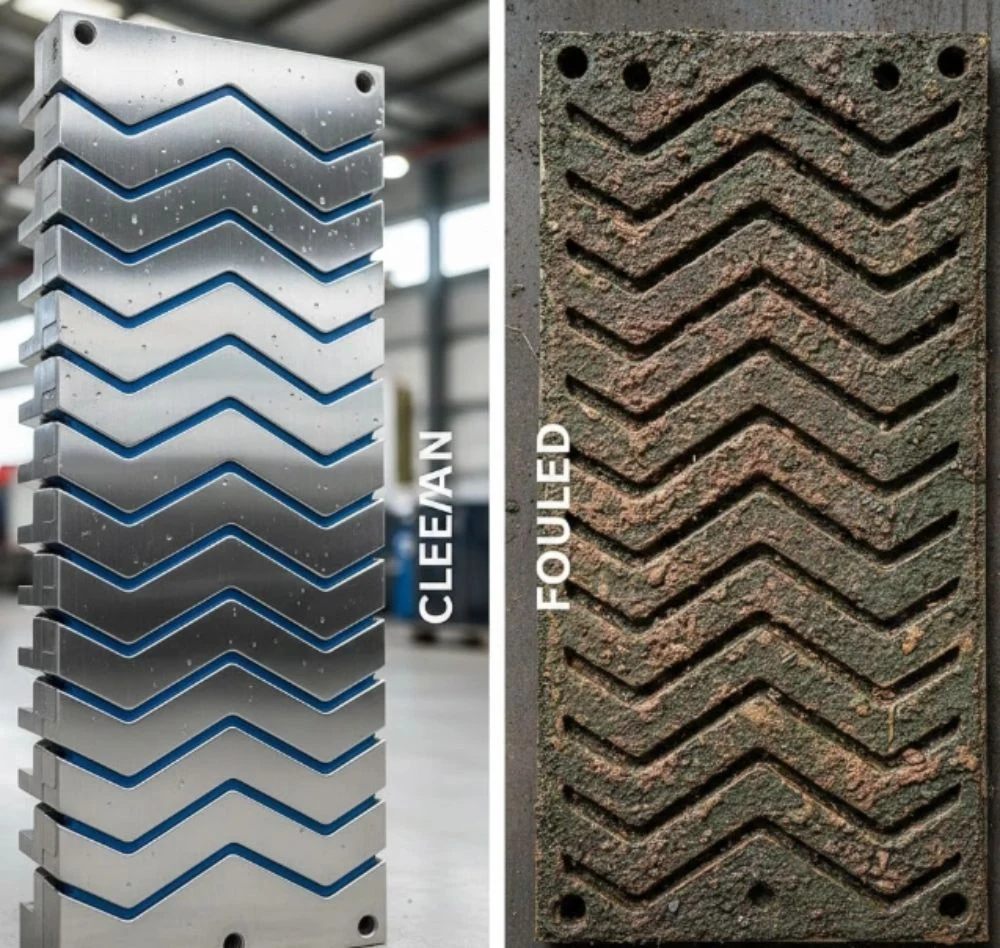
Fouling in a detachable plate heat exchanger comes from the media and from the water. In hard-water service, heated calcium, magnesium and carbonate precipitates form hard scale on the plates. Grano’s maintenance reference describes exactly this mechanism: where water treatment is inadequate or softened water is substandard, the calcium, magnesium and carbonate in the water decompose after heating and adhere to the heat transfer surface; scale has poor thermal conductivity, so the heat exchange efficiency drops and heat energy is wasted.
- Hard-water scale (calcium carbonate, magnesium hydroxide) — the classic hard-water service fouling.
- Corrosion products (iron oxides) where water chemistry is out of control.
- Organic films — proteins, fats and polysaccharides in food, dairy and beverage service.
- Particulates and debris from the pipework where strainers are undersized.
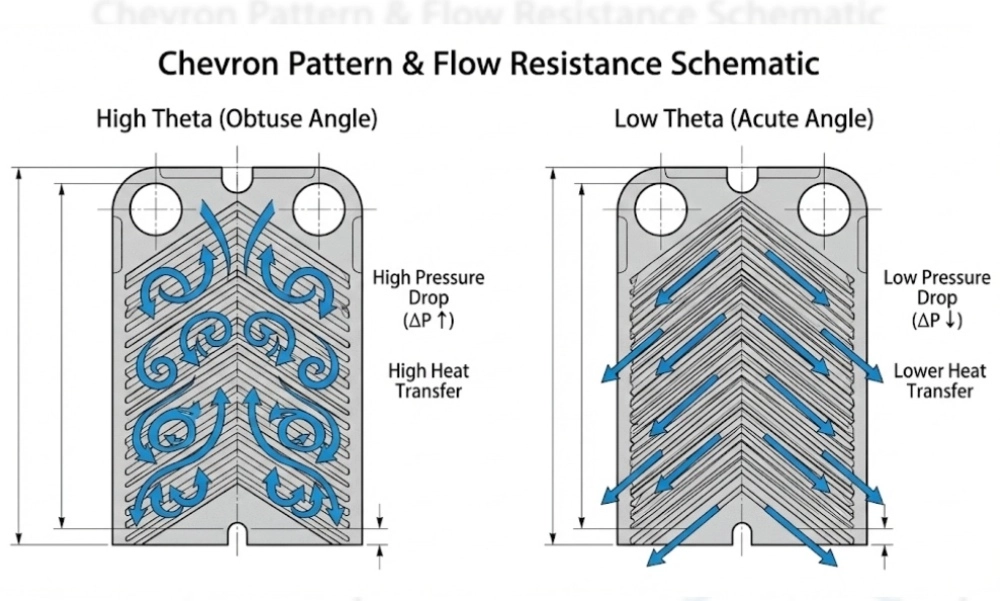
Fouling changes two measurable things at once: it adds thermal resistance between the two fluids, and it narrows the flow channels. The first shows up in the temperatures; the second shows up in the pressure drop. That is why two indicators are needed instead of one: scale that builds uniformly can widen the approach temperature while the pressure drop stays almost flat, and particulate blockage of the channels can raise the pressure drop long before it touches the temperatures. So a calendar-driven cleaning schedule is the wrong question. The right question is: how far has this unit moved from its own clean baseline? Does its data say plate heat exchanger cleaning is due?
Indicator One: Pressure Drop Across the Unit
Pressure drop is the hydraulic signature of fouling. Particulates, scale buildup and debris narrow the corrugated channels, and because the channels of a plate pack are thin and densely packed, channel restriction shows up as rising differential pressure at a constant flow. Record the clean-side pressure drop at a documented flow immediately after a verified cleaning, and trend it from there.
Three rules keep the indicator honest. Measure at the same flow every time, because differential pressure scales roughly with the square of the flow — a 10% flow change can look like a 20% pressure change, with nothing to do with fouling. Log or normalize flow changes in the trend record. And rule out the neighbors first: a blinded strainer upstream, a partially closed valve or a drifting gauge can all masquerade as a dirty exchanger.
As a typical planning rule, treat a rise of roughly 20–30% above the clean baseline at equal flow as the point to start watching and investigating; treat roughly 50% — or the allowable hydraulic limit of the plates, whichever comes first — as the point at which plate heat exchanger cleaning should be scheduled. Your own data will sharpen these numbers. The baseline exists so you can replace a generic rule of thumb with your plant’s reality.
Indicator Two: Approach Temperature
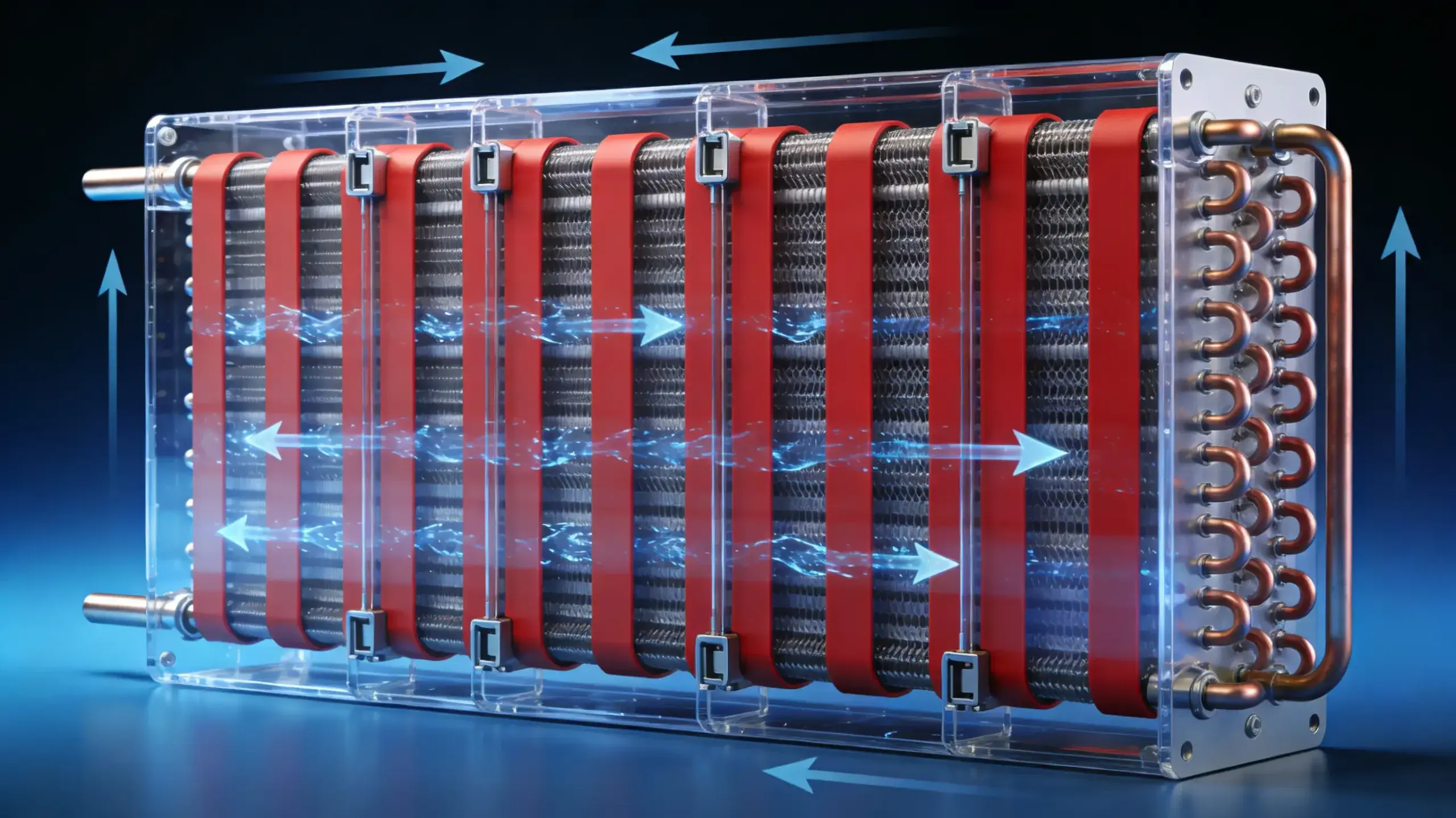
In a counterflow plate heat exchanger, the hot-side outlet and the cold-side outlet leave the unit closest together; the difference between them is the approach temperature. It is the single most sensitive temperature indicator of fouling, because a clean counterflow unit is designed to keep that difference small, and any added thermal resistance forces the two outlet temperatures apart.
Fouling adds resistance in series with the plate surface. For the same inlet temperatures and flows, the result is predictable: the hot-side outlet comes out hotter than design, because heat that should have transferred did not, and the cold-side outlet comes out colder. The approach widens. Record the approach at the same four temperatures and flows as the baseline, and trend it the same way you trend the pressure drop.
Two reading notes. First, the signal is a steady drift beyond your measurement error — a couple of kelvin on the relevant outlet, consistent across repeated readings — not a single reading, because process changes (inlet temperature swings, flow shifts) move the approach too. Second, log effectiveness or heat duty as a percentage of design alongside the approach; when both move in the same direction, fouling is the common cause rather than the process.
Build the Baseline and Set Your Thresholds
The method only works if “clean” is defined and recorded. After a cleaning that was actually verified — plates inspected, the six-step procedure below followed, pressure test passed — log one row: date, flows, four temperatures, clean-side pressure drop, approach, and the media in service. That row is the baseline; every later reading is a delta against it.
- Keep the trend log simple — one row per verification is enough to start.
- Set two action levels: a watch level (for example, +20–30% pressure drop or approach drift beyond instrument error) and a schedule level (for example, +50% pressure drop or a missed capacity target).
- Where two similar units run in parallel, compare them directly — the A/B contrast removes most process-side doubt.
- Note any process change (new media, water treatment adjustment, new strainer) in the log, so a break in the trend can be attributed.
The intervals that fall out of this differ widely from plant to plant — which is precisely the point. A calendar is a guess made once; the baseline is a measurement repeated every time the unit is opened.
When the Data Says Clean: The Six-Step Acid Procedure
When the trend calls for plate heat exchanger cleaning, do the job properly — on your own, or with Grano’s on-site cleaning and maintenance service. Grano’s standard chemical cleaning procedure for a plate heat exchanger has six steps, and the discipline is in the sequence:
- Flush. Before any acid touches the unit, flush with clean water to remove loose dirt and scale. This improves the pickling result and cuts acid consumption.
- Charge. Pour the cleaning solution into the cleaning equipment and pump it into the heat exchanger.
- Pickling. Let the acid-filled unit soak statically for 2 hours, then circulate dynamically for 3 to 4 hours, alternating the flow direction forward and reverse every 30 minutes. After pickling, the solution can be reused only if its pH is still above 2; otherwise dilute and neutralize it before discharge.
- Alkaline wash. Circulate a measured mix of sodium hydroxide (NaOH) and trisodium phosphate (Na3PO4) in softened water to neutralize residual acid, so the plates stop corroding.
- Water wash. Rinse with clean softened water for 0.5 hours to remove all residues.
- Record and pressure test. Log the time of every step during the job, and pressure test the unit before it returns to service — the unit is commissioned only after it passes.
The sequence is not decoration. Acid left on the plates after the scale is gone does damage, which is why the alkaline step is not optional; the 30-minute direction changes keep the solution working on every channel instead of short-circuiting. On the gasket side, confirm the installed gaskets are compatible with the cleaning chemistry before the acid runs — each rubber grade’s chemical-resistance notes, available on the accessories page, and a fresh pre-use inspection are part of the cleaning plan, not an afterthought. Typical practice adds the usual chemical-safety baseline: PPE, ventilation, and disposal of spent solution per local regulations.
This is the standard Grano procedure for scaling in gasketed units. Where the plates are special materials or the unit carries an unusual service history, confirm the cleaning agent and concentration against the plate material and the media before the job is planned — the standard detachable range is listed in the Grano product catalog, and the quality system behind the parts is documented on the about page.
What the Data Usually Says About Frequency
Operators who run the two indicators typically find their real cleaning interval is neither as short as they feared nor as long as the calendar assumed. Aggressive services — untreated hard water, food and beverage media, open loops — can reach the schedule level several times a year. Well-treated, low-fouling services can run more than a full year between cleanings.
The interval is an output of the data, not an input to the calendar. As a side benefit, the trend log tells you which unit to open first when one shared shutdown window has to serve several exchangers: the fouled one, not the one whose date happened to arrive. If your unit has no baseline yet, the first step is one verified cleaning and one recorded row — or a conversation. Contact the Grano team for baseline setup and a cleaning plan matched to your media.
Frequently Asked Questions
Q1: How often should a plate heat exchanger be cleaned?
A1. There is no universal interval. Track pressure drop and approach temperature against a recorded clean baseline and clean when the trends reach your schedule thresholds. In practice, intervals range from several times a year in aggressive service to more than a year in well-treated service.
Q2: How much of a pressure drop increase is too much?
A2. As a typical planning rule: investigate at roughly 20–30% above the clean baseline at the same flow; schedule plate heat exchanger cleaning at roughly 50% or at the plates’ allowable hydraulic limit, whichever comes first.
Q3: What is the approach temperature of a plate heat exchanger?
A3. In a counterflow unit it is the temperature difference between the hot-side outlet and the cold-side outlet. Fouling widens it: for the same inlet conditions, the hot outlet runs hotter and the cold outlet runs colder than design.
Q4: Can a plate heat exchanger be cleaned without taking it apart?
A4. In many services, yes: the six-step acid procedure above is a closed-circuit chemical clean that does not require disassembly. Disassembly with plate-by-plate inspection is still the right call when the trend breaks suddenly (a suspected plate crack or gasket failure) or when the unit has repeatedly missed its capacity target.
Q5: How do I record a baseline for a unit I have never cleaned?
A5. Perform a full cleaning and verification first — inspected and pressure tested — then log flows, four temperatures, pressure drop and approach at normal operating conditions. That row is the baseline; without a verified clean, there is no reference point to trend against.
Key Points
- A calendar interval is an assumption; pressure drop and approach temperature are measurements. Let the data set the cleaning interval.
- Record a clean baseline after every verified cleaning: flows, four temperatures, clean-side pressure drop, approach, and the media in service.
- Typical thresholds: watch at roughly 20–30% pressure drop rise or measurable approach drift; schedule plate heat exchanger cleaning at roughly 50% pressure drop rise or the plates’ hydraulic limit.
- Fouling attacks two things at once — thermal resistance and channel area — which is why two indicators are needed, not one.
- Clean with the six-step procedure (flush, charge, 2 h static + 3–4 h dynamic pickling with 30-minute direction changes, alkaline wash, 0.5 h water wash, record and pressure test), and confirm gasket compatibility before the acid runs.