
A useful request for quotation does more than ask for a shell and tube heat exchanger at the lowest price. It gives the supplier enough information to size the thermal surface, check pressure drop, select materials, design for cleaning, define inspection, and separate the base scope from optional work. When those inputs are missing, quotations may look comparable while describing materially different equipment.
This guide is for plant engineers, EPC teams, equipment distributors, maintenance managers, and procurement staff preparing an RFQ for a new unit or a replacement. It does not replace a project datasheet, process simulation, or pressure-vessel review. Its purpose is practical: help you request a quote that can be evaluated without several rounds of corrective emails.
Begin With the Duty, Not the Exchanger Diameter
Do not start an RFQ with a preferred shell diameter or tube length unless the project has a genuine dimensional constraint. Begin with the job the exchanger must perform. A supplier should receive the normal heat duty, the expected operating range, and any startup, turndown, upset, or seasonal cases that could govern the design.
For both the hot and cold sides, provide:
- fluid name and composition;
- mass or volumetric flow rate;
- inlet and required outlet temperature;
- operating pressure and allowable pressure drop;
- density, viscosity, specific heat, and thermal conductivity when available;
- vapor fraction, phase change, dissolved gas, solids, or entrained droplets;
- expected variation between minimum, normal, and maximum operation.
The fluid description must be specific. “Cooling water” is not enough if chloride, hardness, suspended solids, biological growth, or treatment chemicals influence corrosion and fouling. “Oil” is not enough when viscosity changes sharply with temperature. For condensing or boiling service, identify the composition and pressure at which phase change occurs, along with any non-condensable gas.
If the outlet temperature is a target rather than a guaranteed process requirement, say so. If the heat duty and four terminal temperatures conflict, the supplier needs permission to question the data instead of forcing an apparently precise but physically inconsistent design.
State Every Pressure and Temperature Case
Operating pressure is only one mechanical input. The RFQ should distinguish normal operating pressure, maximum operating pressure, design pressure, test pressure requirements, vacuum conditions, static head, and any blocked-in or shutdown case. It should also identify whether either side can remain pressurized while the other is empty.
Temperature data needs the same discipline. List normal inlet and outlet temperatures, design temperature, startup temperature, steam-out or cleaning temperature, minimum metal temperature, and credible thermal-cycle conditions. A shell exposed to repeated rapid heating and cooling may need different attention than a unit operating steadily at the same maximum temperature.
For pressure-containing equipment, specify the required construction code and project jurisdiction. The current ASME Boiler and Pressure Vessel Code (BPVC), Section VIII, Division 1 sets requirements for the design, fabrication, inspection, testing, and certification of applicable pressure vessels. Do not write “ASME” as a loose preference. State the required code edition, stamping or registration expectations, local regulatory requirements, and whether third-party inspection is included.
Define the Applicable Mechanical Standard
Many industrial buyers use the TEMA Standards for Shell-and-Tube Heat Exchangers to define construction and mechanical requirements for shell-and-tube heat exchangers. Petroleum, petrochemical, and natural-gas projects may also specify API 660. The purchase specification should name the required standard, edition, class, and any project deviations.
The standard matters because it shapes details that are easy to overlook in a short commercial quote: tube-sheet construction, pass-partition arrangements, removable bundle access, gasket selection, corrosion allowance, impingement protection, venting and draining, tolerances, inspection access, and preparation for shipment.
Ask the supplier to list exceptions and clarifications in a separate schedule. A sentence such as “designed generally to TEMA” is not equivalent to full compliance with a named class and edition. When two standards or a client specification overlap, the RFQ should state which requirement governs if they conflict.
Tell the Supplier Which Side Should Carry Each Fluid
Shell-side and tube-side assignment is an engineering decision, not an administrative detail. It affects pressure containment, pressure drop, cleaning access, corrosion cost, phase distribution, vibration risk, and the amount of expensive alloy required.
Common considerations include:
- putting the higher-pressure fluid on the tube side when that simplifies containment;
- putting a corrosive fluid on the side that minimizes costly alloy quantity;
- placing a heavily fouling fluid where mechanical cleaning is practical;
- giving condensing vapor enough distribution area and a path for non-condensables;
- avoiding velocities that promote erosion, vibration, or unacceptable pressure drop;
- allowing complete venting and draining during operation and maintenance.
These are considerations, not universal rules. A good proposal should state the selected allocation and explain the trade-off when it is not obvious. If the project already fixes the allocation, include the reason so the supplier does not optimize around a different assumption.
Describe Fouling and the Cleaning Method
Fouling allowance should not be copied from an unrelated project. Describe the deposit that is actually expected: mineral scale, corrosion products, oil film, polymer, coke, biological material, fibers, or suspended solids. Provide water analysis, solids size, process history, and target run length when available.
Then state how the exchanger will be cleaned. Tube-side rodding requires sufficient straight clearance beyond the channel cover. Hydroblasting needs safe access and drainage. A removable bundle needs pulling space, lifting provisions, and a route through the plant. Chemical cleaning requires compatible materials, isolation points, circulation connections, venting, sampling, and a disposal plan.
Cleaning access changes the mechanical arrangement and the installed footprint. It should therefore be decided before layout approval, not after the exchanger arrives. If frequent opening is expected, request details for channel covers, lifting lugs, gasket replacement, bundle extraction, and the tools needed for routine service.
Specify Materials From the Process Risk
Material selection should be tied to fluid chemistry, temperature, contaminants, velocity, fabrication method, and expected corrosion mechanism. Listing “stainless steel” without a grade is incomplete. The shell, tubes, tube sheets, channel, covers, baffles, tie rods, fasteners, gaskets, linings, and weld overlay may require different materials.
Your RFQ should define:
- minimum material grades for each pressure and wetted component;
- corrosion allowance and any side-specific allowance;
- tube wall thickness basis, including allowances for forming or bending;
- cladding, weld overlay, or solid-alloy requirements;
- gasket material and restrictions imposed by the process fluid;
- hardness, heat-treatment, impact-test, or sour-service requirements when applicable;
- positive material identification and material certificate requirements.
If metallurgy is not yet fixed, provide the chemistry and ask for a documented recommendation. Require the supplier to identify exclusions. A material that tolerates the main fluid may still be vulnerable to cleaning chemicals, shutdown condensation, chloride concentration, oxygen ingress, or crevice conditions.
Lock the Thermal and Hydraulic Design Basis
The thermal proposal should show more than calculated surface area. Request the heat duty, overall heat-transfer coefficient, effective surface area, fouling assumptions, temperature approach, correction factor, shell-side and tube-side velocities, calculated pressure drops, and design margins for each governing case.
Margins need plain definitions. Extra surface may provide useful allowance for uncertainty, but too much area can lower velocity and encourage fouling in some services. Excessive pressure-drop allowance can create pumping or control problems. Ask the supplier to distinguish between fouling resistance, thermal overdesign, spare surface, and manufacturing rounding.
The proposed shell-and-tube product range should be matched to the duty rather than selected only by nominal nozzle size. If the operating envelope would be better served by a compact, openable unit, compare the same data against plate heat exchanger alternatives before freezing the technology.
Make Configuration Choices Visible in the Quote
A quotation should identify the exchanger configuration, not simply say “shell and tube.” Ask for the TEMA designation or an equivalent construction description, the number of shells in series or parallel, tube passes, tube pattern, tube pitch, baffle type, baffle cut, baffle spacing, sealing strips, pass lanes, and bundle support method.
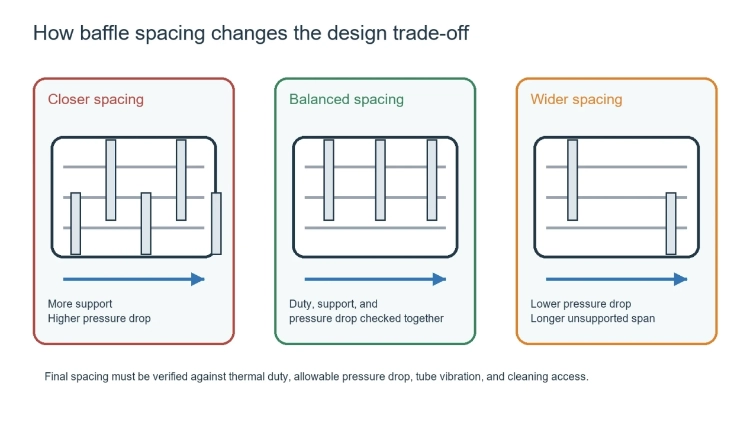
Baffle decisions are linked. Closer spacing can increase shell-side velocity and tube support, but it can also consume pressure drop and complicate cleaning. Wider spacing may reduce hydraulic resistance while increasing unsupported tube span. The final arrangement should be checked together for heat transfer, pressure drop, vibration, bypass flow, fouling, and maintainability.
For phase-change service, request an explanation of inlet distribution, vapor disengagement, condensate removal, liquid level, vent location, and control assumptions. For U-tube or floating-head arrangements, confirm the intended response to differential thermal expansion and how the bundle will be inspected.
Include Nozzles, Loads, Supports, and Site Limits
Provide the piping class, flange standard, facing, rating, nominal size, orientation, and required mating details for every connection. Include vents, drains, instrument taps, relief connections, chemical-cleaning connections, and spare nozzles. If allowable nozzle loads matter, supply the project criteria rather than assuming the vendor’s standard values will match the piping analysis.
The layout package should also show:
- maximum shipping and operating dimensions;
- empty, operating, flooded, and test weights;
- support type and anchor-bolt arrangement;
- lifting points and center of gravity;
- bundle-pulling and channel-cover removal clearance;
- insulation thickness and personnel-protection requirements;
- access platforms, ladders, davits, or monorail interfaces;
- indoor, outdoor, coastal, seismic, wind, or low-temperature exposure.
Small omissions here create expensive site changes. An exchanger that fits the foundation but cannot open for cleaning is not a successful installation.
Separate Inspection, Testing, and Documentation
Buyers often compare one quote with basic shop testing against another that includes extensive nondestructive examination, witnessed testing, material traceability, and a complete manufacturing record book. Put the required inspection and documentation into the RFQ so those costs are visible.
Possible requirements include material certificates, welding procedures and qualifications, welder records, inspection and test plans, dimensional reports, tube-to-tube-sheet examination, radiography or ultrasonic testing, dye-penetrant testing, positive material identification, hydrostatic or pneumatic testing, leak testing, passivation or pickling records, painting reports, nameplate data, and final data books.
Define hold points, witness points, acceptance criteria, report language, electronic file format, and document submission schedule. If third-party inspection is required, state who appoints and pays the inspector and how reinspection is handled.
Clarify the Commercial Scope Before Comparing Price
The base price should clearly state what is included. Ask suppliers to separate the exchanger, supports, insulation, companion flanges, bolts and gaskets, instruments, spare parts, special tools, preservation, export packaging, freight, duties, commissioning, site supervision, and training.
Also request:
- quotation validity and currency;
- Incoterm and named delivery place;
- manufacturing lead time and approval milestones;
- shipping split and maximum package dimensions;
- warranty start point, duration, and exclusions;
- recommended commissioning and operating spares;
- deviation list and optional-price schedule;
- change-order rules after drawing approval.
Grano’s published service capabilities cover packaging, logistics inspection, and after-sales cleaning for plate equipment. For a shell-and-tube enquiry, ask the supplier to confirm the exact service, testing, documentation, and site-support scope in the quotation rather than assuming a general web description applies to the project.
Use a Bid Comparison That Exposes Differences
Do not compare only the total price. Build a bid tabulation with one row for every technical and commercial requirement. Mark each response as compliant, deviating, excluded, optional, or not stated. Keep thermal performance, materials, code compliance, inspection, schedule, shipping, spares, and service visible beside the price.
A low quote may be entirely valid because the design is simpler. It may also omit alloy thickness, corrosion allowance, inspection, removable-bundle features, documentation, or freight. The comparison should reveal which is true. When a supplier proposes a value-engineered alternative, evaluate it separately from the compliant base bid.
Before placing the order, convert all accepted clarifications into the purchase specification and approved datasheet. Email explanations that never enter the order documents are easy to lose during design, fabrication, or inspection.
Shell and Tube Heat Exchanger RFQ Checklist
Use this final review before issuing the enquiry:
- Both fluids and their compositions are identified.
- Normal, minimum, maximum, startup, shutdown, and upset cases are listed.
- Heat duty, flow rates, temperatures, pressures, and allowable pressure drops are consistent.
- Phase change, non-condensables, solids, viscosity, and fouling risks are described.
- Construction code, mechanical standard, edition, class, and jurisdiction are stated.
- Shell-side and tube-side allocation is fixed or left for a documented recommendation.
- Materials, corrosion allowances, gaskets, linings, and material verification are defined.
- Cleaning method, bundle-removal space, lifting, drainage, and service access are shown.
- Nozzles, supports, loads, insulation, instruments, and environmental conditions are included.
- Inspection, testing, witness points, documentation, and acceptance criteria are listed.
- Spares, preservation, packaging, freight, schedule, warranty, and field support are separated.
- Deviations and optional alternatives must be returned in a clear schedule.
If important process data is still missing, use the engineering contact page to request a preliminary review, but label the result as budgetary until the final design basis is approved.
FAQs
Q1: Can I request a quote with only flow rate and inlet temperatures?
A1: You can request a budget estimate, but a firm thermal and mechanical proposal normally needs both fluids, compositions, target outlet conditions or duty, allowable pressure drops, pressure and temperature cases, fouling information, materials, and applicable standards. Missing data should be listed as assumptions, not hidden.
Q2: Should the supplier choose the TEMA type?
A2: The supplier can recommend a configuration, but the buyer should state the cleaning method, thermal-expansion risk, allowable leakage paths, maintenance access, and project standard. The proposal should identify the selected construction and explain material deviations from the requested basis.
Q3: Why do two quotations show very different heat-transfer areas?
A3: They may use different fluid properties, fouling resistances, coefficients, correction factors, velocities, pressure-drop allowances, tube sizes, or margins. Ask both suppliers to disclose the design basis before deciding that the larger or smaller area is better.
Q4: What information is most important for a replacement exchanger?
A4: Provide the original datasheet and drawings if available, plus current operating data, process changes, failure history, nozzle coordinates, foundation limits, bundle-pulling space, piping loads, and photographs of the installed arrangement. State whether the new unit must be dimensionally interchangeable.
Q5: When should I ask for a plate heat exchanger instead?
A5: Consider a plate design when the fluids and operating envelope suit narrow channels and gaskets or welded plates, and when compactness, close temperature approach, modular capacity, or easy opening is valuable. Keep the same duty, pressure-drop, fouling, material, and maintenance basis when comparing technologies.
Conclusion
A strong RFQ turns process intent into verifiable purchase requirements. It gives every bidder the same fluids, cases, standards, materials, cleaning plan, testing scope, layout limits, and commercial boundaries. That makes the shell and tube heat exchanger easier to design, easier to compare, and less likely to generate late changes.
The best next step is not to ask for a “standard unit.” It is to issue a controlled datasheet, require assumptions and deviations to be visible, and make the approved design basis part of the purchase order. That discipline protects both the buyer and the manufacturer.