



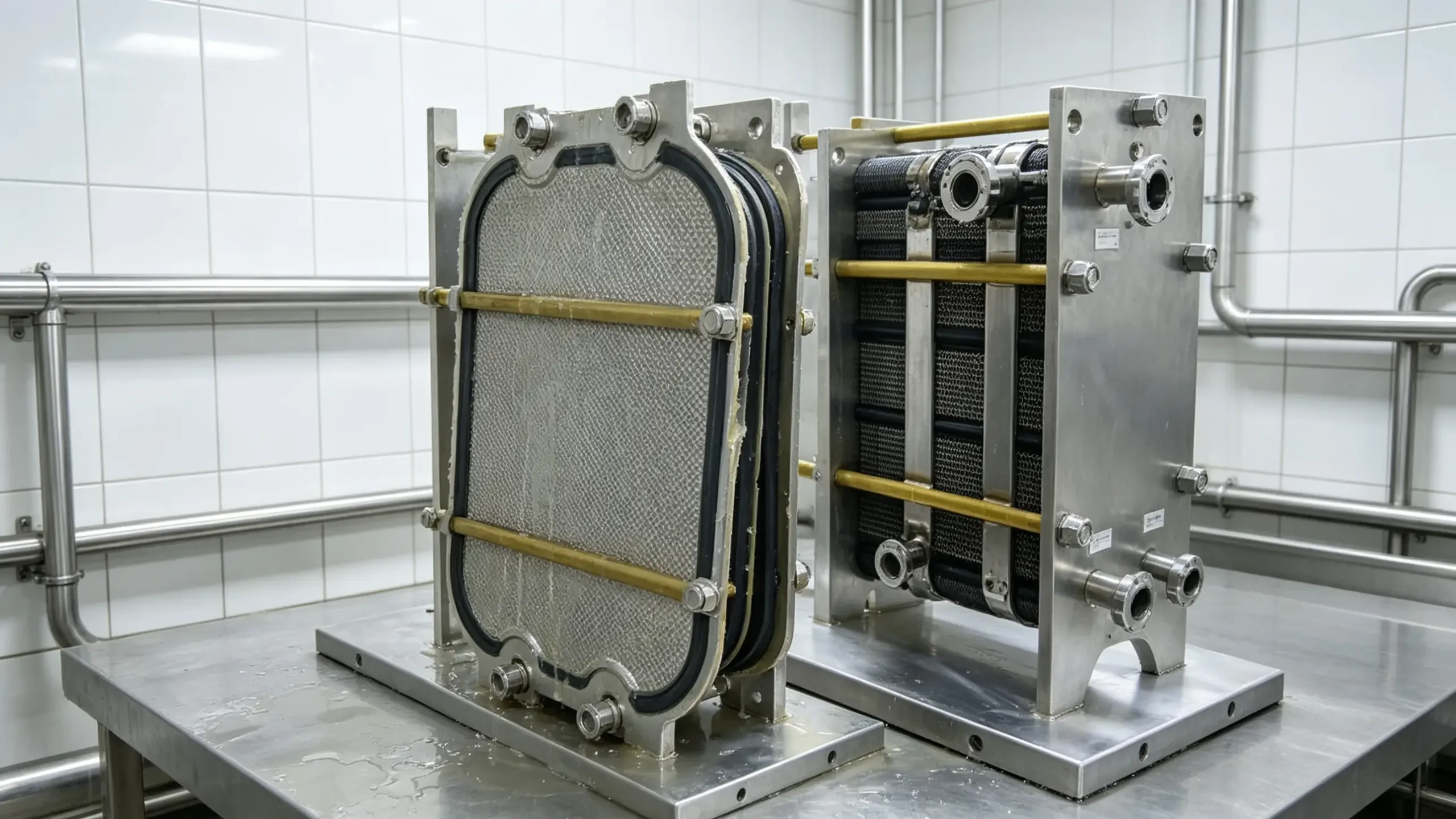
In food and beverage processing, a leaking plate heat exchanger is not just a maintenance issue. Internal leakage may cause medium mixing, product loss, unstable outlet temperature, and unplanned cleaning. For juice, dairy, beer, sauce, and hot water circulation lines, that can mean a rejected batch or a long stop on a busy production day.
Grano has worked in plate heat exchangers, plates, gaskets, and maintenance since 2015, with practical support for detachable units, replacement parts, and on-site or remote service. Its service team can help review leakage causes, gasket condition, plate damage, cleaning records, and installation details, while the company background gives buyers a clearer view of its production and export experience.
Why Internal Plate Heat Exchanger Leaking Is a Serious Food Processing Risk
Internal leaking is harder to spot than external dripping. A small outside leak can be seen during inspection. Internal leakage hides between plates, channels, and pressure differences. By the time it shows up in product quality or temperature behavior, the line may already need checking.
Product Safety and Medium Mixing
Food and beverage plants depend on strict separation between product side and service side. If a plate is corroded or perforated, water, cleaning liquid, or heat transfer medium may mix with the product. In a juice sterilization line or dairy heating loop, that risk is not acceptable. The attachment notes that medium mixing can be linked to plate corrosion and perforation. In real plant work, pressure movement on one side can be an early warning sign.
Downtime and Batch Loss
Once internal leaking is suspected, production usually slows or stops. The equipment may need disassembly, plate inspection, gasket replacement, cleaning, and pressure testing. Even a small damaged gasket can turn into hours of labor. A gasket is cheap compared with a full batch that cannot be released.
Unstable Temperature Control
Internal leakage also disturbs heat transfer. Operators may see outlet temperature drift, rising pressure drop, or strange flow behavior. More steam or chilled water may be used to compensate, but that does not solve the root cause. It only hides the problem for a short time.
What Usually Causes Internal Leakage in Plate Heat Exchangers
Most internal leakage comes from a few repeat causes. They are not mysterious. Poor gasket fit, plate damage, wrong tightening, wrong material selection, and dirty media cause many failures. Food plants can prevent most of them with better checks before and after operation.
Plate Corrosion and Perforation
Plate corrosion is one of the most serious causes. Acidic drinks, salty liquids, CIP chemicals, and high temperature water all affect the plate surface. If the plate material does not match the medium, small pits may form. Later, these pits may become pinholes.
Grano’s Plate Heat Exchanger can be built with stainless steel, titanium alloy, carbon steel, and other materials. In food and beverage service, the correct plate material should be selected by medium, chloride level, pH value, temperature, and cleaning method.
Gasket Aging and Compression Failure
The gasket is not a small accessory to ignore. It seals the plate edges and forms the channel gap between plates. The knowledge base notes that the gasket’s temperature resistance is closely linked to the working temperature of the plate exchanger. If a gasket becomes hard, swollen, cracked, or off-center, leakage risk rises.
Food lines with frequent heating, cooling, and CIP cycles should not wait until the gasket breaks. A simple inspection schedule is better. It is not glamorous work, but it saves production time.
Uneven Bolt Tightening
A detachable plate heat exchanger needs even compression. If bolts are tightened more on one side than the other, the plate pack may not stay parallel. The gasket may shift. The sealing face may not receive equal pressure.
During assembly, clamping bolts should be tightened evenly and symmetrically. The compression length should also be recorded before disassembly, then restored during reassembly. A torque wrench is not optional for serious maintenance work.
How Correct Product Selection Reduces Leakage Before Installation
Leakage prevention starts before the unit arrives at the plant. A heat exchanger selected only by heat transfer area may fail early if gasket material, plate material, pressure, and cleaning needs are not checked.
Matching Materials to Food Media
A standard water-to-water unit does not always suit juice, syrup, oil, milk, or cleaning chemicals. Some fluids contain salts. Some are acidic. Some carry particles. The wrong plate or gasket material can work for a while, then fail at the worst time.
| Selection Item | Real Data from Grano Knowledge Base | Buyer Note |
|---|---|---|
| Plate Heat Exchanger Heat Exchange Area | Up to 5000 m², customized | Useful for small and large process duties |
| Maximum Working Pressure | 25 MPa | Check with actual line pressure and safety margin |
| Maximum Operating Temperature | 200°C | Match with heating and CIP requirements |
| Common Materials | Stainless steel, titanium alloy, carbon steel | Select by medium corrosion risk |
| Main Accessories | Plates, gaskets, bolts, heating elements | Spare parts planning matters for maintenance |
Choosing the Right Gasket Material
Gasket choice should match food medium, cleaning agent, temperature, and oil content. Food EPDM is commonly used for water, water vapor, and superheated water. Food butyronitrile suits oil-water exchange and animal or vegetable oil related media. Food fluorine is suitable where higher temperature and stronger chemical resistance are needed.
| Gasket Material | Operating Temperature from Knowledge Base | Common Use Direction |
|---|---|---|
| Food EPDM | -54°C to 150°C | Water, water vapor, hot water |
| Food Butyronitrile | -30°C to 120°C | Oil-water exchange, animal and vegetable oil |
| Food Fluorine | -29°C to 220°C | Higher temperature, acid, alkali, salt media |
| Silicone Rubber | -100°C to 230°C | Low temperature and dry heat conditions |
| High Temperature Fluorine | -29°C to 300°C | Higher heat and chemical conditions |
Reviewing Flow Path Design
Some processes need more than a standard single-pass design. A Multi-Pass Heat Exchanger may be selected when the process needs a longer flow path, special temperature approach, or a more controlled outlet temperature. It should be selected after thermal calculation, not by habit.
In food and beverage work, too low flow velocity may increase deposits. Too high pressure drop may stress the system. A balanced design helps reduce cleaning trouble and sealing stress.
How Installation Practices Prevent Internal Leaking
A good unit can still fail if installation is careless. Many leakage problems start with pipe debris, wrong connection direction, tight equipment rooms, or rushed assembly.
Clean Pipework Before Start-Up
The knowledge base clearly states that pipes connected to the heat exchanger should be cleaned before connection. Sand, gravel, welding slag, and other debris can enter the plate channels. In a food plant, debris can scratch plates, block channels, or damage gasket sealing areas.
A simple flushing step before start-up can prevent many later complaints. It is a small step, but installers sometimes skip it when the project is behind schedule.
Follow Correct Inlet and Outlet Direction
Hot and cold media should be connected according to the factory nameplate and process design. Incorrect direction may reduce heat transfer and create unstable pressure behavior. It may also make cleaning less effective.
A Plate Heat Exchanger uses narrow, corrugated channels to create strong fluid disturbance and high heat transfer. That design works best when the flow arrangement is correct.
Reserve Space for Maintenance
Food factories often have tight equipment rooms. Still, a detachable heat exchanger needs space around it. Plates must be removed, gaskets checked, bolts tightened, and the plate pack opened for cleaning.
If there is no space, maintenance becomes rough. Plates get scratched. Gaskets get pulled in the wrong direction. Workers rush the job. Leakage risk increases after every poor service session.
How Cleaning and Maintenance Help Stop Leakage
Cleaning is not only about heat transfer efficiency. It also protects plates and gaskets. Dirty channels raise pressure drop, reduce performance, and can create local stress. In food and beverage lines, deposits can come from minerals, protein, sugar, pulp, oil, or water treatment problems.
Scale and Deposit Control
The Grano knowledge base explains that poor water treatment can cause calcium carbonate and magnesium hydroxide deposits. These deposits stick to the heat transfer surface and reduce thermal performance. Similar trouble can happen with food residues if cleaning is weak.
When pressure drop gradually increases, do not only increase pump power. Check whether channels are blocked or scaled. A higher pressure drop is often the plant’s early warning.
Safe Chemical Cleaning
The documented cleaning steps include flushing, pickling, alkali washing, water washing, records, and pressure testing. Before acid cleaning, open flushing should remove mud and loose scale. After acid washing, alkaline washing helps neutralize the system. Clean softened water should rinse residues.
Cleaning should be controlled. Too strong a chemical, too long a soak, or poor rinsing can damage plates and gaskets. That is one reason many plants use outside maintenance support for larger units.
Pressure Test After Reassembly
After plate or gasket service, pressure testing should be done before the unit returns to production. The knowledge base mentions maintaining pressure for 30 minutes after filling and pressurizing during testing. If there is no pressure drop, the system can move toward reconnection.
For food and beverage plants, this step should be treated as standard practice. A skipped pressure test may save one hour today and lose a full shift tomorrow.
Why Work With Grano for Leakage Prevention
Leakage prevention is not a single purchase. It is product selection, gasket matching, installation, cleaning, inspection, and spare parts planning. This is where supplier support matters.
Complete Product and Parts Supply
Grano provides plate heat exchangers, heat exchanger units, plates, gaskets, bolts, and maintenance services. For plants that already use existing detachable units, replacement plates and sealing gaskets may be the fastest way to restore stable operation.
The knowledge base includes a food processing plant case where a juice sterilization system needed regular plate and gasket replacement. The supplied plates used food-grade stainless steel, and the gaskets were glued with food-grade environmentally friendly glue. Parts were packed in aviation aluminum boxes and shipped directly to the factory by air. This is exactly the type of detail buyers care about when downtime is expensive.
Practical Service Support
Grano also offers cleaning, maintenance, technical support, and replacement service. Its service is relevant when you need help with recurring leakage, rising pressure drop, old gaskets, or damaged plates.
The company can also pre-paste sealing gaskets on plates before delivery when requested, using high-performance environmentally friendly glue. That makes field installation faster and cleaner.
Suitable Choice for New and Retrofit Projects
For new food and beverage lines, Grano can help select a suitable heat exchanger based on process duty, medium, pressure, temperature, cleaning method, and space. For retrofit projects, it can provide plates, gaskets, and full units for replacement work.
If your line has internal leakage, unstable outlet temperature, pressure drop increase, or frequent gasket failure, start with the basics: plate condition, gasket material, bolt tightening, flow direction, cleaning records, and pressure test results. Then choose the right Plate Heat Exchanger or Multi-Pass Heat Exchanger for the process instead of only replacing the failed part.
FAQ
Q1: What Is the Main Cause of Internal Plate Heat Exchanger Leaking?
A: Common causes include plate corrosion, plate perforation, gasket aging, uneven bolt tightening, plate deformation, and wrong gasket material. In food and beverage processing, cleaning chemicals and high temperature cycles can speed up gasket wear.
Q2: How Can You Detect Internal Leakage Early?
A: Watch for pressure changes between sides, unstable outlet temperature, rising pressure drop, unusual product quality changes, or repeated cleaning problems. A pressure test after maintenance is also important.
Q3: Which Gasket Material Is Better for Food and Beverage Processing?
A: It depends on the medium. Food EPDM is suitable for water, steam, and hot water. Food butyronitrile suits oil-water exchange. Food fluorine fits higher temperature and stronger chemical conditions.
Q4: When Should You Choose a Multi-Pass Heat Exchanger?
A: A multi-pass design may be suitable when the process needs a longer flow path, tighter outlet temperature control, or a special temperature approach. It should be selected after calculation and process review.
Q5: Can Regular Cleaning Prevent Internal Leakage?
A: Regular cleaning helps reduce scale, deposits, pressure drop, and local stress. It cannot repair a damaged plate or aged gasket, but it can slow the conditions that often lead to leakage.


