



A chiller does not trip on high pressure because it wants attention. It trips because heat cannot leave the system fast enough. In HVAC plants, that failure often starts inside dirty condenser water loops and poorly protected heat exchangers.
Grano has worked in plate heat exchanger production, gaskets, plates, installation, and maintenance since 2015, with service experience across HVAC, power, cooling, and industrial systems. Its service support is useful when you need sizing, cleaning, replacement plates, or practical field advice, not just a catalog answer. The company profile also notes strong PHE know-how, export experience, and long-term parts supply through stable material sources. Learn more about the team.
Why High-Pressure Shutdowns Start in Cooling Water
A water-cooled chiller depends on smooth heat rejection. Refrigerant gives heat to condenser water, condenser water goes to the cooling tower, and the tower rejects heat to outdoor air. When that chain gets dirty, head pressure rises. Then compressor lift rises. Then power rises. At some point, the safety control stops the machine.
Scale Does Not Need to Be Thick to Hurt
Cooling tower water carries dissolved minerals, airborne dirt, corrosion by-products, biological slime, and fine solids. Open towers are very good at pulling air through water. That also means they pull in dust, leaves, pollen, city particles, and oily dirt from nearby traffic. Not very glamorous, but real maintenance teams see this sludge in strainers all summer.
Once deposits sit on condenser tubes or heat exchanger plates, heat transfer drops. A cooling water treatment guide states that fouling on condenser tubes reduces heat transfer, raises condenser head pressure, and increases energy cost. It also says each extra 1°F in refrigerant condensing temperature needs about 1.5% more compressor energy, and heavy deposits can push head pressure past chiller limits.
| Calcium Carbonate Scale Thickness | Fouling Factor Listed in HVAC Reference | Practical Meaning for Your Chiller |
|---|---|---|
| 0 mm | Clean | Normal heat rejection and normal compressor lift |
| 0.1524 mm | 0.0005 | A common design fouling allowance |
| 0.3048 mm | 0.0010 | Higher condensing temperature begins to show |
| 0.6096 mm | 0.0020 | Head pressure and compressor load climb fast |
| 0.9144 mm | 0.0030 | Shutdown risk becomes much more likely |
The same HVAC source notes that many chillers are rated around 0.60 to 0.90 kW per ton of refrigeration, while a 0.03 inch calcium carbonate layer can raise electrical energy use by 27%; if the deposit is iron oxide, the loss can be about 40%.
Why Chemicals and Bigger Pumps Often Miss the Real Problem
Water treatment chemicals matter. Nobody serious would argue against proper control of hardness, pH, conductivity, corrosion, and biological growth. The trap is treating chemical dosing as the whole answer. A bigger pump can also look tempting, especially when pressure drop rises and operators want flow back. But more pump head does not remove the dirt layer. Sometimes it just burns more power while forcing dirty water deeper into narrow passages.
Low-Flow Corners Become Dirt Pockets
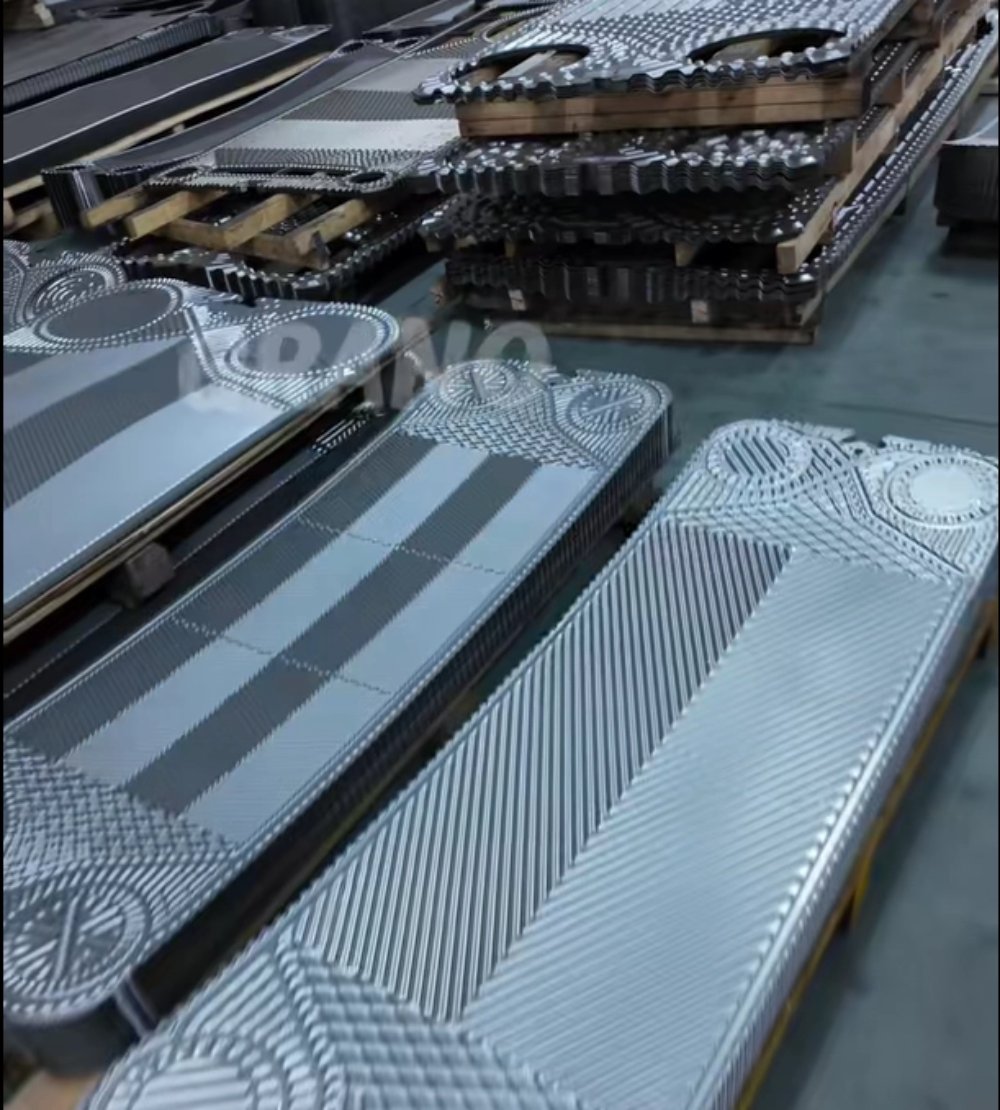
In a plate heat exchanger, corrugated plates create narrow and winding channels. Good corrugation raises turbulence and heat transfer. The attached technical file explains that the plate surface is pressed into corrugated or grooved shapes to improve rigidity, raise fluid disturbance, and create a high heat transfer coefficient. It also notes that the exchanger uses plates, sealing pads, clamping plates, and clamping bolts to form flow channels.
That design works well when the water is reasonably clean and flow stays in the intended range. With cooling tower sludge, the same small passages may collect suspended solids, especially near low velocity zones. The knowledge file lists gradual pressure drop increase as a common fault caused by unclean media, too many particles, scaling, or blocked flow channels. It also warns that debris such as sand, gravel, and welding slag should be kept out of the exchanger by cleaning connected pipes before operation.
How Dirty Tower Water Creates an Insulation Layer
Deposits do two bad jobs at once. They block flow and they insulate. Flow blockage raises pressure drop. Insulation raises condensing temperature. The chiller then works harder for less cooling. Facility managers usually notice this as warmer supply water, unstable condenser approach, higher compressor current, and a power bill that looks rude for no good reason.
Biofilm Can Be Worse Than Hard Scale
A key detail gets missed in many plant rooms: slime is often more damaging than normal mineral scale. The cooling water reference states that calcium carbonate scale can transfer heat up to four times better than biofilm deposits. In plain terms, slime can be a stronger thermal blanket than hard scale. It also says condenser deposits may contain slime, scale, corrosion by-products, and suspended solids scrubbed from air.
A second energy guide explains the flow side. If a condenser is designed for water entering at 25°C and leaving at 30°C, that is a 5°C temperature difference. If flow drops to half the design value, the difference becomes 10°C and leaving condenser water rises to 35°C. That higher leaving water raises condenser temperature and pressure, which means higher compressor lift.
| Operating Change | Published Example or Rule | What It Tells Your Maintenance Team |
|---|---|---|
| Extra refrigerant condensing temperature | 1°F raises compressor energy about 1.5% | Small temperature creep is expensive |
| Condenser water flow reduced to half | 25°C in, 30°C out becomes 25°C in, 35°C out | Low flow quickly raises condenser pressure |
| Cooling tower design target | About 2°C above outdoor wet-bulb temperature | Dirty towers lose the main advantage of water cooling |
| Biofilm compared with calcium carbonate | Calcium carbonate transfers heat up to 4 times better | Slime can drive faster high-pressure alarms |
Where Physical Isolation Fits in HVAC Design
The strongest fix is often not more chemical. It is separating the dirty open tower loop from the cleaner chiller or building loop. A heat exchanger becomes a physical barrier. The tower can stay exposed to air and dirt, while the chiller side runs with cleaner, better controlled water. This cuts risk to expensive condenser equipment and gives the maintenance team a removable cleaning point.
Gasketed Plate Units Are Built for Summer Cleaning
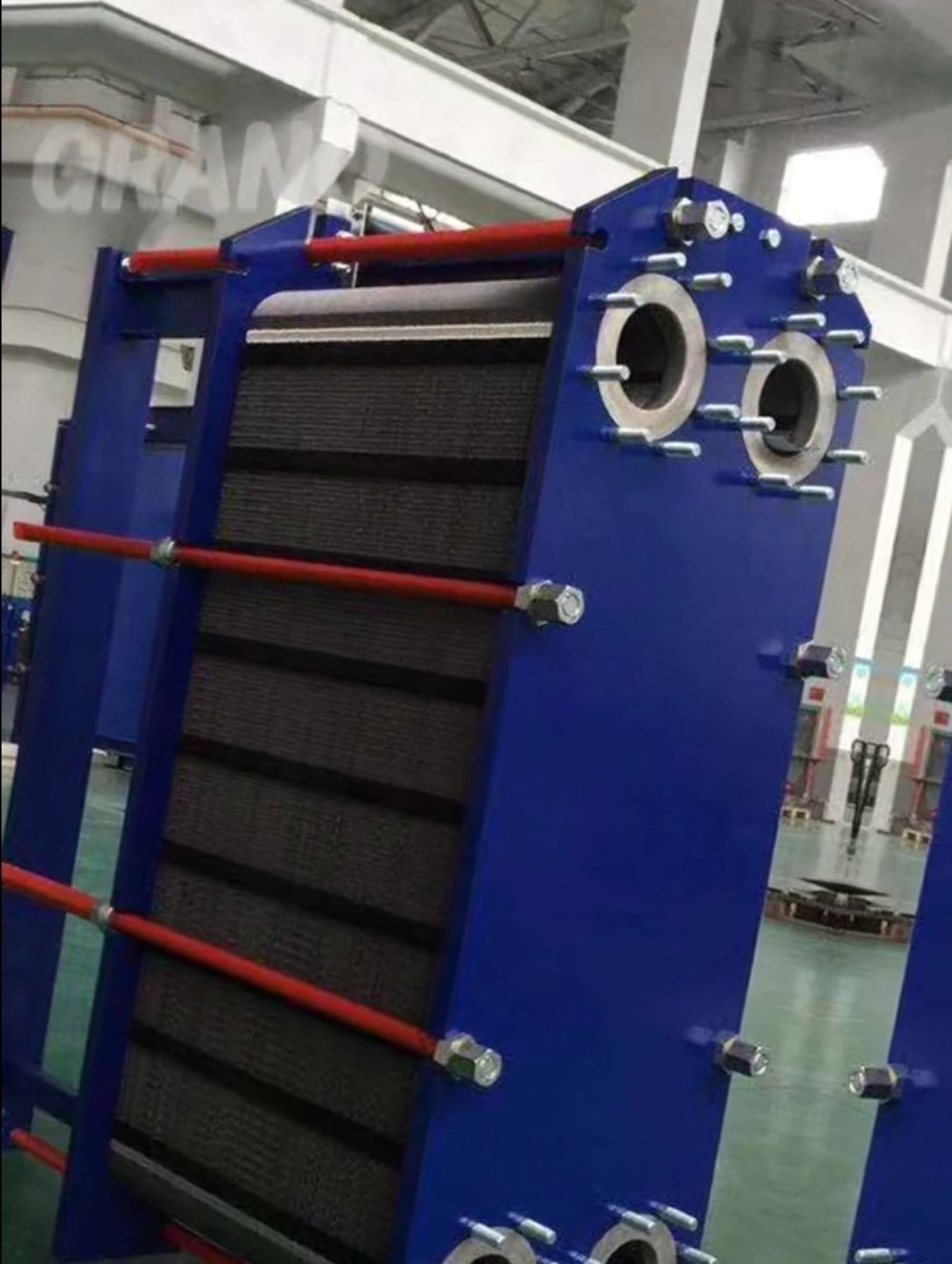
For cooling tower isolation, a gasketed Plate Heat Exchanger is often the practical choice. The product file states that plate heat exchangers are small, efficient, easy to maintain, and widely used in HVAC, heating, chemical, metallurgy, industrial cooling, food processing, and petrochemical work. It lists detachable design, easy cleaning, modular expansion, material choices such as stainless steel and titanium alloy, heat exchange area up to 5000 m², working pressure up to 25 MPa, and operating temperature up to 200°C.
That detachable frame matters in July. When pressure drop climbs, you can open the unit, clean plates, inspect gaskets, remove mud, and return the exchanger to service without cutting major pipework. The maintenance file gives a clear workflow: record compression length before disassembly, remove clamping bolts and plates, clean dirt and adhesive residue, check plates for cracks, pits, perforation, or deformation, refit sealing strips, tighten evenly with a torque wrench, and run a pressure test for 30 minutes before service.
Choosing the Right Heat Exchanger for Cooling Tower Work
Not every heat exchanger belongs in dirty water. A compact sealed unit may be excellent in a clean refrigerant or water-to-water circuit, but a muddy open tower loop needs access, wide passages, and realistic maintenance time. The right choice depends on particle load, water chemistry, duty, pressure, temperature, and cleaning frequency.
Compare Service Access Before You Buy
| Equipment Type | Listed Capacity Data | Best HVAC Use | Cleaning Reality |
|---|---|---|---|
| Gasketed Plate Unit | Up to 5000 m², 25 MPa, 200°C | Cooling tower isolation, chiller protection, serviceable loops | Can be opened, cleaned, inspected, and re-gasketed |
| Brazed Plate Heat Exchanger | Up to 2500 m², 40 MPa, 300°C | Compact clean loops, refrigerant duties, heating and cooling skids | Sealed construction, filtration must be strict |
| Shell and Tube Unit | Custom area, 50 MPa, 400°C | Large flow and low pressure drop duties | Strong structure, but larger footprint |
The product file describes brazed units as compact, corrosion resistant, high pressure resistant, and quick in thermal response. That is valuable in clean closed loops. For open tower water with mud and biological slime, a serviceable plate unit is usually easier to defend because cleaning access is built into the design.
Maintenance Habits That Prevent the Next Shutdown
A good isolation exchanger still needs discipline. Daily readings are not paperwork for fun. They are early warnings. A cooling tower handbook recommends recording water and refrigerant temperatures, pump pressures, outdoor conditions, and pressure drops across condensers, heat exchangers, and filtration devices. It also says systems using plate heat exchangers should have temperature and pressure differentials checked daily for clogging or fouling.
Clean by Cause, Not by Panic
When scale is already present, the attachment describes why acid cleaning works: acid dissolves calcium, magnesium, and carbonate scale; strips oxide bonding from metal; releases carbon dioxide that helps lift deposits; and loosens mixed silicate or sulfate scale so it can be washed away. The listed cleaning steps include flushing first, injecting cleaning liquid, static acid soaking for 2 hours, dynamic circulation for 3 to 4 hours, alternating forward and reverse cleaning every 0.5 hour, alkali washing, softened water rinsing for 0.5 hour, recording each step, and pressure testing after cleaning.
That is the grown-up answer to high pressure trips: measure, isolate, clean, inspect, and test. Add good filtration, correct water treatment, and enough access space around the exchanger. Your chiller gets cleaner water. Your pump stops fighting mud. Your summer callouts drop. The quiet plant room is a nice bonus.
FAQ
Q1: Why Does a Chiller Shut Down on High Pressure During Hot Weather?
A: Heat cannot leave the condenser fast enough. Scale, slime, low flow, blocked strainers, dirty cooling towers, and fouled heat exchangers raise condensing pressure until the safety control stops the chiller.
Q2: Can More Chemical Dosing Solve Cooling Tower Scaling?
A: Chemicals help control scale, corrosion, and biology, but they cannot remove all suspended dirt or fix blocked passages. A physical isolation exchanger plus filtration and proper cleaning gives better protection.
Q3: Why Is a Plate Heat Exchanger Useful Between the Tower and Chiller?
A: It separates dirty tower water from the cleaner chiller loop. A gasketed Plate Heat Exchanger also opens for cleaning, plate inspection, and gasket replacement.
Q4: When Is a Brazed Plate Heat Exchanger a Good HVAC Choice?
A: A Brazed Plate Heat Exchanger fits clean closed loops, compact skids, refrigerant circuits, and high-pressure duties. It is not the first choice for muddy open tower water unless filtration is very strong.
Q5: What Data Should You Track to Catch Fouling Early?
A: Track condenser approach, inlet and outlet water temperature, pressure drop across the heat exchanger, pump pressure, tower basin condition, strainer condition, and compressor current. Rising pressure drop with falling heat duty usually means fouling or blockage.


