

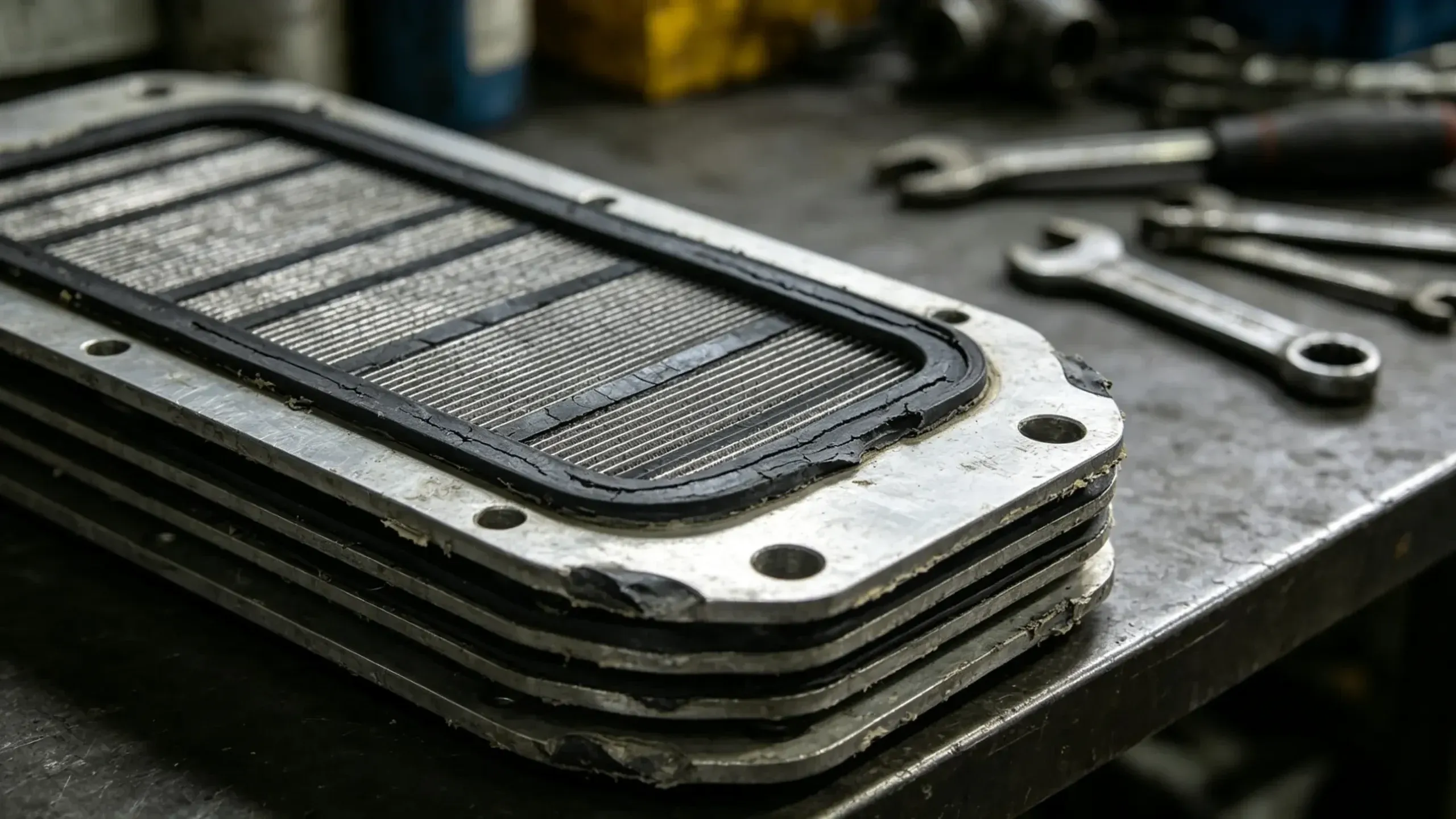
A plate heat exchanger gasket does not carry a single printed expiration date, and that is exactly what makes shelf life confusing. Rubber degrades with time, temperature and light, so the real answer is conditional: stored in a cool, dry, dark environment at or below 40 °C, away from chemicals and heavy pressure, most gaskets remain serviceable for several years. Stored on a sunlit shelf above a hot pipe, the same gasket can be compromised long before its first installation. This article covers the storage conditions that actually preserve gasket life, the aging mechanisms behind an “expired” part, how long stored spares can realistically last, and a pre-use inspection checklist your maintenance team can apply in under five minutes.
Why Gasket Shelf Life Matters More Than It Looks
The gasket is usually the smallest and cheapest component in a detachable plate heat exchanger, yet it sits at the center of most failure stories. Industry fault analyses consistently point to the same cluster of leak causes: a corroded or cracked plate, uneven fastening, plate deformation, an aged sealing gasket, uneven gasket thickness, and a gasket seated off-center. Three of those seven causes are gasket-related, and one of them — aging — starts the moment a gasket leaves the factory, whether it is installed or sitting in a cabinet.
The consequences are not symmetric. A gasket that fails in service can let two process fluids mix — in food, pharma or chemical service that is a contamination event, not just a maintenance ticket. It can also silently reduce the maximum safe operating temperature and pressure of the unit, because in a gasketed exchanger the rubber seal, not the metal plate, often sets the temperature limit. Planning spares around real shelf life, rather than around an unverified “new = good” assumption, is the cheapest reliability improvement most plants never make.
How Rubber Ages: The Mechanisms Behind an “Expired” Gasket
All elastomers used in plate heat exchanger gaskets — EPDM, nitrile, fluorocarbon, silicone and butyl — age through the same broad set of mechanisms, and every mechanism is accelerated by the wrong storage environment:
- Oxidation. Heat and oxygen break and reform polymer chains. The result is a gasket that hardens, loses elasticity, and finally cracks at the groove corners.
- Ozone attack. Ozone — produced in small amounts by motors and electrical equipment — causes fine surface cracking (crazing), especially on strained or thin edges.
- Light and UV exposure. Surface oxidation that may not be visible on the core but degrades exactly the sealing edges that matter.
- Compression set. Any sustained load — a stack of boxes on top of gasket cartons, or gaskets hung on hooks for months — produces permanent set that shows up as a leak after installation.
Temperature is the multiplier. As a widely used rule of thumb in rubber storage, every 10 °C increase in storage temperature roughly doubles the rate of oxidation-driven aging. A gasket stored at 60 °C is therefore aging on the order of four times faster than one stored at 40 °C. This single relationship explains why two warehouses with identical gasket stock can reach opposite conclusions within a year.
The Storage Conditions That Actually Preserve Gasket Life
Grano’s storage specification for plate heat exchanger gaskets is specific and worth treating as the floor, not the ceiling: store in a cool, dry, dark environment; keep the ambient temperature at or below 40 °C; do not allow contact with acids, alkalis, oils or organic solvents; and avoid heavy pressure. Here is what each condition protects against, and how to implement it in a typical plant warehouse.
Keep It Cool: The 40 °C Ambient Limit
The 40 °C limit refers to the ambient storage temperature, not a theoretical worst case. In practice that means keeping gasket storage away from boiler rooms, heater exhausts, sun-exposed warehouse roofs and pipework runs. A cabinet two meters from a hot steam line can easily exceed the limit locally even when the room thermostat reads 25 °C. If your warehouse cannot hold 40 °C in summer, rotate stock faster and re-verify stored gaskets before use.
Keep It Dry
Humidity promotes mildew on rubber surfaces and can wick into packaging. Store gaskets on pallets or shelves rather than directly on concrete floors, keep them in their original packaging until installation, and seal cartons after partial use. In coastal or flood-prone sites, a simple moisture indicator in the storage cabinet is cheap insurance.
Keep It Dark
Store gaskets in opaque packaging and away from windows and skylights. Original cartons and closed cabinets do the job. UV exposure is the reason “dark” is in the specification: it is the condition that is hardest to observe failing and easiest to fix with a lid.
Keep It Chemically Clean
The no-contact rule covers acids, alkalis, oils and organic solvents — and it covers the environment, not just direct spills. Gaskets stored above an oil drum, next to solvent drums with weeping lids, or in a cabinet that previously held hydraulic components, can be compromised without ever being touched by a droplet. Ozone-generating equipment (motors, VFDs, transformers) belongs in a different part of the warehouse.
Keep It Unstressed
Rubber exhibits cold flow: any sustained deformation becomes permanent. Do not stack heavy items on gasket cartons, avoid hanging gasket sets on hooks for extended periods, and keep them flat in their original stacking. A gasket that is stored “squared” seats more predictably in the groove.
Record It
First-in, first-out is the whole discipline: record the manufacture or purchase lot and date on the carton, note the storage location, and review the stock at every gasket change. Storage history is part of shelf life — a gasket with no records is, for planning purposes, an aged gasket.
How Long Can a Plate Heat Exchanger Gasket Be Stored?
Because degradation is condition-driven rather than calendar-driven, no single “maximum shelf life” number applies to all gaskets. Under the storage conditions above — at or below 40 °C, dry, dark, chemical-free and unstressed — most EPDM, nitrile and fluorocarbon gaskets are expected to remain serviceable for several years, and condition checks at installation confirm the margin. As a practical planning rule, many maintenance teams treat roughly five years in good storage as the point at which every unit in stock gets a documented inspection before reuse, and they discard anything whose storage history they cannot reconstruct.
The date is less important than the environment. A gasket that spent two years at 65 °C under a rooflight has less remaining life than one that spent five years in a dark, dry cabinet at 25 °C — even though the first one is “younger.”
Material Changes the Ceiling: Thirteen Gasket Rubbers at a Glance
Storage rules apply to every rubber, but the operating envelope of each material determines how much margin a stored gasket keeps when it finally reaches service. Grano supplies plate heat exchanger gaskets in thirteen rubber grades, each with its own color code and temperature range:
|
Material |
Code |
Color |
Working range (°C) |
Typical service |
|
EPDM |
E |
Red |
-54 to 150 |
Water/steam, air–water and water–water; acids, alkalis, oxidants |
|
High-temperature EPDM |
HE |
Red-yellow |
-54 to 170 |
Same as EPDM, extended hot-side margin |
|
Ultra-high-temperature EPDM |
CE |
Red-yellow |
-54 to 200 |
High-temperature water and steam service |
|
Food EPDM |
SE |
Red |
-54 to 150 |
Food-grade water/steam service |
|
Nitrile (NBR) |
N |
Green |
-30 to 120 |
Oil–water exchange; mineral, animal and vegetable oils |
|
High-temperature NBR |
HN |
Green-yellow |
-30 to 150 |
Hotter oil service with the same chemical profile |
|
Food NBR |
SN |
Green |
-30 to 120 |
Food-grade oil service |
|
HNBR |
QN |
Green-yellow |
-60 to 170 |
Tougher oil and heat service than standard NBR |
|
Fluorocarbon (FKM) |
F |
Brown |
-29 to 220 |
High-temperature oils, acids, alkalis, aggressive media |
|
High-temperature FKM |
HF |
Brown |
-29 to 300 |
Severe high-temperature chemical service |
|
Food FKM |
SF |
Brown |
-29 to 220 |
Food-grade high-temperature chemical service |
|
Silicone |
Q |
Gray |
-100 to 230 |
Wide temperature range; dry heat; low-pressure service |
|
Butyl |
I |
Blue |
-54 to 150 |
Gas and vapor tightness; water service |
Two reading notes. First, EPDM is the default for water-to-water and steam service: it is hydrophobic, stable against acids, alkalis and oxidants, and it is explicitly not resistant to petroleum-based media — so oil circuits belong to nitrile, HNBR or FKM. Second, FKM is a polar rubber with weaker resistance to superheated steam and saturated vapor than its temperature rating suggests, which is why EPDM, not FKM, remains the steam-side default. Whichever grade you store, the six storage conditions above are what keep the grade honest on the shelf.
When to Discard a Stored Gasket: A Pre-Use Inspection Checklist
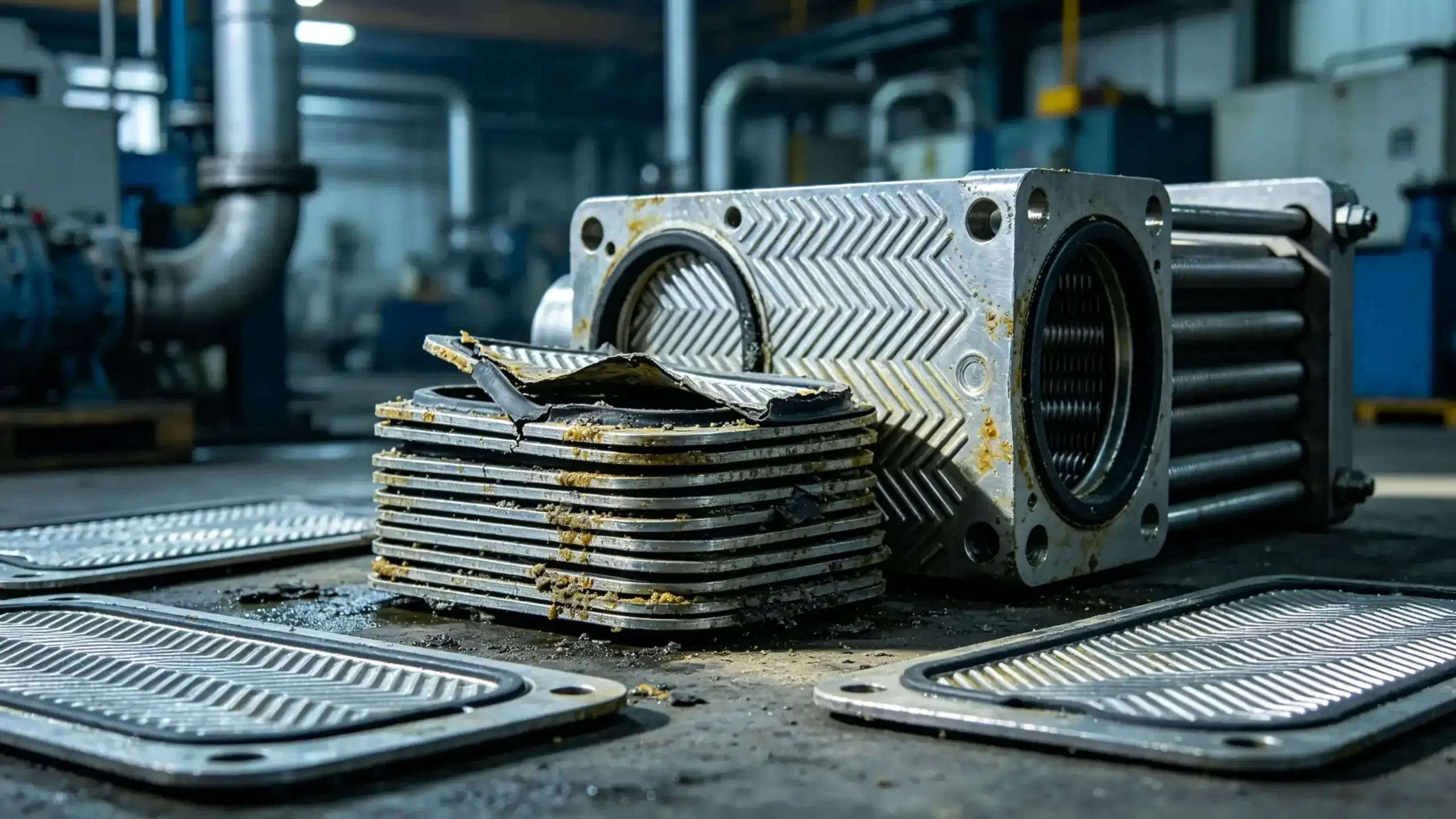
Run this checklist every time a gasket comes out of storage, before it touches a plate. Any one finding is grounds for replacement — the cost of one gasket is trivial against the cost of one leak:
- Surface cracking or crazing, especially at corners and thin edges.
- Tacky, sticky or unusually shiny surface — a sign of oxidation products migrating to the surface.
- Hardness or brittleness: press a corner with a thumbnail; a healthy gasket recovers fully.
- Permanent deformation, out-of-round corners, or edges that no longer sit flat.
- Edge damage, torn lips, or separation between the gasket and any glued backing.
- Mold, mildew or discoloration in the packaging.
- Unknown or undocumented storage history.
Two habits make the checklist honest. Photograph doubtful gaskets before discarding them — the archive tells you whether your storage location, not the supplier, is the problem. And when you do install, clean the plate and the gasket groove first: assembly on a dirty groove defeats a perfect gasket, because trapped debris changes the seating surface the seal is built on.
img.plate heat exchanger maintenance on site.webp
From Shelf to Plate: Fitting, Verification and Re-ordering
Installation side, the failure modes are the familiar ones: seat the gasket without distortion (whether glued, clipped or snap-in), clean the groove, tighten the fastening bolts evenly and symmetrically with a torque wrench, and record the plate-pack compression length so the next service can compare. Uneven tightening is one of the standard leak causes even with a perfect gasket, and the compression-length record is what makes the next opening diagnostic instead of archaeological.
On the ordering side, specify by the data you can verify: the plate model and gasket code, the color code and temperature range required by the duty, and the quantity. If your existing unit predates good records, send the plate code or nameplate photos to the supplier before ordering — Grano maintains compatibility lists for the major plate models and can pre-glue gaskets to plates before delivery using high-performance, environmentally approved adhesive, including food-grade options for food service. The full range of plates, gaskets, bolts and tools is covered on the accessories page, the Grano product catalog lists the standard plate heat exchanger range, and the about page documents the ISO 9001:2015 quality system behind the parts you receive. If your spares are aging, or you simply want storage done right, contact the Grano team for gasket selection and a quote.
Frequently Asked Questions
Q1: Does a plate heat exchanger gasket have an expiration date?
A1. Not a printed one. Rubber degrades with time, temperature and light, so shelf life is managed through storage conditions and inspection. Stored at or below 40 °C in a cool, dry, dark, chemical-free, unstressed environment, most gaskets remain serviceable for several years; inspect every unit before installation regardless of age.
Q2: What is the maximum storage temperature for PHE gaskets?
A2. Grano’s storage specification is an ambient temperature that does not exceed 40 °C, in a cool, dry, dark environment, with no contact with acids, alkalis, oils or organic solvents and no heavy pressure on the stock.
Q3: Can gaskets be stored in the same warehouse as oils or chemicals?
A3. Not in the same space. Acids, alkalis, oils and organic solvents attack elastomers even through the environment, so gasket storage should be separated from chemical and oil storage, and gaskets should stay in their original packaging until installation.
Q4: How can I tell if a stored gasket has aged?
A4. Check for surface cracking, tackiness, hardness or brittleness, permanent deformation, edge damage and mold. If any sign is present, or the storage history is unknown, replace the gasket rather than risk it in service.
Q5: Which gasket material is standard for water-to-water heat exchange?
A5. EPDM (code E) is the standard choice: it is hydrophobic and stable against acids, alkalis and oxidants, with a -54 to 150 °C working range in Grano’s standard grade. It is not suitable for petroleum-based media, where nitrile, HNBR or FKM applies.
Key Points
- Store plate heat exchanger gaskets cool, dry, dark, chemical-free and unstressed, at or below 40 °C ambient — the conditions, not the date, set shelf life.
- Heat is the multiplier: each 10 °C above comfortable storage roughly doubles the oxidation rate.
- Match the rubber to the duty first (13 grades, from EPDM for water service to FKM for high-temperature chemicals), then manage the shelf.
- Inspect every gasket before use and discard on any sign of cracking, tackiness, set or unknown history.
- Specify replacements by plate model, gasket code, color and temperature range, and keep the compression-length record at every opening.