



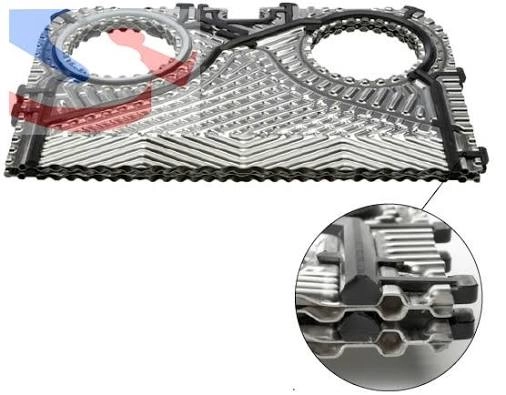
A furnace loop leak rarely begins with a dramatic failure. More often, a Plate Heat Exchanger develops a damp edge, a faint thermal-fluid smell, or a pressure reading that needs correction after every shift. That small sign can grow into medium loss, unstable outlet temperature, fluid mixing, or an emergency shutdown.
Grano has worked in heat exchanger design, production, consultation, OEM supply, parts, and service since 2015. Its range covers gasketed, semi-welded, brazed, and fully welded units, plus plates, gaskets, bolts, cleaning, and technical support. For a furnace loop, this range gives you a real choice: a serviceable gasketed unit for moderate duty or a welded design when heat, pressure cycling, and leak risk matter more.
The main answer is clear. A fully welded unit gives better protection against gasket-related leaks. A gasketed unit may still be better when fouling is heavy, regular opening is expected, or future capacity changes are likely.
Why Do Furnace Loops Develop Leaks?
Thermal Cycling
Heating and cooling make the metal expand and contract. In a gasketed unit, the elastomer also ages and takes a compression set. Once it loses spring-back, the plate pack may not keep an even seal.
Uneven Compression
A gasket can shift when tie bolts are tightened unevenly or when the pack is compressed to the wrong length. Valve closure, blocked channels, and pump starts may add short pressure spikes.
Corrosion and Plate Damage
Poor water treatment can form scale and raise pressure drop. Corrosive condensate or the wrong alloy may cause pitting or perforation. Grano’s technical material lists aged gaskets, uneven bolt tightening, plate deformation, cracks, and corrosion penetration among common leak causes.
How Does Each Plate Heat Exchanger Seal the Loop?
Both designs use corrugated plates, but their sealing methods create different leak paths and maintenance needs.
Gasketed Construction
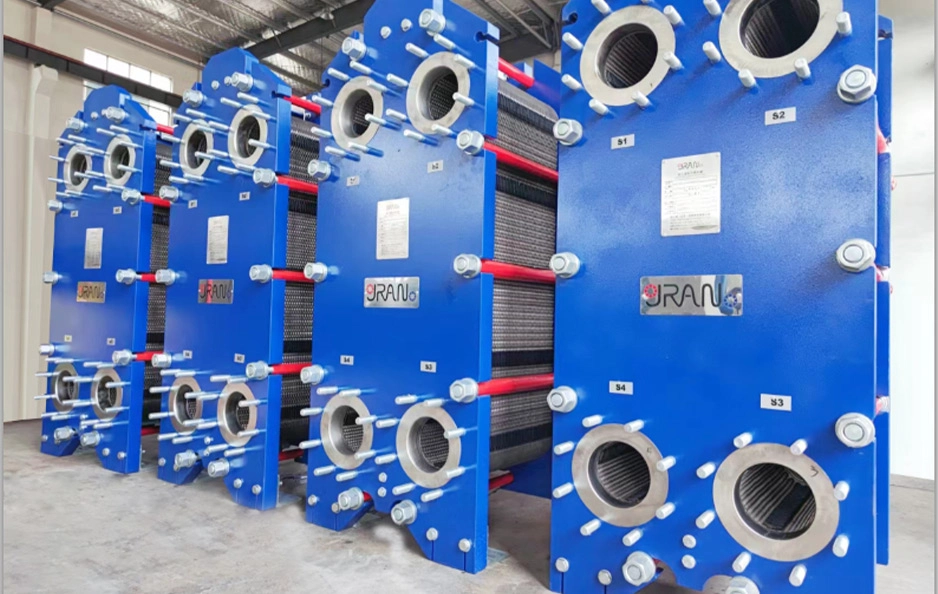
The Grano Plate Heat Exchanger uses corrugated plates, gaskets, frame plates, guide rods, and clamping bolts. Gaskets separate the two fluids. You can release the bolts, open the pack, clean deposits, and replace individual parts without removing all connected pipework.
Fully Welded Construction
The Grano Fully Welded Plate Heat Exchanger removes interplate gaskets and seals the passages by welding. Published data gives a limit of up to 300°C and 40 bar. The design keeps full countercurrent flow and comes in non-detachable, single-side detachable, and double-side detachable forms.
| Selection Point | Gasketed Design | Fully Welded Design |
|---|---|---|
| Interplate seal | Elastomer gaskets | Welded passages |
| Published welded-unit limit | Not applicable | Up to 300°C and 40 bar |
| Routine access | Pack opens by releasing bolts | Depends on configuration |
| Main concern | Gasket age, fit, compression | Weld, plate, and corrosion condition |
| Capacity changes | Plates may be added or removed | Less flexible after fabrication |
Remaining Leak Paths
Welding removes the long gasket perimeter, but a cracked plate, poor weld, wrong alloy, or severe corrosion can still cause failure. “Leak-free” sounds tidy in a meeting, but it is not a design calculation.
Which Design Better Prevents Furnace Loop Leaks?
For hot, cycling service, the fully welded option usually has the edge. No interplate elastomer means no gasket hardening, swelling, shrinkage, or blowout between plates.
High-Temperature Duty
Choose the welded option when your loop has high fluid temperature, frequent starts, or sharp load changes. It fits clean thermal oil, hot process water, and heat-recovery circuits where opening the unit is uncommon.
Gasket Compatibility
A gasketed design works well when the seal matches the fluid. These reference ranges come from Grano’s supplied technical material. They are not automatic equipment ratings; pressure, concentration, exposure time, and exact grade still matter.
| Gasket Material | Reference Range | Typical Direction |
|---|---|---|
| Nitrile rubber | -20°C to 135°C | Oil-related general duty |
| EPDM rubber | -50°C to 180°C | Water and selected chemicals |
| Fluororubber | -50°C to 250°C | Heat, oil, acids, and alkalis |
| Neoprene | -20°C to 150°C | General oil-resistant duty |
| Silicone rubber | -65°C to 230°C | Low temperature and dry heat |
Practical Verdict
A fully welded heat exchanger is the best option if a leak would result in a shutdown of production and the fluid is reasonably clean. A gasketed Plate Heat Exchanger is best when frequent mechanical cleaning is required, fast change-out of plates is necessary or future expansion is anticipated. Note that furnace chamber temperature is NOT the same as exchanger inlet temperature. Report actual fluid temperature.
When Is a Gasketed Design Still Better?
A welded unit that cannot be cleaned for your service may still be a poor purchase.
Heavy Fouling
Dirty or scale-forming fluid may require direct plate access. A gasketed pack lets you remove deposits and replace only damaged parts.
Flexible Heat Duty
Plate count can change when production rises or outlet targets move. This helps staged furnace projects, especially when the first heat-duty estimate was, well, a little optimistic.
Controlled Maintenance
Reliable service needs clean gasket grooves, correct plate order, even bolt tightening, and a recorded compression length. Grano’s procedure also calls for pipe flushing before start-up and a 30-minute pressure hold after reassembly, with no pressure drop before reconnection.
What Should You Specify Before Buying?
Heat-transfer area alone is not enough. Include normal and upset conditions.
Temperature, Pressure, and Flow
Provide inlet temperatures, outlet targets, flow rates, working and design pressure, allowable pressure drop, and start-stop frequency.
Fluid and Fouling Data
List fluid name, concentration, pH, chlorides, solids, viscosity, oil content, and cleaning chemicals.
Site Requirements
Give nozzle sizes, footprint limits, maintenance space, shutdown intervals, and future expansion plans.
Why Choose Grano for a Furnace Loop?
Grano can compare both constructions instead of forcing one answer. For moderate-temperature loops that need regular access, its gasketed model offers compact heat transfer, adjustable plate count, low pressure loss, and direct servicing. For hotter circuits, its fully welded model removes gasket aging from the plate pack and carries published limits up to 300°C and 40 bar.
Send the fluid names, flow rates, temperatures, pressure data, fouling risk, and cleaning plan. The right Plate Heat Exchanger keeps your furnace loop stable without turning each shutdown into repair work.
FAQ
Q1: Can a gasketed heat exchanger be used in a furnace loop?
A: Yes. It suits moderate temperatures, compatible fluids, and systems that need regular opening. Grano can match the gasket to your data.
Q2: Does a fully welded unit remove every leak risk?
A: No. It removes interplate gasket leaks, but corrosion, plate cracks, weld defects, and poor installation can still cause failure.
Q3: What data is needed to select a Plate Heat Exchanger?
A: Provide both fluids, flow rates, temperatures, working and design pressure, allowable pressure drop, fouling risk, and cleaning method.


