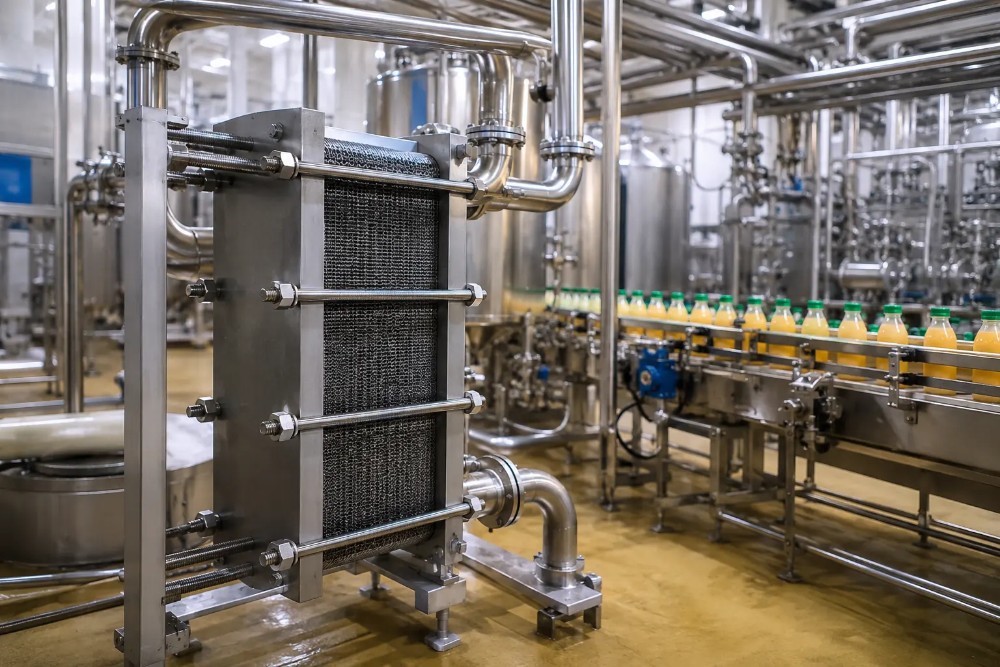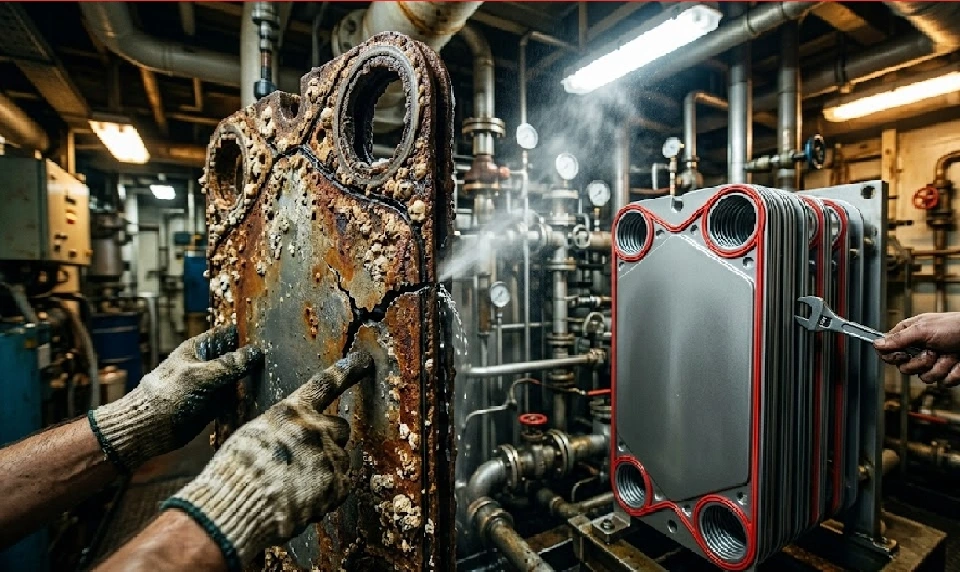

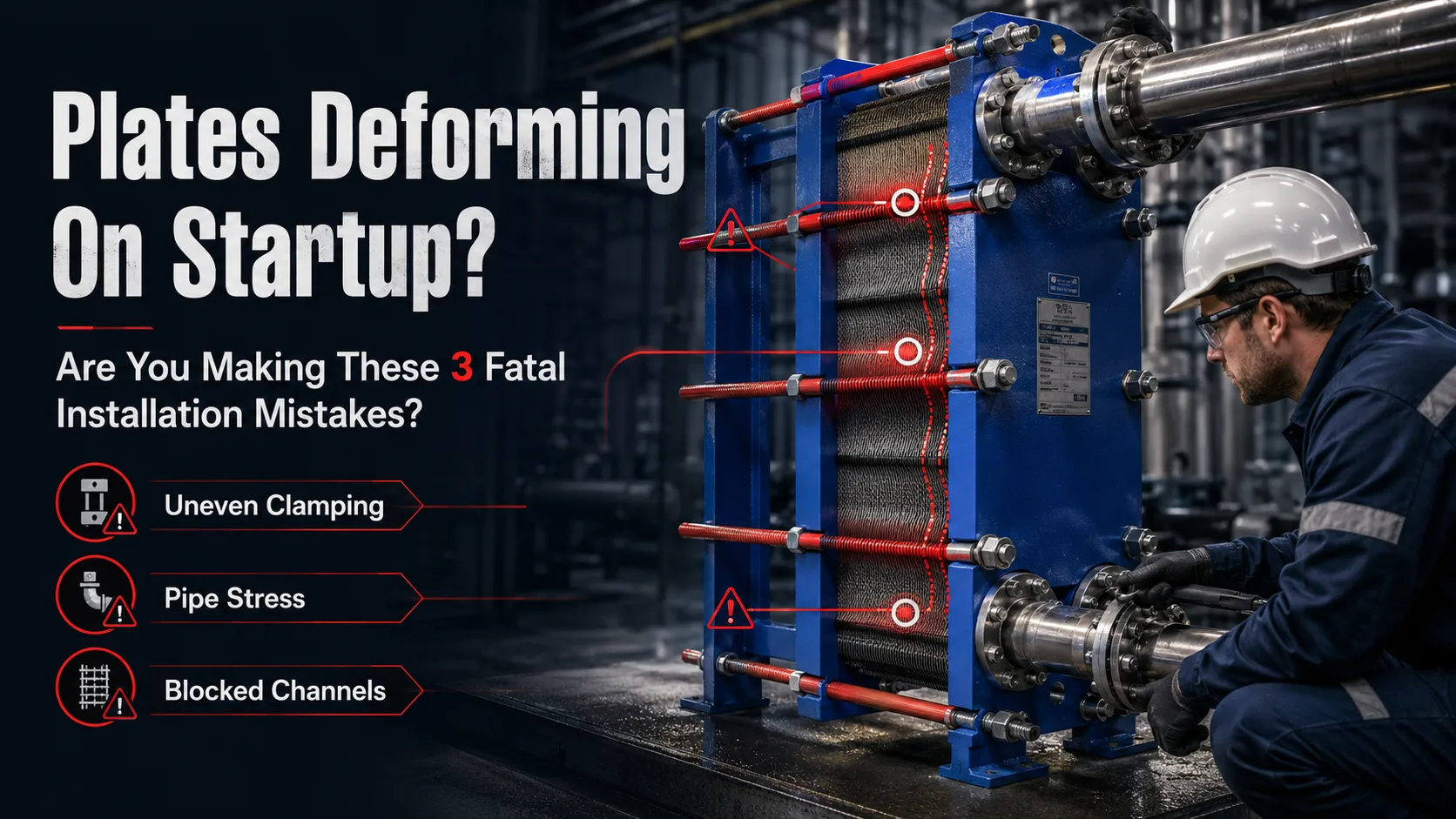
A freshly cleaned plate pack should restart smoothly. When startup ends with heavy leakage, crushed corrugations, and twisted plates, the failure usually points to installation discipline, not just equipment age.
Grano is a heat exchanger specialist established in 2015, focused on detachable plate heat exchangers, plates, gaskets, and maintenance service. Its product range covers gasketed units, semi-welded units, brazed heat exchangers, shell and tube heat exchangers, and spare parts for industrial use. For maintenance teams, EPC contractors, and plant buyers, the value is practical: correct plate matching, gasket selection, cleaning support, and a team that knows how plate packs behave after real service, not only on a sales sheet.
The Startup Failure That Turns Cleaning Into Scrap
A common failure pattern starts after cleaning. The plates are removed, washed, fitted with gaskets, and stacked back into the frame. The pump starts. Then leakage appears fast. After shutdown and disassembly, the plate group is no longer flat. Some plates show large physical twisting. Some corrugations are flattened. In severe cases, plates bite into each other and cannot return to service.
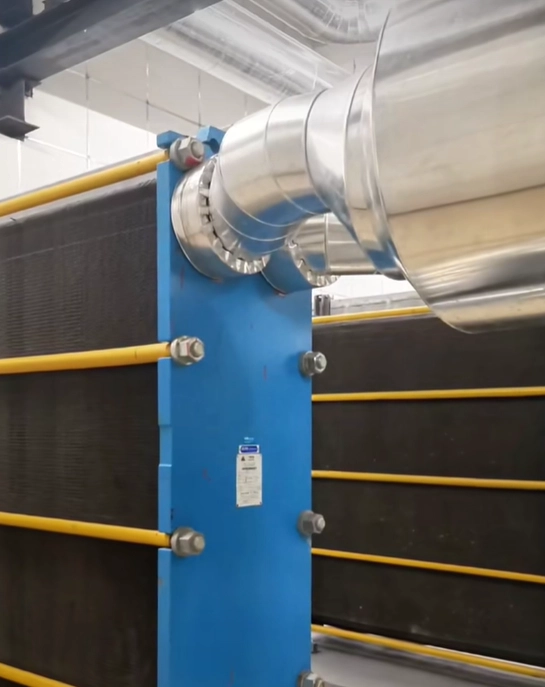
That kind of failure is expensive because it wastes more than one gasket set. It can destroy plates, delay production, and force urgent replacement. A Plate Heat Exchanger relies on thin corrugated plates, gaskets, clamping plates, guide rods, and bolts working as one controlled assembly. The official product description states that gasketed plate heat exchangers use corrugated metal plates with corner ports, a fixed plate, a movable clamping plate, clamping bolts, and gaskets that separate the two fluids into alternate channels. The corrugated surface increases turbulence and creates structural support points for pressure difference resistance.
Leakage After Pump Start
Leakage right after startup often has a simple root: the gasket is not compressed evenly. The knowledge base lists uneven clamping bolts, excessive plate deformation, aging gaskets, uneven gasket thickness, and off-center gasket compression as common causes of leakage after plate replacement.
Small leaks during commissioning are not small news. They are early warnings. A small drip can mean one side of the frame is tighter than the other. It can also mean the gasket has moved out of the groove. Once the pump keeps running, the thin metal plates carry extra local stress.
Twisted Plate Groups
A twisted plate group usually means the pack was forced into a bad shape before pressure arrived. During assembly, clamping studs should be tightened evenly and symmetrically to keep plates parallel. The same source also says the correct installation direction must be followed to avoid heat exchange loss.
This is not a “nice-to-have” rule. Parallel plates create even channels. Crooked plates create uneven channels, then the flow pushes harder on the weak side.
Crushed Corrugations
Corrugations are not decorative. They increase rigidity, raise turbulence, and form contact points across the plate pack. The knowledge base explains that cross-corrugation creates thousands of staggered contact points, allowing fluid disturbance, high heat transfer, and pressure-bearing capacity.
When the pack is over-compressed, those contact points can pass their physical limit. The corrugations collapse. After that, sealing pressure does not improve. It gets worse. The plate has already lost its designed geometry.
Fatal Mistake 1: Over-Tightening the Bolts
The most dangerous myth is simple: tighter bolts mean better sealing. In plate heat exchanger work, that shortcut damages equipment. A gasket needs controlled compression. A plate needs its corrugation depth. A frame needs parallel force. More force is not better after the correct A-dimension is reached.
The service support path matters here because many failures happen during cleaning, regasketing, and recommissioning. A service job should not end with guesswork. It should end with measurement, torque control, and a pressure test.
Ignored A-Dimension
Every plate heat exchanger has a designed clamping dimension. Many technicians call it the A-dimension or tightening length. If that length is ignored, the plate pack may be crushed past the depth of the corrugations. Once plastic deformation starts, the damage is permanent.
The knowledge base gives a clear maintenance rule: before disassembling the plate heat exchanger, first measure the compression length of the plate bundle and record it. During reassembly, the bolts should be tightened evenly to the tightening length, and the exchanger should pass an overall pressure test before use.
That record is not paperwork for paperwork’s sake. It is the difference between controlled compression and “tight until it stops leaking,” which is a bad habit in many pump rooms.
Uneven Diagonal Force
If one side is tightened first, the movable clamping plate can tilt. The plates then slide, twist, or pinch at the flow distribution zone. A star-cross tightening sequence helps spread force across the frame.
For large plate models, such as VT80-class replacement work, a practical field rule is to check top, bottom, left, and right dimensions repeatedly. Keeping deviation near 1 to 2 mm is a sensible maintenance target when the frame and plate pack allow it. Use calipers. Use a torque wrench. A steel ruler and a “good feeling” are not enough.
Wrong Tool Choice
Impact wrenches are fast, but speed can hide uneven force. Manual tightening with a torque wrench takes longer. It also saves plates. For larger frames, synchronized tightening by two workers on opposite bolts is safer than one worker chasing bolts around the frame.
A small note from real maintenance life: the worker who tightens fastest is not always the worker who saves the most money.
Fatal Mistake 2: Wrong Plate Arrangement
Plate heat exchangers depend on correct plate order. A/B plate arrangement creates alternating channels and proper corrugated contact. If the order is wrong, the support pattern changes. The unit may still close, but it is no longer assembled as designed.
The product is compact and easy to disassemble, which is one of the reasons it is widely used in HVAC, industrial cooling, food processing, petrochemical systems, heating, metallurgy, chemicals, and pharmaceuticals. But easy disassembly also means reassembly mistakes are possible when markings are poor or plates are stacked in a rush.
A/B Plate Pairing Errors
The knowledge base states that herringbone heat exchange plates are divided into A plates and B plates. During installation, A and B plates must be arranged crosswise. “AA” and “BB” arrangements are not allowed.
This rule is vital. Two plates with the same pattern may fail to create the right cross-support. When fluid pressure enters, the plate can deflect inward. In bad cases, it collapses fast.
Blind Plate and Flow Zone Mistakes
A blind plate or special plate placed in the wrong position can block a path or force the medium into the wrong channel. The symptom may look like pump trouble: pressure drop rises, outlet temperature misses the target, and the exchanger feels “tight” during operation.
The knowledge base notes that corner holes act as connecting channels and the working medium passes through narrow, tortuous channels between plates. That narrow path is what makes the equipment efficient. It also punishes wrong plate order quickly.
Missing Plate Cleaning Before Assembly
Plates should be clean before assembly. The gasket groove and corrugated surface should have no dirt. If adhesive is used, gaskets must not twist or loosen. If non-adhesive fixing is used, gaskets still must not deviate from the plate groove.
A bit of old glue under a gasket can shift compression. A grain of hard scale on the corrugation can create a pressure point. It sounds minor. It is not minor once the bolts close the pack.
Fatal Mistake 3: Dirty Flow Channels and Pipe Stress
Even when the plate pack is assembled correctly, startup can still damage it if the piping and flow path are dirty or stressed. Plate heat exchangers are efficient because their channels are narrow. That same feature makes them sensitive to debris, welding slag, gravel, scale, and bad water quality.
Before commissioning, the connecting pipes should be cleaned. The knowledge base warns that sand, gravel, welding slag, and other debris can enter the exchanger and cause blockage. It also says the inlet and outlet pipes for hot and cold media should connect in the direction specified on the factory nameplate.
Blockage From Welding Slag
Welding slag trapped in a channel reduces flow area. Pressure drop rises. Flow distribution becomes uneven. Then some plates carry more pressure difference than others.
The knowledge base lists gradually rising pressure drop as a common fault caused by unclean media, too many particles, debris, scaling, or blocked flow channels.
Scale After Poor Water Treatment
Poor water treatment leaves calcium, magnesium, and carbonate deposits on the heat transfer surface. After heating, they form hard scale such as calcium carbonate and magnesium hydroxide. Scale has poor thermal conductivity, so it wastes heat and reduces transfer performance.
|
Failure Signal |
Likely Cause |
What It Means During Startup |
|
Fast Leakage |
Uneven Bolts or Gasket Shift |
The Plate Pack Is Not Compressed Evenly |
|
Twisted Plates |
Diagonal Force or Wrong Sequence |
The Frame Closed Crookedly |
|
Flattened Corrugations |
Over-Compression Past A-Dimension |
The Plate Geometry Is Damaged |
|
Rising Pressure Drop |
Debris, Scale, or Blocked Channels |
Flow Is No Longer Even |
|
Poor Outlet Temperature |
Wrong Plate Order or Wrong Pipe Direction |
The Designed Flow Path Is Broken |
External Pipe Load
The exchanger should not carry pipe weight. Installation guidance states that the equipment should not be deformed, fasteners should not be loose, and lifting ropes must not hang on connecting pipes, positioning beams, or plates. Enough space should be reserved around the exchanger for maintenance.
Pipe stress can pull the frame out of alignment. During startup, vibration from the pump then adds more movement. One bad bracket can ruin a good plate pack. Very unglamorous, very real.
Better Assembly Habits That Prevent Plate Damage
A good restart follows a repeatable SOP. Check the drawing. Confirm plate order. Clean grooves. Fit gaskets flat. Measure the tightening length. Tighten evenly. Flush the lines. Open valves slowly. Run a pressure test before handing the unit back to production.
The Plate Heat Exchanger product line is suitable for projects where compact size, high efficiency, easy maintenance, and modular expansion matter. Product data from the knowledge base lists customizable heat exchange area up to 5000 m², maximum working pressure up to 25 MPa, maximum operating temperature up to 200°C, and material choices such as stainless steel, titanium alloy, and carbon steel.
Measuring Before Tightening
Measure the A-dimension on all sides during tightening. Do not only check one point. Large frames can look closed while one corner is still ahead of the other. A caliper check is cheap. A full plate pack replacement is not.
Matching Gaskets to Media
Gasket choice also affects startup safety. The gasket forms the channel gap and limits working temperature and pressure behavior. The knowledge base lists several common gasket materials and temperature ranges.
|
Gasket Material |
Typical Medium Range |
Operating Temperature |
|
Nitrile Rubber |
Oil-Resistant, General Conditions |
-20°C to 135°C |
|
EPDM Rubber |
Acid, Alkali, Salt, Chloride, Organic Solvent Conditions |
-50°C to 180°C |
|
Fluororubber |
High Temperature, Acid, Alkali, Oil, Reagents |
-50°C to 250°C |
|
Neoprene |
Oil-Resistant, General Conditions |
-20°C to 150°C |
|
Silicone Rubber |
Low Temperature and Dry Heat Resistance |
-65°C to 230°C |
A wrong gasket may pass a short cold-water test, then fail once heat cycles begin. That is annoying. It is also avoidable.
Choosing Technical Support Early
For replacement plates, gaskets, bolts, cleaning, and recommissioning advice, check the company background and available maintenance service before the shutdown window starts. Technical review before startup is usually cheaper than emergency repair after startup.
FAQ
Q1: Why Do Plates Deform Right After Startup?
A: Plates often deform because the pack was over-tightened, tightened unevenly, arranged in the wrong A/B sequence, or exposed to blocked flow channels. Startup pressure then turns the hidden mistake into visible damage.
Q2: Does Tighter Bolt Compression Stop Leakage Better?
A: No. Tighter is not always better. If compression passes the correct A-dimension, corrugations can flatten and plates can suffer permanent deformation. Correct compression beats brute force.
Q3: Why Must A and B Plates Be Arranged Crosswise?
A: Crosswise A/B arrangement creates the correct corrugated support and flow channel pattern. Same-pattern plates placed together may lose support points and collapse under pressure.
Q4: What Should Be Checked Before Reassembly?
A: Check plate order, gasket position, gasket groove cleanliness, corrugated surface cleanliness, tightening length, bolt condition, pipe direction, pipe cleanliness, and service clearance.
Q5: When Should You Replace Plates Instead of Reusing Them?
A: Replace plates when they have cracks, perforations, severe pits, heavy deformation, flattened corrugations, or corrosion. Reusing damaged plates may cause leakage, pressure drop, and medium mixing after startup.