



Within the sphere of complex industrial thermal processes, and specifically in the field of sanitary industries like dairy (HTST) products, pharmaceutical products, and fine chemicals, conventional single-pass heat exchangers are often not adequate to meet the requirements of complex multi-variable processes. When a process needs to have different stages for heating, cooling, and regenerating in a limited space, the Multi-Section (Multi-Stage) Plate Heat Exchanger (PHE) is the standard engineering solution.
This engineering overview outlines the structural, mechanical, and hydraulic aspects and design considerations related to the implementation of multi-section units, going beyond the basics to address engineering issues.
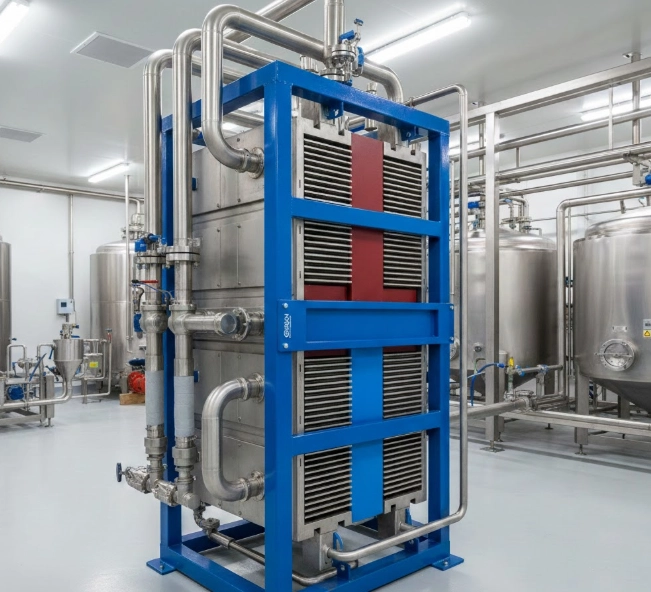
Structural Mechanics and Flow Configuration
Unlike single-pass units, a multi-section PHE integrates multiple thermal duties into a single frame. The defining component is the Intermediate Partition Plate (also referred to as the Connector Grid or Divider Plate).
The Role of the Connector Grid
The partition plate functions as a mechanical and hydraulic boundary within the plate pack. It serves two primary engineering functions:
- Flow Diversion:It utilizes internal porting (corners) to direct fluid into specific plate blocks (stages) or divert it to external piping for auxiliary loops (e.g., holding tubes, homogenizers, or separators).
- Differential Pressure Isolation:It physically separates process stages (e.g., separating the cooling section from the heating section), allowing for independent pressure profiles within the same frame.
Flow Logic
Through the strategic arrangement of partition plates and pass configurations, the PHE allows for:
- Regeneration:Product-to-product heat transfer where the outgoing heated fluid pre-heats the incoming cold fluid.
- Multi-Zone Processing:Sequential processing (e.g., Zone 1: Pre-cooling; Zone 2: Deep cooling with glycol) without external piping between stages.
Engineering Advantages in Process Integration
1. Thermal Regeneration and NTU Efficiency
In high-volume processing, the primary design objective is maximizing the Regenerative Efficiency (often exceeding 90-95% in modern HTST loops). A multi-section design permits the counter-current flow of raw and pasteurized product within a dedicated section. This drastically reduces the boiler steam and cooling medium load required for the subsequent heating and cooling sections.
2. Hydraulic Footprint Reduction
Consolidating three or four unit operations into a single frame reduces the skid footprint. More importantly, it minimizes the hold-up volume and reduces the equivalent length of interconnecting piping, thereby reducing the total system head loss and pump energy requirements relative to installing discrete exchangers.
Critical Design Considerations
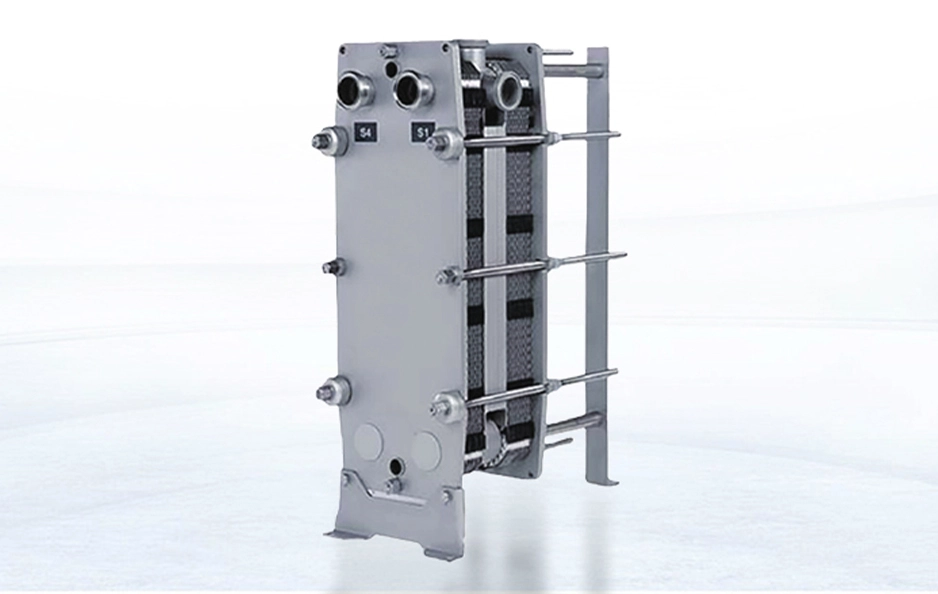
Designing a multi-section unit requires addressing specific hydraulic and mechanical constraints that are less prevalent in single-pass units.
1. Flow Maldistribution and Port Velocity
In multi-section units, fluids often enter and exit the plate pack through connector grids rather than the main frame ports. If the port diameter of the connector grid is undersized relative to the flow rate, it induces excessive port pressure drop. This leads to maldistribution across the plate width, which reduces the effective heat transfer coefficient (U-value) and creates potential fouling zones due to low shear stress.
2. Differential Pressure and Plate Flexing
The partition plate is subject to pressure from both sides. A critical failure mode occurs when there is a significant pressure delta between adjacent sections (e.g., a high-pressure heating section next to a low-pressure cooling section).
- Engineering Control:The partition plate thickness must be calculated to withstand the maximum differential pressure to prevent bending.
- Material Selection:Grano typically specifies 304 or 316L solid stainless steel blocks (often 40mm–60mm thick depending on frame size) to ensure mechanical rigidity.
3. Total System Pressure Drop (ΔP)
While multi-section units save space, the series arrangement of multiple passes significantly increases the total hydraulic resistance. Engineers must calculate the Total Dynamic Head (TDH) accurately. The sum of pressure drops across the regeneration, heating, and cooling sections, plus external loops (holding tubes), must not exceed the pump’s performance curve or the plate design pressure limit.
Case Study: Sanitary HTST Integration
Application: Continuous Milk Pasteurization
Design Configuration: 3-Stage Frame (Regeneration / Heating / Cooling)
Stage 1 (Regeneration): Incoming raw milk (4°C) is pre-heated in a heat exchanger by outgoing pasteurized milk (72°C).
Technical Note: This section is designed with a high NTU (Number of Transfer Units) to maximize energy recovery.
Stage 2 (Heating):Pre-heated milk is brought to the pasteurization setpoint of 72.5°C using hot water or steam.
Stage 3 (Cooling):The product is cooled to the storage temperature of 4°C using chilled water or glycol.
Result: The integration achieved an 85% regenerative energy saving. By utilizing a single frame, the facility eliminated the need for two intermediate balance tanks and associated transfer pumps.
Maintenance and Assembly Protocols
For maintenance engineers, the complexity of a multi-section PHE dictates strict adherence to assembly protocols.
- Plate Sequencing (The “Hanging Map”):Unlike simple units, multi-section exchangers often use different plate corrugations (Theta-High vs. Theta-Low) or materials in different sections. Reassembling the plate pack out of sequence changes the channel geometry, altering both thermal performance and pressure drop.
- A-Dimension Specification:Tightening the plate pack must be done to the specific A-Dimension (distance between pressure plates) provided in the GA drawing. Over-tightening can crush the connector grid gaskets; under-tightening causes inter-section cross-contamination.
- Gasket Compatibility:Different sections may utilize different gasket materials (e.g., EPDM for steam heating, NBR for cooling). Verification of material compatibility during changeouts is mandatory.
FAQ
Q: Can a multi-section unit be expanded post-commissioning?
A: Yes, provided the frame rail length (carrying bar) has available capacity. Expansion involves adding plate cassettes to specific sections. However, this alters the hydraulic resistance and thermal duty. A re-calculation of the port velocities and pressure drop is required to ensure the existing pumps remain adequate.
Q: Why is the pressure drop calculation critical in multi-section designs?
A: Multi-section units inherently involve longer flow paths and multiple flow diversions (turning losses) at the connector grids. Underestimating ΔP will result in reduced flow rates, failure to achieve turbulent flow (lower Reynolds number), and increased fouling rates.
Q: How is cross-contamination detected between sections?
A: Inter-section leakage is often subtle. It is detected via:
- Thermal anomalies:Unexplained temperature shifts in the cooling medium or product.
- Differential Pressure Testing:During maintenance, independent hydrostatic testing of each section (while adjacent sections are at atmospheric pressure) is required to identify partition plate seal failures.


