



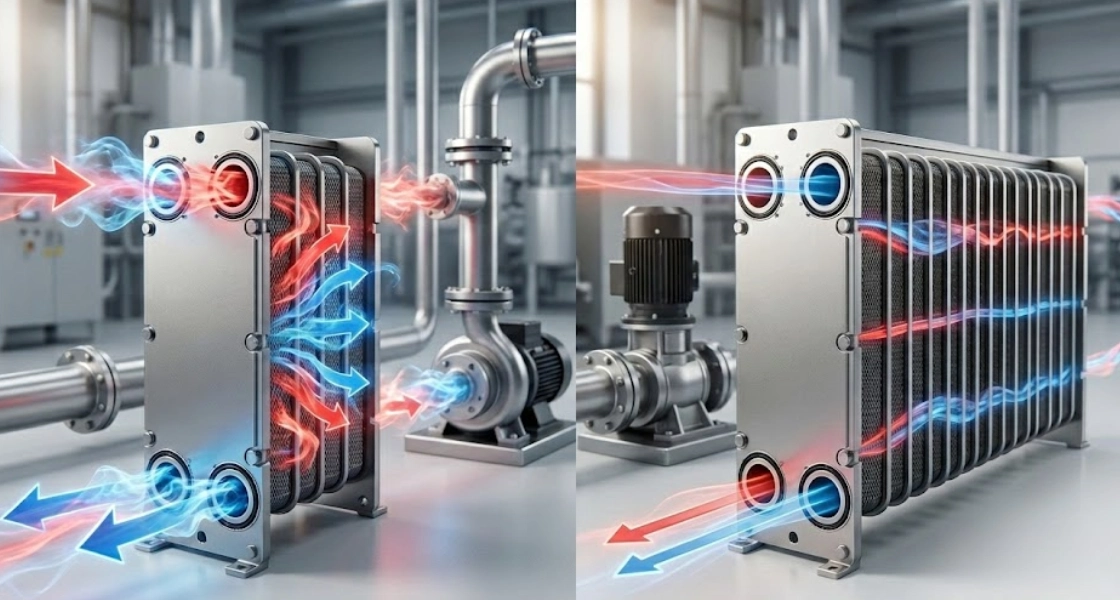
Within the realm of industrial thermal management, scaling up processes often necessitates upgrading existing equipment. For Plate Heat Exchangers (PHEs), their modularity offers a very convenient option in that additional plates can be added to the frame to increase the heat transfer surface. Such flexibility can be cited as a key reason why business-to-business clients in the chemical processing industries, HVAC industries, and industrial equipment manufacturers choose Grano PHEs.
However, for plant managers and engineers, there exists a rather intriguing problem. After investing in capacity expansion, the theoretical heat transfer surface can be increased. Yet in many instances, the actual heat transfer efficiency will be only marginally enhanced—or in some cases, efficiency will actually be reduced. What accounts for this occurrence? The answer can be attributed to the complex fluid dynamics at play in the system. In the following discussion, design errors, the relationship between flow rate and pressure drop, and the engineering considerations that need to be made prior to upgrading a plate heat exchanger will be discussed.
1. The Common Phenomenon of Efficiency Drop After Expansion
A gasketed plate heat exchanger is designed to be adaptable. In theory, increasing the number of plates directly increases the surface area (A) available for heat exchange. According to the foundational heat transfer formula:
Q = U · A · ΔT_lm
where Q is the total heat load, U is the overall heat transfer coefficient, and ΔT_lm is the log mean temperature difference. Mathematically, increasing A should naturally result in an increase in Q.
Yet, in numerous industrial applications, operators report that after adding 20% or 30% more plates to their PHE frame, the exit temperatures fail to meet the new target specifications. This “expansion failure” phenomenon is incredibly common. The system simply fails to deliver the expected proportionate boost in thermal capacity, leaving facilities struggling to meet their production or cooling demands.
2. Common Design Mistakes During Expansion
The root cause of this paradox usually stems from a singular, critical design mistake: tunnel vision on surface area. Many project managers and maintenance teams focus entirely on increasing the physical heat transfer area while completely ignoring the hydraulic realities of the surrounding system.
A plate heat exchanger does not operate in a vacuum; it is a single component within a larger fluid circuit. When plates are added, the internal geometry of the PHE changes. If the expansion is planned without simultaneously evaluating the system’s total volumetric flow rate, channel flow velocity, and allowable pressure drop, the newly added plates cannot function optimally. The system becomes hydraulically unbalanced, meaning the impressive new heat transfer area is essentially wasted.
3. The Impact of Flow Rate Drop on Heat Transfer Efficiency
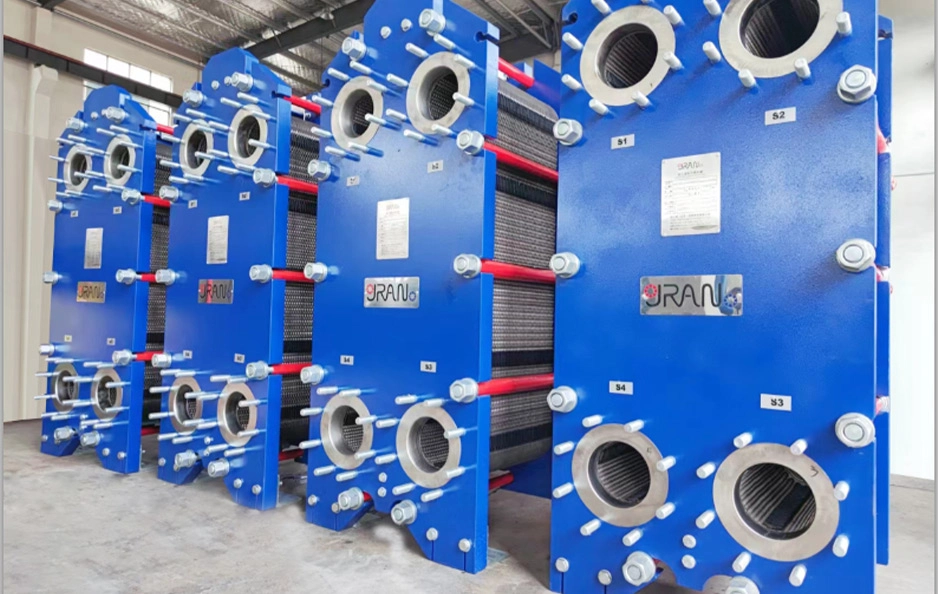
To understand why performance drops, we must look at what happens inside the channels. Plate heat exchangers achieve their world-class efficiency because the corrugated plate patterns create highly turbulent flow. This turbulence continuously disrupts the thermal boundary layer, maximizing the heat transfer coefficient ($U$).
When you add plates to a PHE without upgrading the system’s pump, the total volumetric flow rate remains roughly the same, but it is now divided among a greater number of parallel flow channels. Consequently, the fluid velocity within each individual channel decreases.
If the channel velocity drops below a critical threshold, the fluid flow transitions from highly turbulent to transitional or even laminar flow. When turbulence drops, the heat transfer coefficient plummets. In many cases, the severe reduction in the $U$-value completely cancels out the benefits of the increased surface area.
Table 1: Impact of Capacity Expansion on Channel Velocity and System Efficiency
|
Total System Flow Rate |
Number of Plates |
Channel Flow Velocity |
Flow Regime |
Heat Transfer Coefficient (U) |
Actual Heat Transfer Capacity |
|
150 m³/h |
100 (Baseline) |
0.45 m/s |
Highly Turbulent |
5,200 W/(m²·K) |
100% (Baseline) |
|
150 m³/h |
130 (Expanded) |
0.34 m/s |
Moderate Turbulence |
3,900 W/(m²·K) |
~ 98% (Minimal Gain) |
|
150 m³/h |
160 (Over-Expanded) |
0.28 m/s |
Low / Laminar |
2,400 W/(m²·K) |
~ 75% (Efficiency Drop) |
(Note: Data is illustrative based on standard engineering dynamics for water-to-water heat transfer applications.)
4. The Impact of System Pressure Drop Changes
Another counterintuitive factor is pressure drop. Adding plates in a parallel configuration increases the cross-sectional area for the fluid to pass through, which generally decreases the overall pressure drop ($\Delta P$) across the heat exchanger.
While a lower pressure drop is usually desirable for saving pump energy, a drastic reduction can cause systemic issues. Centrifugal circulation pumps are selected based on specific system resistance curves. If the equipment pressure drop becomes too low, the pump may run out on its curve, potentially failing to maintain the necessary head and stability. If the pump cannot maintain the original targeted flow rate under the new low-resistance conditions, the entire system’s hydraulic balance is thrown off, directly crippling the overall heat exchange capacity.
Case Study: Industrial Chemical Plant Expansion Setback
In a recent industrial scenario, a chemical processing plant attempted to increase the cooling capacity of their reactor by expanding their existing titanium plate heat exchanger. They added 40% more plates to handle a projected production increase. However, because the existing pumps relied on a specific backpressure to maintain steady volumetric flow, the sudden drop in equipment resistance caused the pump to operate inefficiently. The channel velocity dropped by nearly half, causing rapid fouling in the chemical lines and ultimately reducing the total heat exchange efficiency by 15%. It was later determined that redesigning the flow arrangement and adjusting the pump impeller were required to utilize the new plates effectively.
5. Limitations of Piping Systems on Expansion Effects
Even if the pump is addressed, the existing piping infrastructure often serves as a severe bottleneck. The pipes, valves, and fittings connected to the PHE were originally sized for a specific maximum flow rate.
If an operator attempts to push more fluid through the system to maintain high channel velocity in the newly expanded PHE, the legacy piping may restrict this flow. Small pipe diameters create immense friction losses at higher velocities. Therefore, the valves and piping capacity will throttle the system, making it physically impossible to deliver the necessary flow to fully utilize the newly added heat transfer surface area.
6. Comprehensive Factors to Consider When Expanding PHEs
Before purchasing additional plates and gaskets, facility managers and engineers must look beyond surface area. A successful capacity expansion requires a holistic hydraulic and thermal review. Key factors to comprehensively consider include:
- Flow Conditions:Can the current system deliver the required total volumetric flow to support additional channels?
- Allowable System Pressure Drop:How will adding plates alter the resistance, and how will your existing pumps react to this new pressure profile?
- Flow Velocity Range:Will the fluid velocity inside the expanded channels remain high enough to sustain the necessary turbulence and prevent rapid fouling?
- Piping Structure:Are the existing inlet and outlet pipes, as well as the port hole sizes on the fixed frame, large enough to accommodate an increased flow rate without causing excessive localized pressure drops?
7. Engineering Advice from Grano
At Grano, our philosophy is that equipment upgrades must align with system realities. Our primary engineering advice is this: Never attempt to increase heat transfer capacity solely by adding plates to a frame.
Before any expansion, conduct a comprehensive re-evaluation of your entire system’s operating conditions. Calculate the updated channel velocities, check the pump curves against the revised pressure drop, and check the pipe limits. In some cases, increasing the capacity may not require more plates but may require a change in the corrugation angle to increase turbulence and pressure drop without changing the physical size. Consult with veteran thermal engineers to help you implement the increase in performance required by your B2B business model.
FAQ
Q: Can I expand my plate heat exchanger indefinitely as long as the frame is long enough?
A: No. Even if your carrying bar and frame have extra space, expansion is limited by your port hole size, piping capacity, and pump specifications. Adding too many plates will drop the channel velocity to a point where turbulence is lost, severely reducing the heat transfer coefficient and potentially causing rapid fouling.
Q: How do I know if my efficiency drop is due to flow rate issues or just dirty plates?
A: While fouling is a major cause of efficiency loss, a drop immediately following a capacity expansion is almost certainly hydraulic. If the pressure drop across the exchanger is significantly lower than before the expansion, but temperatures are not being met, the channel velocity has likely dropped too low.
Q: Does Grano provide engineering support for capacity expansions on existing units?
A: Yes. Grano specializes in providing professional thermal solutions. We don’t just supply replacement plates and gaskets; we help evaluate your current system’s flow rate, pressure drop, and thermal requirements to design an expansion strategy that genuinely improves performance.


