



In the bustling world of heat management, the Brazed Plate Heat Exchanger (BPHE) is widely loved for its small size, amazing heat transfer skills, and its ability to handle very high pressures. However, these great strengths come with a hidden weakness: a very delicate and sensitive internal setup. At Grano, we often remind our partners that a BPHE is only as good and reliable as the liquid flowing through its heart.
If you don’t have the right filtration system, even the most modern and expensive Grano heat exchanger can fall victim to nasty clogging, lower efficiency, and broken parts that cannot be fixed. In this long guide, we will look into why filtering is basically the “life insurance” for your BPHE and how to pick the best tools to keep your money safe.
 p
p
Why Brazed Plate Heat Exchangers Demand Superior Filtration
Unlike the older gasketed plate heat exchangers, which you can pull apart and scrub by hand with a brush, a brazed plate heat exchanger is a forever-sealed box. The metal plates are stuck together in a vacuum furnace using copper or nickel. This creates a single, solid block that gives you absolutely no way to reach the inside for a physical cleaning.
1. The Narrow Channel Challenge
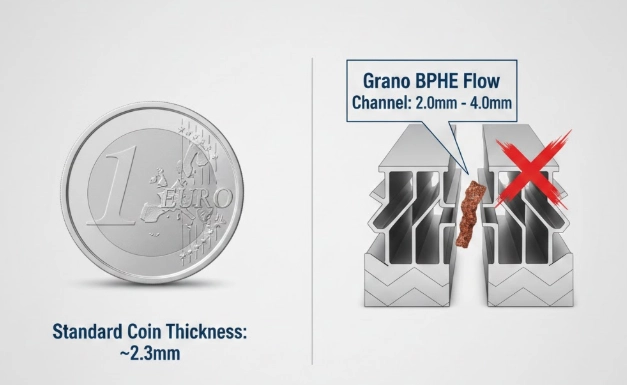
The inside paths where the water flows in a BPHE are incredibly tight. Usually, these gaps stay between 2.0mm to 4.0mm. While this tightness helps create the fast, messy water movement (called turbulence) needed for great heat exchange, it also means that even a tiny bit of trash can act like a giant wall. These bits catch other particles, quickly leading to a total block that stops the whole machine.
2. The “No-Clean” Trap
Once a BPHE is filled with solid dirt or stringy materials, the usual cleaning methods—like pumping chemicals through (CIP)—often fail completely. This happens because the cleaning liquids simply cannot reach the deep center of the clog. If the blockage is really bad, you have to throw the whole unit away and buy a new one. This leads to massive costs and stops your business from running for a long time.
The Golden Rule: Filtration Accuracy vs. Channel Width
The most frequent error people make when building a system is picking a random, cheap filter without looking at the actual shape of the heat exchanger inside.
The Main Rule: The holes in your filter screen should be no larger than 1/2 to 1/3 of the size of the gap inside the heat exchanger. For a normal Grano BPHE, a filter with a precision of 16 to 40 mesh (about 0.4mm to 1.0mm) is usually the best choice for safety.
Quick Reference for Filter Sizing
|
Heat Exchanger Type |
Typical Channel Gap |
Recommended Filter Precision |
|
Micro-Channel BPHE |
1.0 – 2.0 mm |
60 – 80 Mesh (≤ 0.25 mm) |
|
Standard BPHE |
2.5 – 4.0 mm |
20 – 40 Mesh (0.4 – 0.9 mm) |
|
Large Flow BPHE |
> 4.0 mm |
16 – 20 Mesh (1.0 – 1.2 mm) |
Choosing the Right Filter Type for Your System
At Grano, we suggest different ways to filter based on how much water you move and how often you want to clean the parts:
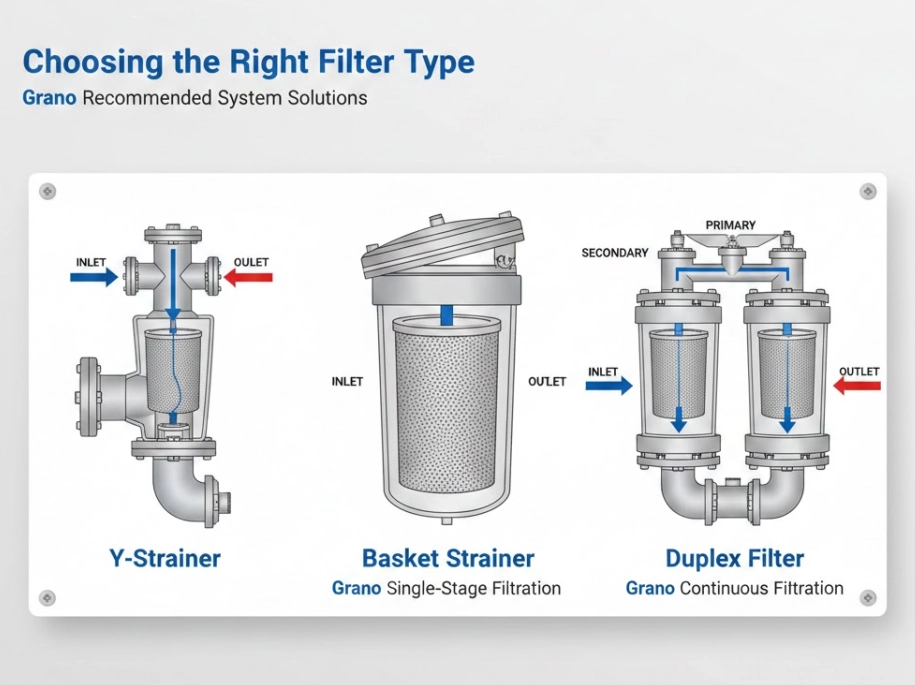
1. Y-Type Strainers (The Basic Start)
The Y-strainer is the most popular pick because it is cheap and fits into small spaces. It is great for small-flow systems where the water is mostly clean to start with. However, it cannot hold a lot of dirt. If you use it in a “dirty” system, like an open cooling tower, it will fill up too fast and cause trouble.
2. Basket Strainers (The Tough Worker)
For main loops or systems where a lot of water moves very fast, basket strainers are much better. They have a big “basket” inside that offers more room to catch trash. This means the water pressure stays high and you don’t have to stop and clean it every single day.
3. Duplex Filters (The Always-On Choice)
In very important jobs like big factories or data centers where you can never turn the power off, duplex filters are a must-have. They have two filter boxes with a special handle. You can switch the water to one side while you clean the other side, so the machine never has to stop working for even a second.
Installation Strategy: Location Matters
A filter put in the wrong spot is just as bad as having no filter at all. To keep your Grano BPHE safe, you should follow these smart installation steps:
- Stay Very Close:Put the filter as close to the BPHE entrance as you possibly can. This stops “new dirt”—like rust or old paint flaking off the pipes—from getting into the heat exchanger after the water was already cleaned.
- Check Both Sides:If both the hot and cold water could be dirty, you must put a filter on both sides. Many people forget that both sides of the plate can get clogged.
- Watch the Pressure:Always put a pressure gauge before and after the filter. If the pressure on the second gauge starts to drop, it is a loud “alarm” telling you that the filter is full of gunk. You need to clean it before the heat exchanger gets hurt.
Case Study: Preventing Failure in a District Heating System
A big building project in Europe noticed that their heat was dropping by 30% only four months after they started. They were using high-quality brazed plate heat exchangers but they only used simple 2.0mm Y-strainers to protect them.
The Problem: When the engineers looked inside, the BPHE entrances were totally blocked with tiny black iron dust and leftover sand from the building construction. These tiny bits were small enough to go right through the big 2.0mm holes in the strainer.
The Grano Solution:
- New Parts:The dirty, blocked units were swapped out for fresh Grano high-efficiency BPHEs.
- Better Filters:The old strainers were thrown away and replaced with 5mm (40 mesh) magnetic filters. These special filters are great because they use magnets to catch the tiny metal dust that is common in old iron pipes.
- The Result:The system started working perfectly again. When they checked it two years later, the inside of the heat exchanger was still perfectly clean.
Engineering Recommendations for Long-Term Reliability
To make sure your Grano machine stays healthy for its full 15 or 20-year life, we have a few extra tips:
The Importance of the First Flush
Before you turn on a brand-new system for the first time, you must flush the pipes. Do not let the water go through the BPHE during this time. Use a bypass pipe to wash out all the leftover metal bits from welding, dirt, and dust. If you don’t do this, all that construction trash will go straight into your Grano unit on day one.
Checking the Water Quality
Keep a close eye on the water itself. You should check the pH levels and how much salt or “hardness” is in the water. While filters stop solid rocks and dirt, chemical testing stops “scale” (hard white crust) from growing on the plates.
Automatic Cleaning Options
If you run a very busy factory, you might want to look into automatic backwash filters. These smart machines clean themselves out using the water pressure, so your workers don’t have to open them up and clean them by hand. This saves a lot of time and prevents human mistakes.
Conclusion
For any brazed plate heat exchanger, a filter is not just a “nice thing to have.” It is a vital part of the whole system that you cannot skip. By choosing a filter with the right sized holes and making sure you clean it often, you ensure that your Grano equipment stays strong and works perfectly for a very long time.
FAQ
Q: Can I just use a regular 20-mesh strainer for every Grano heat exchanger?
A: Not always. While a 20-mesh screen (about 0.9mm) is very common, some special Grano heat exchangers have very tiny paths as small as 1.5mm. For those, you really need a 40-mesh or even a 60-mesh filter. If the holes are too big, the trash will get stuck inside the plates instead of in the filter.
Q: If my water is in a “closed loop” that stays inside the pipes, do I still need a good filter?
A: Yes, you definitely do. Even in closed systems, the pipes can rust on the inside, and pumps can shed tiny metal bits as they wear down over the years. Also, if the water gets hot, “scale” can flake off. A good filter will catch these “hidden” pieces of trash before they cause a blockage in your BPHE.
Q: How can I tell exactly when I need to stop and clean my filter?
A: The best way is to look at the pressure gauges. You should check what the pressure is when the filter is brand new and clean. Once the pressure difference between the inlet and outlet grows by 0.5 to 1.0 bar, it means the filter is getting full of dirt. You should clean it right away to keep the water moving smoothly through your Grano system.


