



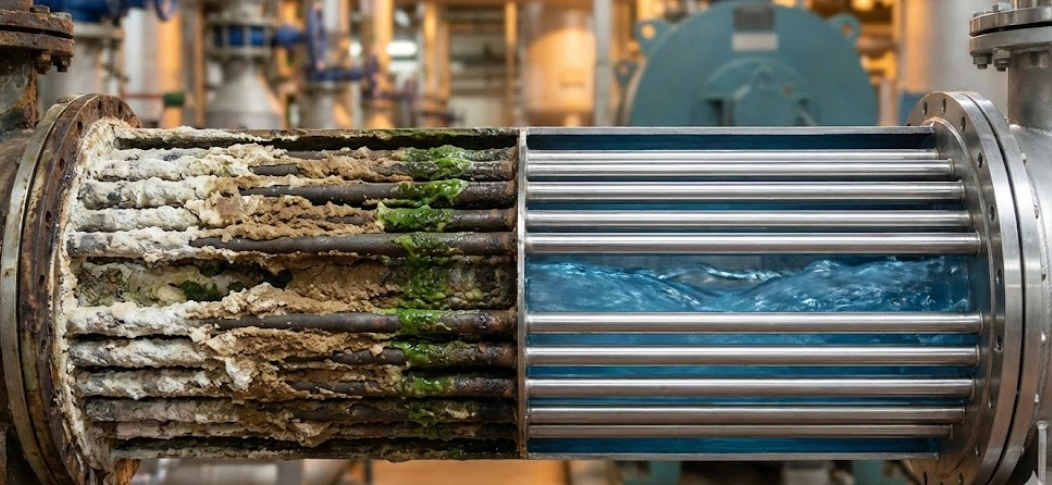
Introduction: The Hidden Cost of the “Energy Thief”
In the busy world of industrial processing, there is a quiet problem that ruins efficiency, makes energy bills go up, and forces factories to stop working when they do not want to. This problem is called Fouling.
For the people who manage huge petrochemical plants, complex HVAC systems, or food processing lines, the Shell and Tube Heat Exchanger (STHE) is basically the heart of the whole operation. When that heart gets clogged up, the money you lose happens almost immediately. It is not just a small annoyance; it is a major financial drain. According to recent reports from around the world, heat exchanger fouling costs industrialized nations roughly 0.25% of their total GDP every single year. That is a massive amount of money just vanishing because of dirty pipes.
Even more scary is how little dirt it takes to cause a problem. A layer of fouling that is just 0.6 mm thick can increase the fuel you need to burn by up to 40%. Imagine paying 40% more for gas in your car just because the engine was a little bit dusty; that is exactly what is happening in factories right now.
At Grano, we understand that a heat exchanger is only good if it can stay clean and keep running. If it clogs up every week, it is not an asset; it is a liability. With more than ten years of experience in designing high-efficiency thermal solutions, we help clients in over 40 different countries fight these exact challenges. We have seen everything from slime to rock-hard scale, and we know how to fix it.
In this detailed guide, we are going to break down the 5 most common reasons why fouling happens and give you real engineering strategies to stop them before they ruin your budget.
The Real Cost of Fouling: By the Numbers
Before we go into the causes, let’s first quantify what is at stake. Fouling is like wearing a thick winter coat in the tubes of a heat exchanger. It is a thermal insulator. The more insulation, the harder it is to push the heat through. The harder it is, the more it costs, and the more it spins the meter, especially with a pump or a boiler.
Table 1: Impact of Scale Thickness on Energy Consumption
| Scale Thickness (Inches) | Scale Thickness (mm) | Estimated Energy Loss (%) |
|---|---|---|
| 1/64″ | 0.4 mm | 4% |
| 1/32″ | 0.8 mm | 7% |
| 1/16″ | 1.6 mm | 11% |
| 1/8″ | 3.2 mm | 18% |
| 1/4″ | 6.4 mm | 38%+ |
Source: Derived from industrial boiler and heat exchanger efficiency data.
As you can see from the data above, even a tiny bit of buildup effectively “steals” your energy. You are paying for heat that never actually gets transferred. Now, let’s identify the bad guys causing this mess.
The 5 Common Causes of Shell and Tube Fouling
When we talk about fouling, it usually refers to one of five particular things happening within your tubes. The first step to fixing the problem is to determine which of these five things it actually is.
1. Crystallization (Scaling)
Think of Crystallization (Scaling) as the “clogged arteries” of a cooling system. It’s that same chalky, white gunk you find in old kettles, and it thrives wherever water gets hot.
The science is simple: water packed with dissolved salts (like calcium or magnesium) loses its “grip” on those minerals when the temperature rises. The salts solidify, sticking to the hot tubes and forming a stubborn, stony crust.
-
The Culprit: Cooling towers are the biggest offenders. Between the heat and the constant evaporation, minerals concentrate quickly, turning into a hard shell that kills efficiency.
2. Particulate (Sediment) Fouling
This type of fouling is a bit simpler to understand. It is basically dirt. Suspended solids—like sand from a river, rust from old pipes, silt, or dust from catalysts—float along in the water until they get tired and settle down.
Gravity pulls these heavy particles down to the bottom of the heat exchanger tubes. This usually happens when the water is moving too slowly. If the fluid velocity is not fast enough to sweep the dirt away, it piles up like a sand dune.
-
Critical Zone: In Shell and Tube exchangers, there are areas called “dead zones.” These are spots, usually near the baffles, where the water flow is very calm. Sediment loves these spots and builds up there quickly.
3. Biological Fouling
This one is exactly as gross as it sounds. Warm, wet environments are the perfect places for living things to grow. If your water has nutrients in it, bacteria, algae, and even tiny barnacles can start to live inside your heat exchanger.
These organisms attach themselves to the surfaces and grow a layer of slime, often called a “bio-film.” This slime is a terrible problem for two reasons. First, it is an excellent insulator, so it blocks heat transfer very well. Second, the bacteria can release acids that eat into the metal, causing Microbiologically Influenced Corrosion (MIC).
-
Common Scenario: This is a major headache for plants that use untreated river water or sea water for their cooling needs.
4. Corrosion Fouling
Sometimes, the problem comes from the tubes themselves. If the material of the tube reacts chemically with the fluid flowing through it, the metal can start to rust or corrode.
The product of this corrosion—like a layer of rust—builds up on the surface of the tube. This creates a double penalty for the plant manager. First, the tube wall gets thinner and weaker, which means it might leak or burst. Second, that layer of rust acts like a barrier that stops heat from moving efficiently.
-
Common Scenario: This happens often when processing acidic fluids using standard carbon steel tubes instead of upgrading to proper corrosion-resistant alloys.
5. Chemical Reaction Fouling
This type occurs when the fluid itself changes chemically because it got too hot. It is not dirt, and it is not rust; it is the fluid cooking onto the pipe.
A good example is in the oil industry. If you heat oil too much, it can “coke.” This means the hydrocarbons break down and leave behind a solid, carbon-based residue that looks like burnt sugar or tar. This usually happens because the surface temperature of the tube was too high for the fluid to handle.
-
Common Scenario: We see this constantly in oil refining and petrochemical processes where temperatures are pushed to the limit.
Proven Prevention Strategies
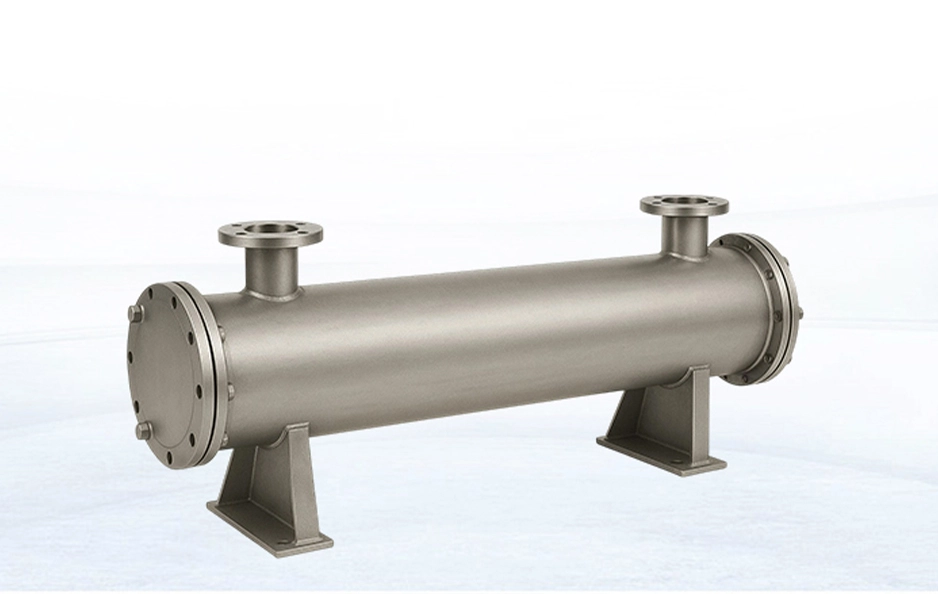
The bad news is that fouling cannot always be 100% eliminated. The good news is that it can be controlled and managed so it doesn’t ruin your business. Here is how expert engineering makes the difference.
1. Optimize Fluid Velocity (The “Scrubbing” Effect)
The speed at which your fluid moves is your first line of defense. You want the flow to be “turbulent,” which means it is mixing and moving chaotically, rather than smooth and slow. This turbulence creates a natural scrubbing action that washes particles away before they can stick.
-
Grano’s Approach: We design our Shell and Tube exchangers to keep the shear stress on the walls high. By carefully adjusting the space between the tubes and the cut of the baffles, we make sure the water keeps moving fast enough to clean itself, eliminating those stagnant areas where sediment likes to hide.
2. Strict Temperature Management
Since scaling and chemical reaction fouling are both caused by heat, avoiding excessive wall temperatures is the key to stopping them.
Tip: You need to monitor something called the LMTD (Log Mean Temperature Difference). Basically, if the metal skin of the tube gets hotter than the fluid can handle, fouling is guaranteed to happen. Keeping the temperature in the “safe zone” prevents the fluid from cooking onto the pipes.
3. Advanced Material Selection
Fighting corrosion fouling starts before you even turn the machine on. It starts with choosing the right metal. If your process involves aggressive fluids like chlorides or acids, standard steel is going to fail.
Grano Solutions: We offer custom manufacturing using high-grade materials such as Titanium, Hastelloy, and Stainless Steel (304/316). For example, if you are using seawater, Titanium tubes provide a defense that is almost impossible to penetrate. Barnacles and rust simply have a hard time sticking to it.
4. Smart Design & Dead Zone Elimination
Many standard “off-the-shelf” exchangers are not designed with your specific dirty water in mind. They often have poor baffle designs that create pockets where water stops moving.
Engineering Fix: By using helical baffles or optimizing the percentage of the baffle cut, we can ensure that the flow is distributed evenly across the whole shell. This leaves no quiet corners for solids to settle down and start causing trouble.
Case Study: Solving the “3-Month Clog” in a Petrochemical Plant
To show you how this works in the real world, let’s look at a recent project.
The Challenge:
A mid-sized petrochemical client came to us with a serious headache. They were struggling with a standard shell and tube oil cooler that was failing them constantly. The unit suffered from severe particulate fouling on the shell side. It got so bad that they had to shut down the entire line for cleaning every 3 months.
When we looked at it, we found the culprit immediately. The shell-side velocity was too low, and the baffles were spaced too far apart, allowing sludge to accumulate in the corners.
The Grano Solution:
Our engineering team analyzed their process data and proposed a custom STHE retrofit. We didn’t just sell them a new version of the old bad unit; we redesigned it.
-
Redesigned Baffle Pitch: We tightened the spacing between the baffles. This forced the fluid to move faster, ensuring the velocity stayed above the “critical settling velocity” of the sludge.
-
Material Upgrade: We replaced the rough carbon steel tubes with polished Stainless Steel 316. The smoother surface made it much harder for the sticky particulates to grab onto the wall.
The Results:
-
Extended Run Time: The maintenance interval jumped from 3 months to 14 months. That is nearly a year of extra production time without a shutdown.
-
Energy Savings: The client reported a 12% reduction in the energy needed to pump the fluid because the pressure remained stable.
-
ROI: The new unit paid for itself in saved maintenance costs within the first 8 months of operation.
Conclusion: Don’t Let Fouling Slow You Down
Yes, fouling does occur, but it does not necessarily need to break the bank. With the identification of the root cause, which can include scale, sediment, bio-growth, or corrosion, and the correct application of engineering principles, the lifespan of the equipment can be maximized.
At Grano, we don’t just supply heat exchangers; we engineer the correct solution for your fluid characteristics and requirements. Whether it is replacing existing fouled heat exchanger equipment or building a brand new plant, we are here to assist you.
Ready to optimize your thermal efficiency?
Contact Grano Today or reach us via WhatsApp for a quick consultation.
FAQ
Q: How often should I clean my shell and tube heat exchanger to prevent permanent damage?
A: Cleaning frequency is determined by the Fouling Factor of your fluid. The rule of thumb is: clean when the heat transfer coefficient (U value) drops 15-20%, or pressure drop increases 10%. Measure the temperature at the inlet and outlet to determine the best cleaning schedule for your equipment.
Q: Can Grano manufacture replacements for existing heat exchangers from other brands?
A: Yes. Grano offers high-quality substitutes for Alfa Laval, GEA, and APV equipment. We can replicate original dimensions for a drop-in replacement or redesign the internal bundle for better performance and fouling resistance, yet keeping the same external connections to avoid piping changes.
Q: Which material is best for preventing bio-fouling in seawater applications?
A: Titanium is the “gold standard” material for seawater service. It is resistant to chloride-induced corrosion. Its surface also inhibits bio-fouling to a strong extent, making it easier to clean less frequently compared to copper-nickel or stainless steel.


