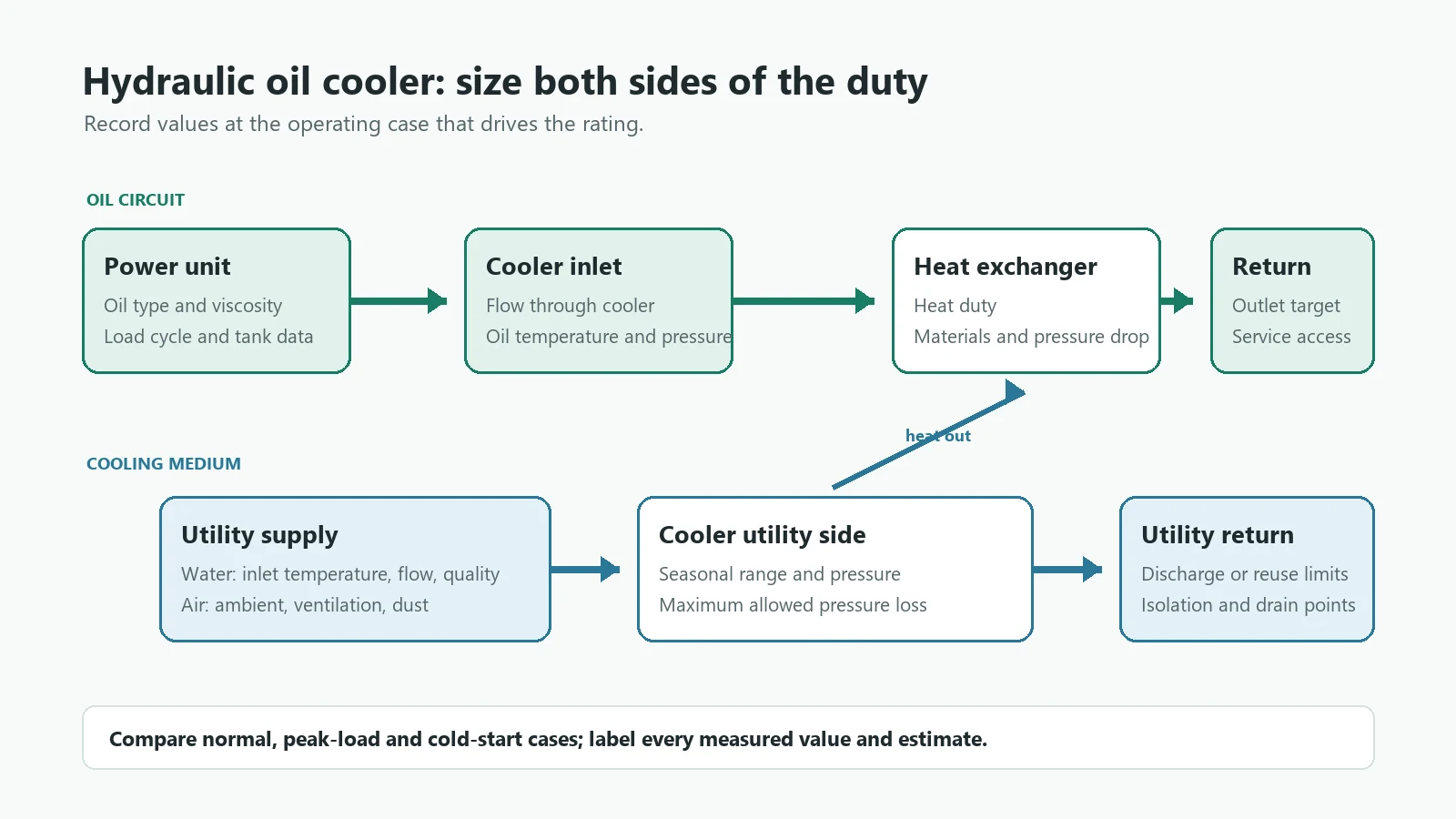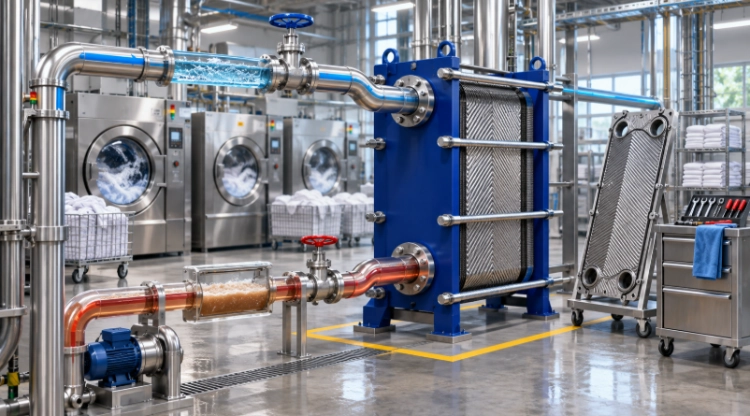

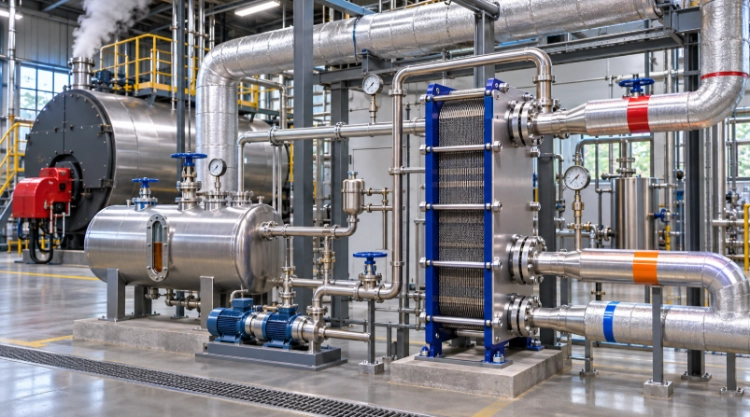
Hot condensate leaving a steam user is tempting. It looks like “free heat” for any cold water nearby. But the condensate is also treated boiler water, and its heat may already have a route home. Before pricing a plate exchanger, follow the return line to the receiver and boiler. A direct return can save makeup water and treatment as well as fuel. The U.S. Department of Energy’s condensate tip sheet explains why. If that return line is sound, the exchanger has to earn its place somewhere else in the system.
Sometimes direct return is off the table. The line may carry process contamination, or there may be a nearby water demand that can take heat from a separate stream. Vent steam and blowdown present other possibilities. Put these on separate drawings. Their temperatures may look similar while their pressures and phases are anything but.
In brief
- Preserve the value of clean condensate that can return to the boiler.
- Treat pumped liquid, flash steam and blowdown as different exchanger duties.
- Prove a real receiving-water demand before claiming annual heat savings.
|
Return condition |
First question |
Likely next step |
|
Clean liquid return |
Can it go back directly? |
Compare direct-return value before adding a plate unit |
|
Contaminated pumped stream |
Where could a plate leak send the fluid? |
Review separation and monitoring |
|
Flashing or vent stream |
What phase reaches the inlet? |
Obtain a duty-specific vapor and drainage design |
Trace the condensate before choosing a recovery point
Mark each steam user, trap, receiver, pump and return header on a drawing. Which branches return clean condensate? Which might carry product contamination? Where does pressure drop, and where is vapor vented? The answer is rarely “at the first hot pipe.” A trap needs enough pressure difference to discharge. Add backpressure without reviewing it and the process equipment may stop draining properly.
Measure at the proposed tie-in. Include condensate flow, pressure and temperature through a normal shift and a lower-load period. At a drop in pressure, some of that hot liquid may flash. A line that looked like a simple water connection on the drawing is then carrying vapor as well; its volume flow and thermal behavior change sharply. The DOE steam survey guide distinguishes return, flash and vent losses. Keep that distinction when specifying equipment.
A contaminated return is a different problem. First determine whether it can be treated, segregated or monitored for direct return. If direct return is ruled out, there may still be heat worth taking through an exchanger. But test the leak scenario: where would the contaminated liquid go if a plate failed, and who would know?
Where a plate exchanger can fit
The easiest plate duty to describe is usually a pumped condensate side stream. Flow and pressure are measurable, and the receiving water is another liquid. A vent plume is a different inlet. So is blowdown. Give each its own RFQ page, complete with phase, pressure, drainage and material conditions. They should never appear as interchangeable names for “hot water.”
Pressurized return and flash boundaries
Suppose someone marks a connection just after several traps. During a cycle, that header might hold liquid one minute and a liquid-vapor mix the next. Its pressure can move as users open and close. Will every trap still discharge against the added backpressure? That calculation comes before the plate selection. The line may need a receiver or separator upstream of a liquid-rated pack. If the job is to condense flash steam, say so on the duty sheet and specify vapor distribution, drainage and non-condensable handling.
Taking heat from a pumped return has another limit. The downstream receiver or deaerator still has operating requirements. So does the pump. The lowest possible return temperature is not automatically the best plant result. Put those downstream conditions on the duty sheet. Include shutdown and startup: a unit designed around a full-load hour may need a bypass when only one steam user is running.
Match the cold stream to the hours when heat appears
Boiler makeup water often looks promising on a diagram. In operation, its flow may stop while condensate keeps coming back. Process or wash water could offer a steadier demand. Overlay the two flow histories before calculating annual savings. Note summer and winter inlet temperatures. A full receiving tank is not a minor control detail: the hot stream needs a safe path when there is no more room for useful heat.
For each case, put the four temperatures and two mass flows in one row. Beside them, state how much pressure each circuit can afford to lose. A close outlet approach may look easy at winter makeup-water temperature and fail in summer. The rating sheet should show the limiting case, not just a headline kilowatt value.
Think through a plate leak with both pumps running, then with one stopped. The higher-pressure fluid may reverse between those cases. Would boiler feedwater or a process stream be exposed? Set up monitoring and isolation around the site’s answer to that question, especially where a process-contaminated return is possible.
Match the exchanger to the fluid and the maintenance plan
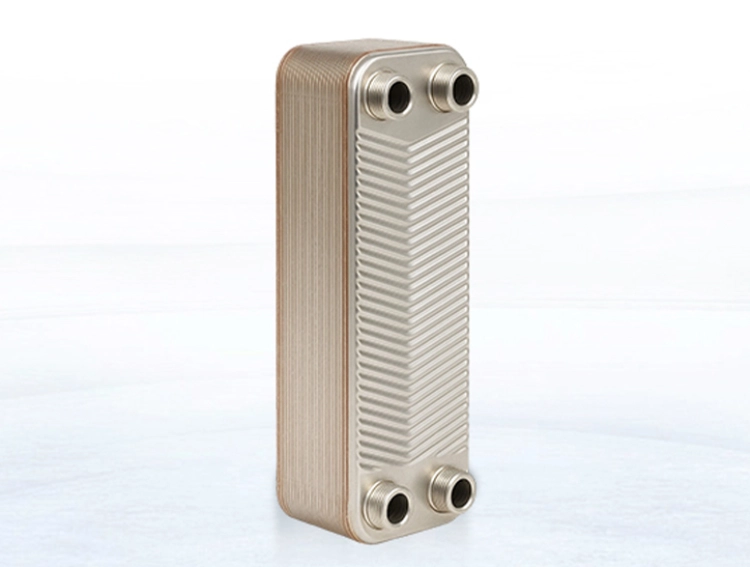
For clean liquid-to-liquid service, Grano’s detachable plate heat exchanger range is a candidate. Inside the frame, corrugated plates alternate the hot and cold streams. Gaskets establish the route through each port, and bolts compress the pack between clamping plates. If a deposit develops, the crew can open that pack and look at the affected surface. Grano also lists plates and gaskets as separate products. Keep their exact IDs with the machine record, or a repair may stall over a small part.
Collect the plate pattern, port arrangement, gasket material, plate sequence and closing dimension for the proposed Grano unit while the supplier still has the quote open. A replacement gasket that looks close is not necessarily right for the groove or the fluid. Reassembly needs the approved order and even clamping. In the boiler room, mark the distance required to move the frame plate and remove a plate. Otherwise “serviceable” may mean lifting the whole unit out of a crowded corner.
The return-water chemistry and treatment program set the material question. How will the proposed gasket tolerate both the normal water and the cleaning fluid used after a deposit forms? Get the material schedule and the selected model’s pressure and temperature limits in writing. Grano also lists shell-and-tube equipment. A solids-bearing stream, or a return line with almost no spare pump head, may warrant a comparison. Boiler-room floor space is costly, but so is losing the return line.
Place the bypass, isolation valves and instruments on the exchanger drawing. A technician should be able to point to the temperature and pressure taps used for the acceptance test without tracing an entire plant header. The piping engineer then locates drains and vents for the finished arrangement. Test the control valve at low load; it has to manage the receiving-water temperature while the steam users continue to drain freely.
Prove the benefit at the plant boundary
Before installation, log condensate returned, makeup water, fuel use and the relevant vent or drain loss. After startup, log those again under comparable production, plus exchanger flows and terminal temperatures. A high calculated transfer rate at the plate pack is encouraging. It is not proof of fuel savings if another control valve bypasses heat all afternoon or the return system loses more elsewhere.
The calculation also needs pump energy, treatment and maintenance, plus the hours the receiving water actually needs preheat. The DOE lists condensate return and blowdown heat recovery separately. If a project changes both, draw a boundary around each savings claim so a kilowatt of heat is only counted once.
Send قمح a marked-up return drawing, measured stream conditions, water chemistry and the plant’s design code. Ask the supplier to identify the intended duty in plain terms: pumped liquid condensate, condensing vapor, blowdown or another stream. A model-specific rating and material schedule can then be reviewed by the steam engineer before a purchase order is issued.
التعليمات
Should every hot condensate line have a plate exchanger?
No. Clean condensate may be more valuable returned directly. Establish the return route and the receiving heat demand first.
Is a flash-steam line just another hot-water inlet?
No. Vapor formation changes flow, heat transfer and drainage. It needs a duty-specific design rather than a liquid-only calculation.