



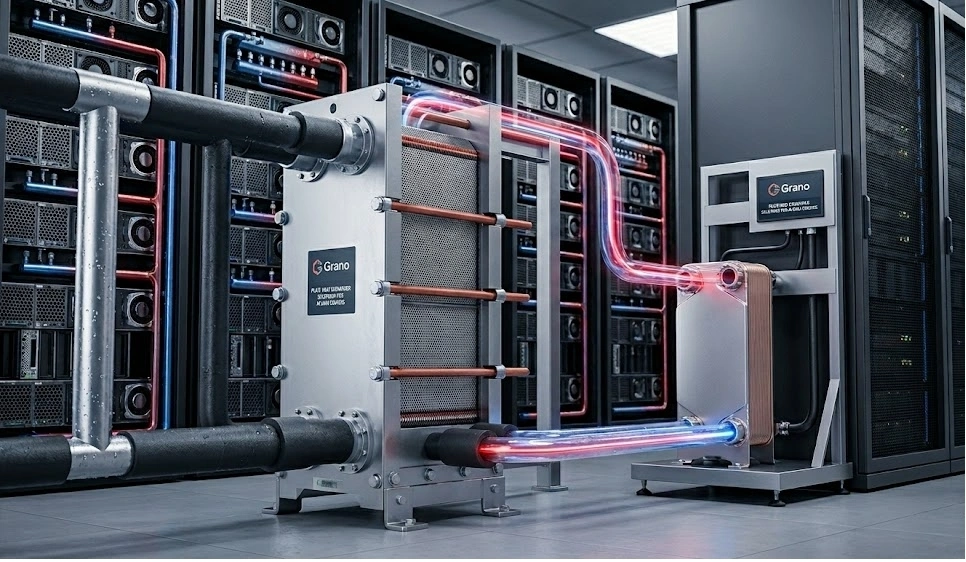
The Air Cooling Limit is no longer a theoretical line in AI infrastructure. When one rack can jump from legacy density to 40 kW, 70 kW, or even about 120 kW in advanced configurations, airflow alone becomes expensive, noisy, and hard to scale. You are not just fighting temperature; you are protecting sustained compute output, fan energy, and floor space at the same time. That is why liquid cooling has shifted from an optional upgrade to a design requirement in modern AI data centers.
If you are sourcing thermal hardware for this shift, one company worth a serious look is Grano. Founded in 2015, it focuses on plate heat exchangers, related parts, and maintenance services, with capabilities that cover design, manufacturing, testing, spare parts, and after-sales support. For you, that matters because an AI cooling project is rarely just about buying one exchanger. You need a supplier that can help with compact rack-side hardware, larger facility-side units, cleaning strategy, materials, and future expansion. In that sense, this is a practical partner: it offers both brazed and detachable plate heat exchanger solutions, plus service support, so your liquid loop can grow with your compute plan instead of being rebuilt every refresh cycle.
Why the Air Cooling Limit arrives so quickly in AI data centers
AI changed the thermal problem faster than most buildings could change with it. A widely cited industry pattern shows traditional enterprise and cloud racks averaging around 10 kW, while accelerated systems pushed rack density to about 25 kW in 2022, 40 kW in 2023, and 72 kW in 2024. Public vendor documentation for a current rack-scale AI system lists approximate rack power consumption at 120 kW. At that point, the mechanical room, raised-floor airflow, and in-rack fan strategy all face a very different duty cycle than they were built for.
Representative density figures in public sources
| System or benchmark | Reported density / power |
| Typical enterprise or cloud rack average | ~10 kW/rack |
| AI rack design with A100 generation (2022) | ~25 kW/rack |
| AI rack design with H100 generation (2023) | ~40 kW/rack |
| AI rack design with GH200 generation (2024) | ~72 kW/rack |
| Rack-scale GB200 system | ~120 kW rack power consumption |
Source: Schneider Electric industry analysis and NVIDIA official system documentation. Schneider’s design-planning figures are approximate rack-density references, while NVIDIA’s figure is a product-specific rack power value.
This matters because heat does not merely raise temperature. It also reduces performance when silicon reaches thermal limits. Intel states that throttling reduces clock speed once temperature crosses the processor limit, and NVIDIA documents that GPU thermal throttling lowers clock frequency to prevent overheating. In other words, insufficient cooling does not only risk reliability; it can directly reduce the compute you paid for.
Once you get close to the Air Cooling Limit, adding more airflow stops being a clean fix. ASHRAE notes that designers once viewed 20 to 30 kW cabinets as near the ceiling for air cooling, and that newer air-cooled products reached roughly 40 to 50 kW only through major airflow advances, higher fan power, and lower cooling efficiency. That is a warning for AI operators: air can still be stretched, but the cost of stretching it rises fast.
Why liquid cooling changes the thermal equation
This is where liquid cooling becomes more than a trend. ASHRAE states that water has more than 3,500 times the heat capacity of air, which is why water can carry far more heat away from dense electronics than air can in the same environment. That single physics advantage changes your whole design logic. You stop forcing the room to remove every watt, and instead move a large share of heat directly into a liquid loop near the source.
In practice, that gives you three business advantages. First, you can keep processors closer to sustained peak performance because heat is removed at the chip or rack loop instead of relying only on room air. Second, you can reduce dependence on large internal fans and oversized air-handling equipment. Third, you can support higher rack density without turning the white space into a maze of airflow workarounds. That is why liquid cooling is the most direct answer once AI deployments begin to expose the Air Cooling Limit in live operations.
Where a brazed plate heat exchanger fits at rack level
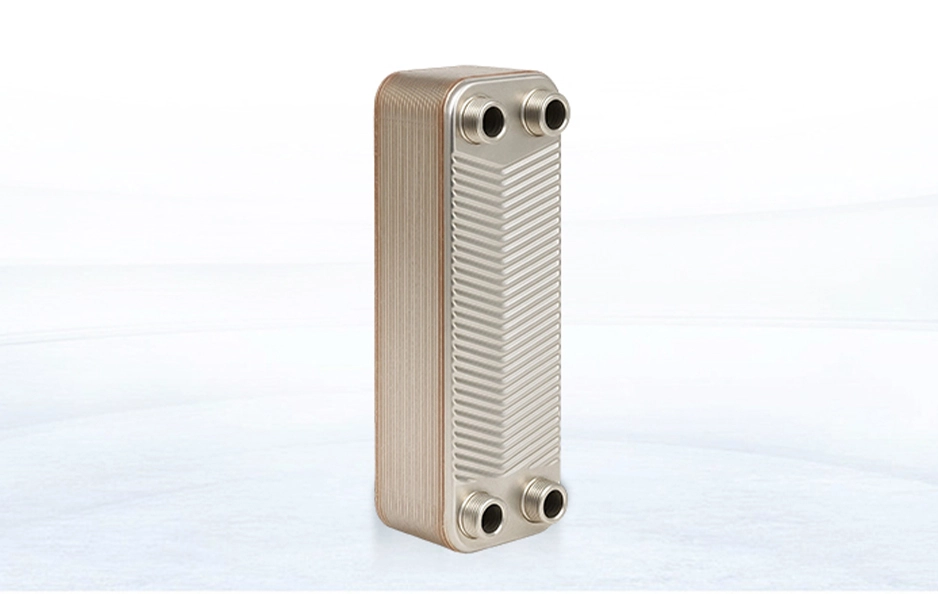
Once you move heat into liquid, the question becomes how efficiently you transfer that heat between loops in a very tight footprint. At the rack or close-coupled level, a Brazed Plate Heat Exchanger is a strong fit because space is scarce and thermal response has to be fast.
A brazed unit uses metal plates joined into one compact core instead of relying on a detachable gasketed frame. For you, that means a smaller footprint, fewer sealing interfaces in the core, and strong suitability for high-pressure, high-temperature service. Based on the uploaded product data, this product line supports up to 40 MPa working pressure and up to 300°C operating temperature, while keeping a compact structure and high heat-transfer efficiency. Those are useful traits when AI workloads change fast and the thermal loop cannot afford lag.
If your design has already crossed the Air Cooling Limit, this kind of compact exchanger becomes more valuable than another layer of fan-driven compensation. You want rapid heat transfer in the smallest possible mechanical envelope, especially in CDU-adjacent or skid-integrated layouts. Modern liquid-cooled rack systems also treat leak detection as a core reliability function, which shows how seriously the industry now treats liquid-loop integrity. A brazed core does not remove the need for good loop design, but it does remove gasket-related maintenance points inside the exchanger core itself.
Where a detachable plate heat exchanger fits at facility level
Rack cooling solves only part of the problem. You still need to move heat from the secondary loop to the building loop, dry cooler, or cooling tower path. That is where a Plate Heat Exchanger becomes the better choice.
At facility level, your priorities change. Tight footprint still matters, but serviceability and expansion matter more. According to the uploaded materials, the detachable plate heat exchanger line supports up to 5,000 m² of heat exchange area, up to 25 MPa working pressure, and up to 200°C operating temperature. More importantly, the unit can be opened for cleaning, and plates can be added or removed as your load grows. For an AI facility, that flexibility is practical. You may start with one cluster, then expand cooling capacity later without replacing the whole thermal interface.
Mineral scale and water-quality drift are real facility issues, especially on larger loops. The uploaded technical material also emphasizes that detachable units are easier to disassemble, inspect, and chemically clean when fouling reduces thermal performance. That directly addresses a common customer concern: you do not only need high initial efficiency; you need efficiency you can recover after months of live operation.
Product comparison for AI cooling loop selection
| Product | Best fit in the cooling path | Key advantage | Max working pressure | Max operating temperature | Heat exchange area |
|---|---|---|---|---|---|
| Brazed Plate Heat Exchanger | Rack-side loop, CDU-adjacent skid, compact high-density thermal interface | Compact core, fast heat transfer, strong pressure tolerance | 40 MPa | 300°C | Up to 2500 m² |
| Plate Heat Exchanger | Secondary loop to facility water loop, chiller, or cooling tower interface | Detachable for cleaning, modular plates for expansion | 25 MPa | 200°C | Up to 5000 m² |
Source: uploaded product materials.
Final takeaway
For AI infrastructure, the Air Cooling Limit is not a temporary inconvenience. It is the point where airflow stops scaling economically with compute density. Liquid cooling changes that by moving heat with far greater efficiency, while plate heat exchangers make the liquid architecture practical at both rack level and facility level. If you want dense racks, stable performance, cleaner expansion, and a cooling system you can maintain over time, the winning strategy is not more air. It is a better heat-transfer path.
FAQs
Q: What is the Air Cooling Limit in an AI data center?
A: In AI environments, the Air Cooling Limit is the point where air-only cooling can no longer remove heat efficiently enough without excessive fan power, airflow complexity, or performance risk. ASHRAE notes that cabinets once thought near the air-cooling ceiling were around 20 to 30 kW, while more advanced air-cooled products later pushed to roughly 40 to 50 kW, but with rising cooling cost and lower efficiency.
Q: When should you move from air cooling to liquid cooling?
A: You should seriously evaluate liquid cooling once your rack plan approaches the Air Cooling Limit, especially when you expect sustained GPU-heavy workloads, rising fan energy, or future density expansion. Industry planning figures have already moved from around 10 kW average racks to 40 kW, 72 kW, and even around 120 kW rack-scale systems in advanced AI deployments.
Q: Why use both brazed and detachable plate heat exchangers in one project?
A: Because they solve different problems. A brazed plate heat exchanger is better when you need compact size and fast heat transfer near the rack loop. A detachable plate heat exchanger is better when you need larger-area heat exchange, easier cleaning, and the option to add plates as the facility grows. Used together, they create a more flexible liquid-cooling architecture.


