



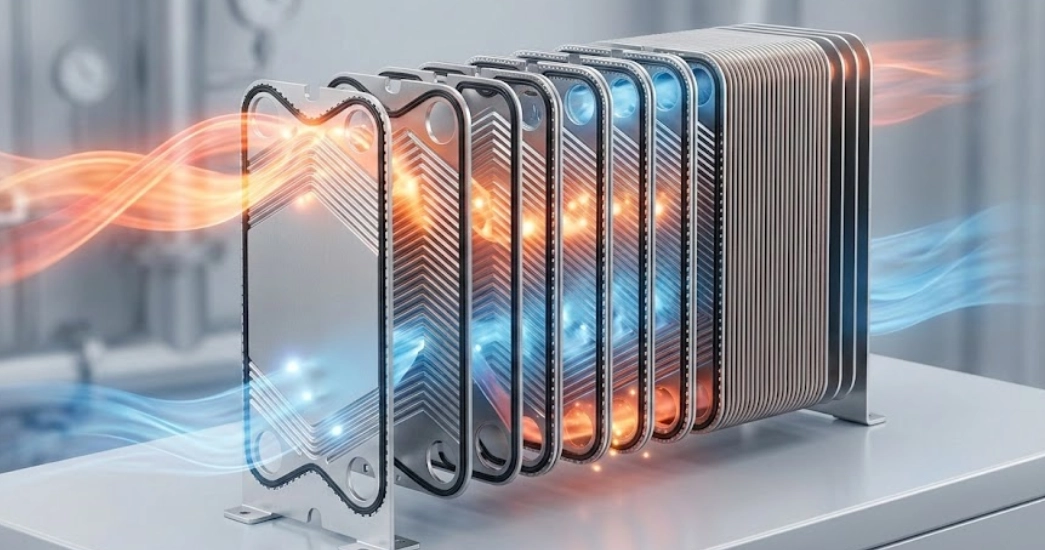
In industrial heat transfer and thermal management, Plate Heat Exchangers (PHE) are used because of their high efficiency, compact design, flexibility, and easy maintenance. At Grano, we are a global manufacturer of high-quality heat exchangers and spare parts, helping numerous industries worldwide save costs through efficient solutions. Over the last decade, we have been able to deliver cost-effective solutions to numerous industries in over 40 countries worldwide.
Our global client base often wonders whether, in a plate heat exchanger, adding plates can increase the efficiency of the heat transfer. It is quite logical to think that the more plates are used, the greater the efficiency of the heat transfer. However, the laws of thermodynamics and fluid mechanics are not as simple. This article is based on the experience and data obtained from the use of plate heat exchangers.
I. The Relationship Between Plate Count and Heat Transfer Area
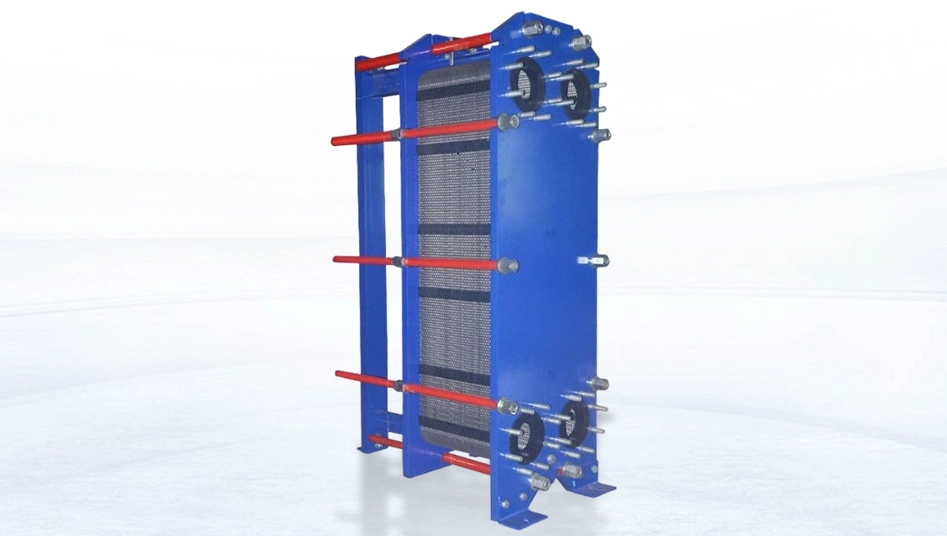
One of the core advantages of a Gasketed Plate Heat Exchanger is its modular design. By simply adding or removing metal plates (such as stainless steel or titanium), operators can easily adjust the physical surface area of the equipment.
According to the fundamental heat transfer equation Q = U × A × ΔT_m (where Q is the total heat transfer rate, U is the overall heat transfer coefficient, A is the heat transfer area, and ΔT_m is the logarithmic mean temperature difference), an increase in area A is indeed a direct variable in increasing the total heat transfer capacity Q.
However, thermal capacity is not dictated by area alone. Blindly increasing the number of plates without adjusting other system parameters often fails to deliver the expected performance improvements.
II. The Role of the Heat Transfer Coefficient
Looking back at the formula above, the overall heat transfer coefficient ($U$) is the other decisive factor determining PHE performance. The premium plates manufactured by Grano feature precisely engineered corrugation patterns (such as chevron designs). The primary purpose of these patterns is to induce intense turbulence as fluid passes through the narrow channels.
This turbulence effectively disrupts the thermal boundary layer on the fluid surface, dramatically increasing the heat transfer coefficient. However, the intensity of this turbulence is intrinsically linked to the flow velocity of the fluid within the channels. If we merely add plates without upgrading the system’s pumping capacity, the internal velocity drops, directly crippling the heat transfer coefficient.
III. How Flow Distribution Affects Efficiency
This is a critical blind spot for many end-users. When the number of plates in a PHE increases, the number of parallel fluid channels inside the unit also increases.
If the total system flow rate remains constant (limited by the existing water pump or process piping), the same volume of fluid is now distributed across a wider network of channels. The inevitable result is a significant drop in flow velocity within each individual channel.
Decreased velocity causes the fluid to transition from a turbulent state back toward a laminar state. Not only does this cause the (U) value to plummet, but it also weakens the “self-cleaning” scouring effect on the plate surfaces, making the equipment much more susceptible to fouling over time.
IV. Balancing Pressure Drop and Heat Transfer Performance
In fluid dynamics, flow velocity and pressure drop are inseparable forces. High velocities yield excellent heat transfer but generate high system resistance, requiring more electrical energy for pumping.
In many industrial systems, the maximum allowable pressure drop is strictly limited. Adding plates increases the cross-sectional flow area, which effectively reduces equipment pressure drop. This can be an excellent solution for systems where pumps are overloading due to high resistance. Conversely, if the pressure drop is reduced too much, it indicates that the flow velocity is severely insufficient, and thermal efficiency will suffer.
When supplying high-quality replacements for major brands, Grano always focuses on finding the “golden balance” between pressure drop and the heat transfer coefficient.
V. Case Study & Data Analysis: Non-Linear Heat Transfer Growth
To illustrate this clearly, let’s examine a real-world engineering case from Grano involving an HVAC cooling system upgrade.
Background:
A commercial facility was operating a Grano gasketed plate heat exchanger configured with 50 plates, designed for a cooling capacity of 1000 kW. Due to business expansion, the client wanted to increase the capacity by 30% to 1300 kW. The client’s initial thought was straightforward: purchase 15 extra plates (a 30% increase in area) and assemble them on-site.
Results and Data Comparison:
|
System Condition |
Plate Count |
Total Flow Rate (L/s) |
Channel Velocity (m/s) |
Pressure Drop (kPa) |
U-Value (W/m²K) |
Actual Capacity (kW) |
|
Initial Baseline |
50 |
20 |
0.40 |
50 |
5500 |
1000 |
|
Adding Plates Only (No pump upgrade) |
65 |
20 |
0.31 |
35 |
4800 |
1045 (+4.5%) |
|
Grano Optimized Solution (Increased flow + plates) |
65 |
26 |
0.40 |
50 |
5500 |
1300 (+30%) |
Data Breakdown:
As the table demonstrates, when the total flow rate remained fixed at 20 L/s, adding 15 plates caused the channel velocity to drop from 0.40 m/s to 0.31 m/s. Consequently, the U-value shrank significantly. The physical benefits of the added surface area were entirely canceled out by the drop in the heat transfer coefficient, resulting in a mere 4.5% increase in total capacity—a poor return on investment. Only when the client followed Grano’s advice to proportionally increase the total system flow alongside the new plates did they achieve the desired 30% performance leap.
VI. The Impact of Plate Count Under Different Working Conditions
In practical engineering, adjusting the plate count is never a one-size-fits-all approach. It must be evaluated based on specific operating conditions:
- Fixed Flow Systems:As shown in the case study, simply adding plates reduces velocity, leading to heavily diminishing returns in heat transfer.
- Variable Flow Systems:If the system features variable frequency drive (VFD) pumps or has excess flow capacity, adding plates while proportionally increasing the flow rate is a highly effective way to boost capacity.
- High Temperature-Difference Systems:In applications with long thermal duties or extreme temperature crosses, adding plates might not be enough. Grano engineers frequently recommend utilizing a Multi-Pass design to ensure the fluid has sufficient physical residence time and thermal contact length.
VII. Design Principles for Determining the Optimal Plate Count
As a comprehensive manufacturer integrating R&D, production, consulting, and OEM services, Grano believes that proper heat exchanger design is not just about stacking metal plates. Our core design principles include:
- Precise Thermal Sizing:Utilizing proprietary thermo-hydraulic calculation software to simulate the scientific combination of high-theta and low-theta corrugation angles.
- Strict Velocity and Pressure Drop Control:Ensuring that channel velocity remains within the optimal turbulent zone (usually requiring a Reynolds number >2200) without ever exceeding the system’s maximum allowable pressure drop.
- Balancing Cost and Lifecycle Maintenance:Redundant plates not only inflate initial procurement costs but also multiply the future time and expense required for replacing gaskets and routine maintenance.
VIII. Summary of Engineering Practice
Designing the correct plate count requires striking a perfect harmony between thermal efficiency, system resistance, and overall equipment cost. For clients looking to expand existing heat transfer systems, Grano’s technical team strongly advises conducting a comprehensive system evaluation (re-rating calculation) before blindly purchasing extra plates. Backed by a complete product line of gasketed, brazed, fully welded, and semi-welded heat exchangers, Grano is ready to tailor the most economically viable upgrade strategy for your business.
FAQ
Q: Can I significantly increase my production capacity just by adding more plates to my existing Grano plate heat exchanger?
A: Not necessarily. While the greatest advantage of a gasketed PHE is its flexible expandability, adding plates directly alters internal velocity and pressure drop. If your existing pumps cannot supply a higher flow rate, the added plates will reduce channel velocity, meaning your heat transfer capacity may barely increase. We recommend contacting Grano’s engineering team for a re-rating calculation before purchasing extra plates.
Q: How does Grano ensure my business gets the exact optimal number of plates?
A: Leveraging over a decade of industry expertise and advanced thermodynamic modeling, Grano’s engineers simulate your specific process data—including fluid types, inlet/outlet temperatures, maximum allowable pressure drop, and flow rates. We don’t just calculate the plate count; we match the exact corrugation angles and pass configurations to ensure you achieve the highest thermal efficiency at the lowest capital cost.
Q: Why did my system’s pressure loss decrease after I added plates myself, but the heat exchanger started fouling much faster?
A: Adding plates expands the total internal cross-sectional area, which reduces fluid resistance—hence the lower pressure drop. However, this also causes a drastic reduction in fluid velocity. Slow-moving fluid lacks the turbulent energy required to scour suspended solids and debris off the plate surfaces, which exponentially accelerates fouling and scaling. This is precisely why maintaining adequate velocity during the design phase is non-negotiable.


