



In the busy world of heating and cooling systems, the Brazed Plate Heat Exchanger (BPHE) is a real star. It is well-known for being small, very strong, and doing its job quickly. However, there is a big mistake that many engineers and workers make quite often. They think that because a BPHE looks like a simple “closed metal box,” they can just bolt it onto a machine in any way they want without any bad results.
At Grano, we often see these high-quality units struggle. It isn’t because they were made poorly in the factory. Usually, it is because they were put in the wrong way. The truth is simple: the way you stand or lay your heat exchanger—whether it is standing up straight, lying flat, or having its ports pointing to the side—really changes how well it gets rid of air, how the liquid moves inside, and how long it stays healthy.
This long guide will look closely at why the direction you choose for your installation is so important. We want to help you understand why this choice matters much more than you might guess.
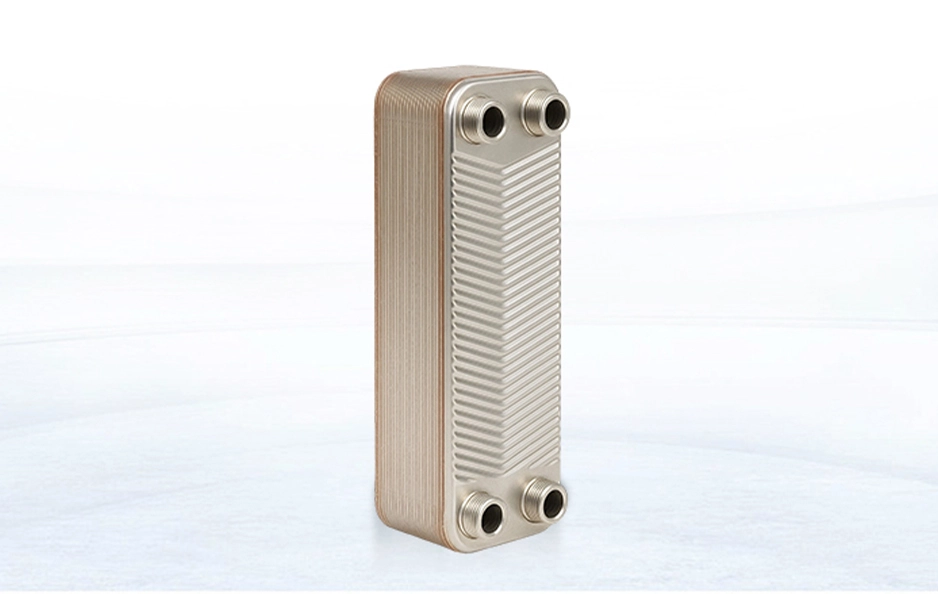
The Myth of “Plug and Play”: Why Many Users Forget About Direction
Why do so many people ignore how a BPHE should face? Most of the time, it is because they don’t have enough room. In modern factories or small heat pump boxes, there isn’t much space to move. Workers often care more about “making the pipes fit” than they do about the science happening inside the metal.
Also, unlike the old shell and tube heat exchangers, BPHEs do not have any parts that move inside. This makes people think that gravity and the way liquids flow do not matter much. But as we will show you, forgetting these things can make your efficiency drop by 10% or even 30%. It can also make your expensive equipment break down much sooner than it should. When you use a Grano product, you want the best, so you have to install it the best way.
Common Installation Methods and What They Do
Before we talk about the “why,” let’s talk about the “how.” In the real world, we usually see three main ways people set these up:
1. Vertical Installation (The Best Way)
In this setup, the unit stands up straight. The ports (the holes where the pipes connect) usually face forward or backward. This is what we almost always suggest at Grano.
2. Horizontal Installation
In this case, the unit is lying flat. The plates inside are parallel to the ground, like a stack of pancakes. Many people do this to save height, but it often causes trouble.
3. Ports Facing Up or Down
This is when the unit is turned so that the pipes come in from the very top or the very bottom. While it might look neat, it can create “traps” for air or dirt.
The Big Fight Against Trapped Air
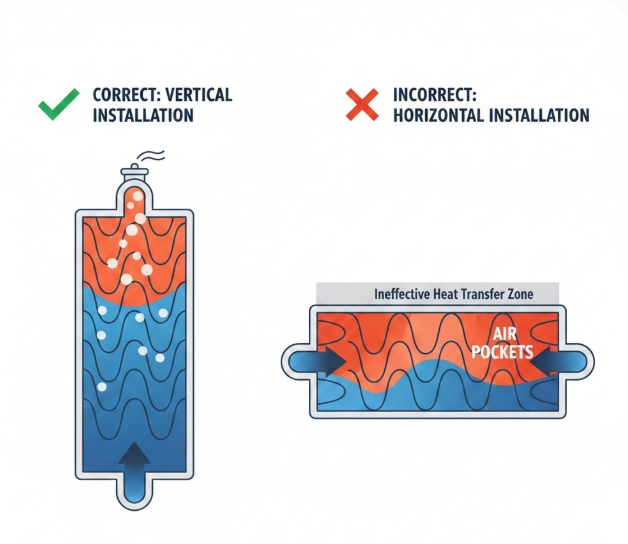
The biggest enemy of a good heat exchanger is hidden air. Air is a very good insulator. This sounds like a good thing, but in a heat exchanger, it is terrible. If a part of the metal plate is covered by a bubble of air, that part of the plate is not touching the liquid. This means it is doing zero work. It is like paying for a whole team of workers but having three of them sleeping on the job.
Why Vertical is King for Venting
When a Grano BPHE is standing up straight and the liquid flows from the bottom to the top, physics helps you. Air bubbles naturally want to float up. The liquid pushes them from behind, and gravity helps them rise. They go straight to the outlet and leave the system.
The Problem with Lying Flat
If you lay the unit flat (horizontally), the air gets stuck in the “hills and valleys” of the metal plates. These little pockets are very hard to move. Even if you turn your pump to a very high speed, the water often just flows under the air, leaving it stuck there forever.
The Result: If 15% of your unit is filled with stuck air, your pump has to work much harder and use more electricity to get the same cooling. This wastes money every single day.
How Fluid Moves: Avoiding the “Dead Zone”
For a BPHE to do its job, the liquid must spread out evenly across every single tiny path between the metal plates. If the liquid only goes through a few paths, you are not using what you paid for.
- Good Flow:In a vertical setup, the liquid fills the bottom area first and then rises up evenly through all the channels. It’s like a crowd of people filling a theater from the front row to the back.
- Bad Flow:If the installation is wrong, the liquid might “short-circuit.” It takes the easy path through the holes closest to the pipes and skips the plates further away. This creates “dead zones.” In these spots, the liquid just sits still. This is very dangerous in cooling systems because the still liquid can freeze and crack the metal, ruining your Grano
Real Data: How Much Performance Do You Lose?
We have done many tests to see what happens when you tilt a heat exchanger. The numbers show a clear story. If you move away from standing it up straight, you lose performance.
|
Installation Angle (from Vertical) |
How Much Heat It Moves |
Pressure Drop (How hard the pump works) |
Risk of Stuck Air |
|
0° (Perfectly Vertical) |
100% (The Goal) |
Normal |
Very Low |
|
30° Slant |
95-97% |
2% Harder |
Low |
|
60° Slant |
88-92% |
8% Harder |
Medium |
|
90° (Lying Flat) |
75-85% |
15% Harder |
Very High |
Note: These numbers can change if your liquid is thick (like oil) or if it is moving very slowly. Slow liquids are even more likely to have problems with orientation.
Long-Term Problems: Why Systems Fail Later
A system might seem “okay” during the first week. The pipes are cold, the machine is running, and the boss is happy. But if the direction is wrong, problems will slowly grow like a hidden sickness.
1. Dirt and Scaling
In those “dead zones” we talked about, tiny bits of dirt or minerals in the water start to settle. Because the water isn’t moving fast enough to wash them away, they stick to the metal. Over time, this layer of dirt (scaling) gets thicker and thicker. Soon, heat cannot pass through the metal at all.
2. Metal Wear and Tear (Erosion)
If air is trapped in some channels, the water has to squeeze through the remaining “open” channels. This makes the water move much faster than it should. This fast-moving water can actually wear away the copper that holds the Grano plates together. This leads to leaks inside the unit, which is a total failure.
3. Shaky Temperature Control
If you have air bubbles moving around inside, your sensors will get confused. One second the heat transfer is good, the next second a bubble moves and it gets worse. Your control system will keep turning things up and down, trying to find a balance. This puts a lot of stress on your pumps and valves.
Pro Advice from the Grano Team
We want your Grano heat exchanger to last for 10 or even 15 years. To make sure that happens, please follow these simple rules from our engineering team:
Rule 1: Always Go “In at the Bottom, Out at the Top”
This is the most important rule. If the liquid enters at the bottom, it has to fill up the whole unit before it can leave. This makes sure every part of the plate is wet and working.
Rule 2: Stand Up Straight
Whenever you can, keep the unit vertical. If a salesman or a builder tells you it is okay to lay it flat because they want to save space, tell them you care about the power bill. If you absolutely must lay it flat, you need to make sure the water is moving very fast (at least 0.4 meters per second) to try and push the air out.
Rule 3: Don’t Forget to “Burp” the System
Just like a baby, a new pipe system needs to get the air out. When you first start your machine, run the pumps at a low speed. This lets the air move slowly to the top. Also, you should always put an “air vent valve” at the highest point of your pipes.
A Story from the Field: The Case of the Noisy Chiller
Let’s look at a real example. A group of builders put three Grano BPHEs into a large cooling machine for an office building. They were smart people, and they picked the right size for the units. But, to make the machine look short and sleek, they installed all three units horizontally.
The Trouble: As soon as summer started, the machine began to act strange. It kept showing “Low Pressure” errors and shutting down. The water wasn’t getting as cold as it was supposed to. The approach temperature (the difference between the liquid and the refrigerant) was 6°C, which is much too high.
The Fix: One of our experts went to look at it. He saw the flat units and told them to flip them so they were standing up. It took a day of work to change the pipes.
The Happy Ending: As soon as they turned it back on, a huge amount of air “burped” out of the pipes.
- The approach temperature dropped from 6°C to 1.5°C immediately.
- The cooling was much stronger.
- Because the system was working correctly, the electricity use dropped by 12%. The building owner saved a lot of money on their very first power bill after the fix.
Summary
In the end, the direction of your Brazed Plate Heat Exchanger is not just a small detail. It is a vital part of the design. A Grano unit is a high-performance tool, like a fast car. You wouldn’t drive a fast car with the wrong tires, so don’t install a great heat exchanger in a way that traps air and dirt.
If you take the time to stand the unit up and pipe it correctly from the bottom to the top, you will be rewarded with a system that is quiet, efficient, and lasts for a very long time.
FAQ
Q: Is it okay if I install my Grano BPHE upside down so the pipes point at the floor?
A: No, this is a bad idea. If the ports point down, the top of the heat exchanger becomes a giant “trap” for air. Since air wants to go up, it will stay stuck at the top of the unit forever. The liquid will just flow past underneath it. This means you lose a lot of your cooling power, and the metal at the top might start to rust or corrode because it is just sitting in a pocket of damp air.
Q: Does it really matter which way it faces if I am using steam to heat water?
A: Actually, it matters even more! When you use steam, it turns back into water (called condensate) as it cools down. If the unit is not vertical, that water cannot drain out. It gets stuck inside and can cause something called “water hammer.” This is when moving water hits the metal plates like a hammer. It can be so loud it sounds like a gunshot, and it can actually rip the brazed metal apart, causing a dangerous leak. Always install steam units vertically so the water can fall out the bottom.
Q: My space is very tiny. Is there ever a time when laying it flat is okay?
A: We only say “yes” to this if you have a very special system. The water must be moving very fast all the time, and you must have other ways to catch air bubbles in your pipes. However, for 95% of normal jobs like home heating, air conditioning, or factory cooling, laying it flat will eventually cause problems. It is always better to move a pipe or change the box design to keep the Grano unit standing up.


