



1. Introduction: Is Your Heat Exchanger Acting More Like a Filter?
In the field of industrial processing, nothing is quite as annoying as a “clogging king”—that single piece of gear that suddenly stops the whole production line. If you deal with paper mill white water, fermentation broths, or textile wastewater, you are very familiar with this situation: pressure drops rise quickly, heat transfer speeds drop sharply, and in the end, the flow comes to a complete stop.
At that moment, your heat exchanger stops working as a device for heat and turns into an unplanned filter.
The expense of this breakdown has two main parts. First, there is the labor cost—groups of workers who spend long hours taking apart, cleaning, and putting back together the heavy plate packs by hand. Second, and even more harmful, is the unplanned downtime. When the production line halts, income disappears right away. If your cleaning routine happens every few days instead of every few months, it is time to examine what is wrong with your heat equipment more closely.
This kind of frequent issue not only drains time and money but also creates stress for the team on the floor. Workers end up dealing with the same frustrating task over and over, which lowers morale and pulls them away from other important jobs. In busy plants where every minute counts, such interruptions can add up to major losses over a month or a year. That is why finding a better way to handle these challenges is so crucial for keeping operations smooth and reliable.
2. The Fatal Flaws: Why Conventional Plate Heat Exchangers (PHEs) Fail
To fix the issue, we need to grasp the basic problems built into regular heat exchanger setups when they face fluids with lots of dirt or particles.
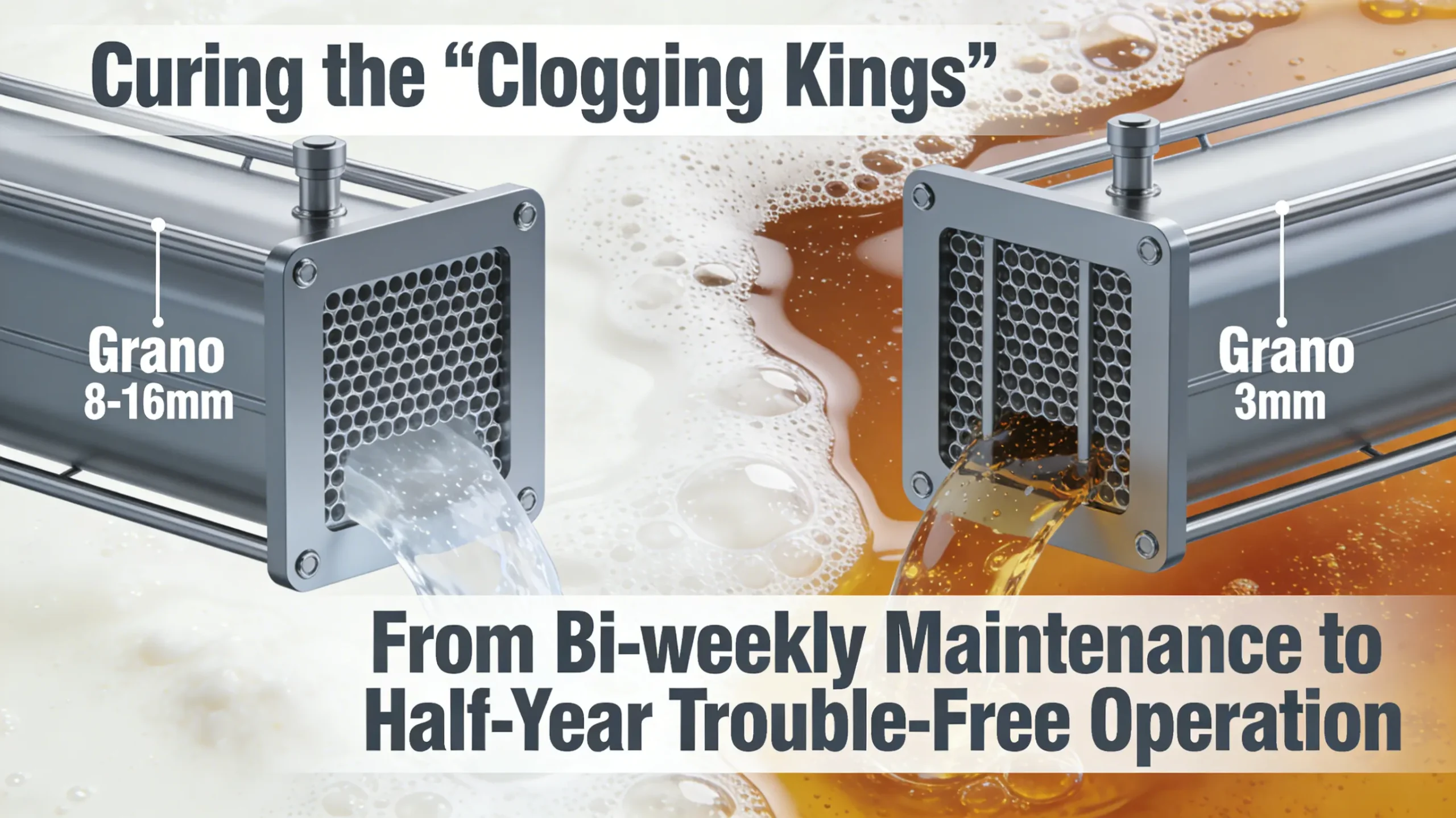
Gap Geometry: The 3mm Bottleneck
A typical PHE is built for good performance with clean liquids. To make this happen, the spaces between plates stay very tight, usually from 2.0mm to 3.0mm. Although this setup creates good mixing in the flow, it serves as a real obstacle for any liquid that carries solid bits. If even one fiber or speck is about half the width of that space, it can easily get stuck there.
This narrow design works fine in ideal conditions, but real-world fluids often include unexpected extras like tiny debris or buildup from the process itself. Over time, these small problems grow into big blockages, forcing shutdowns that no one planned for. Engineers often overlook how quickly a minor jam can turn into a full stop, especially in systems running non-stop.
The “Fishing Net” Effect: Metal Contact Points
Regular plates use a “herringbone” or chevron pattern. To handle strong pressures during operation, the plates press firmly together, forming countless metal-to-metal contact points.
These spots work just like the holes in a fishing net. One single fiber catches on such a point, then grabs another, and soon more follow, building a thick layer that spans the whole channel and blocks the flow completely. That is the main reason why old-style PHEs do not fit well with thick or particle-filled liquids.
In practice, this net-like trapping happens faster than most people expect, especially when the fluid carries sticky or stringy materials. Maintenance logs from many plants show patterns where clogs start small but escalate rapidly, leading to emergency cleanings that disrupt schedules and increase wear on the equipment. Understanding this flaw helps explain why so many operations struggle with reliability in tough environments.
3. The Grano Solution: Wide-Gap “Free-Flow” Technology
At Grano, we completely redesigned the plate structure to manage even the toughest fluids that would ruin a normal exchanger.
Physical Transformation: Room to Breathe
The biggest change you notice right away is the distance between channels. We widened the plate gap to between 8mm and 16mm. This lets liquids with big fibers, pulp, crystals, or even tiny stones move through the device without any trouble at all.
Such open spacing means that materials which once caused instant problems now flow freely, reducing the chance of sudden stops. In tests and real installations, this simple adjustment has shown how much difference a bit more room can make, allowing systems to handle higher loads of solids without losing performance. It is a straightforward fix that brings big gains in daily use.
The “Free-Flow” 3D Design: The Highway for Fluids
The true innovative part is in our Free-Flow shape. Different from usual plates, Grano Wide-Gap plates feature a special three-dimensional pattern that gets rid of all metal-to-metal contact points inside the path for the fluid.
Picture a cramped, twisty path crowded with posts (like a standard PHE) compared to a broad, straight road (the Grano Wide-Gap). By clearing out those “posts,” we eliminate the spots where junk can catch and build up. The outcome is a smooth route for the liquid that stays open even when dealing with heavy amounts of solids.
This design draws from careful studies of how fluids behave in tight spaces, ensuring that movement stays even and effective. Users report that switching to this setup cuts down on surprise issues, letting them focus on output rather than fixes. It is the kind of smart change that turns a weak point into a strong one for the entire process.
4. More Than Just Anti-Clogging: The “Self-Cleaning” Advantage
Although “Wide-Gap” sounds like a basic fix, the real strength comes from smart ways the fluid moves inside.
Optimized Shear Stress: Grano designers apply detailed computer models to make sure that, despite the larger space, the liquid keeps a speed that cleans itself naturally.
High Turbulence: The special ridges on the plates create strong swirling near the walls. This builds wall shear stress that gently wipes the surface, sweeping off any early buildup before it turns into tough scale.
In everyday runs, this turbulence acts like a built-in brush, keeping things clean without extra effort. It means less need for harsh chemicals or tools during checks, saving time and resources for the whole team.
Wide-Gap vs. Shell-and-Tube: In the past, people turned to Shell-and-Tube exchangers for fluids with dirt. But Grano Wide-Gap units provide 3x the heat transfer efficiency compared to those shell-and-tube types, all while taking up just 1/5 of the floor space. You gain the durability of a tube system along with the quick heat swap of a plate one.
This edge in size and speed makes it easier to fit into crowded plants or upgrade old setups without major rebuilds. Many clients find that the smaller footprint frees up room for other gear, improving the overall layout and flow of work.
Beyond these points, the self-cleaning feature also helps with long-term care, as it reduces the buildup of minerals or residues that could affect heat flow over time. Operators appreciate how this leads to steadier temperatures and less variation in output, which is key for quality control in sensitive processes.
5. Where Does the “Black Tech” Shine?
Grano’s Wide-Gap units are now changing how things work in various tough sectors:
| Industry | Application | The Challenge |
|---|---|---|
| Pulp & Paper | White Water Cooling | High concentration of micro-fibers and “stickies.” |
| Bio-Fermentation | Broth Heat Treatment | Viscous fluids containing mycelium and solid nutrients. |
| Textile & Dyeing | Wastewater Heat Recovery | Presence of lint, hair, and dye particulates. |
| Food & Beverage | Fruit Juice/Puree | Large pulp particles (orange, tomato) and seeds. |
| Sugar/Ethanol | Juice Heating | Fibrous mash and crystal formation. |
Each of these areas faces unique hurdles, but the Wide-Gap approach tackles them head-on by allowing free passage of tough materials. For instance, in pulp and paper, the high fiber load once meant constant stops, but now lines run longer with fewer breaks. Similar stories come from food processing, where handling fruit bits without jams keeps flavors fresh and waste low. This versatility makes the technology a go-to for places pushing equipment to its limits.
6. Conclusion: Stop Cleaning, Start Producing
If your setup demands cleaning by hand every two weeks, your gear is not merely unclean—it is simply the wrong choice for the task. Moving to Grano Wide-Gap technology can stretch your cleaning times from weeks out to six months or a full year.
By picking a system made for fluids with lots of particles right from the beginning, you guard your profits, ease the workload on your repair crew, and keep your production at top heat performance levels.
Ready to end the clogging cycle? Do not go back to slow, large shell-and-tube setups. Check out the Grano Wide-Gap Series and let us guide you toward a future without constant maintenance.
Imagine the relief of knowing your system runs reliably, giving your team more time to innovate and grow the business. With proven results in real plants, this shift is not just possible but practical for many operations facing similar woes.
FAQ
Q: Does a wider gap mean I will lose significant heat transfer efficiency?
A: A larger gap does create a bit less mixing than a tight 2mm standard one, but it still beats a shell-and-tube exchanger by a lot. Grano makes up for it with unique plate patterns that keep strong swirling even in bigger channels, so you enjoy both good heat work and easy upkeep.
This balance comes from years of testing different shapes to find what works best without big trade-offs. Clients often see their energy use drop, which adds another layer of savings to the low-maintenance benefits.
Q: Can Grano Wide-Gap plates handle high-pressure applications?
A: Yes. Even with fewer spots where metal touches inside, our Wide-Gap plates use tough metals and special forming methods. We adjust the plate thickness and pick materials like 316L, Titanium, or Hastelloy to fit your exact needs for pressure and resistance to rust.
These choices ensure safety and strength in demanding spots, where failures could cost a lot. Our team reviews each case to match the build to the job, providing peace of mind for critical uses.
Q: How do I know if I need “Wide-Gap” or just a “Semi-Welded” or “Standard” PHE?
A: It all depends on the size of your particles and how much fiber is in the mix. Generally, if bits are over 1.0mm or if fibers like hair or pulp are present, go with Wide-Gap. We recommend sending your fluid details to our experts for a custom check and fit.
This step helps avoid guesswork, as every fluid acts a little differently under heat and flow. Getting that advice early can prevent costly mistakes and set you up for smooth runs from day one.


