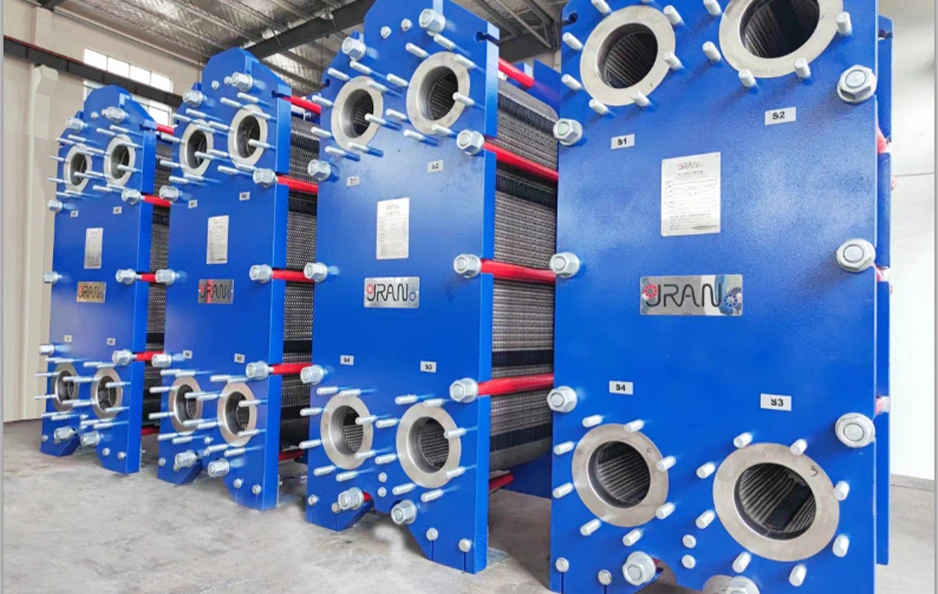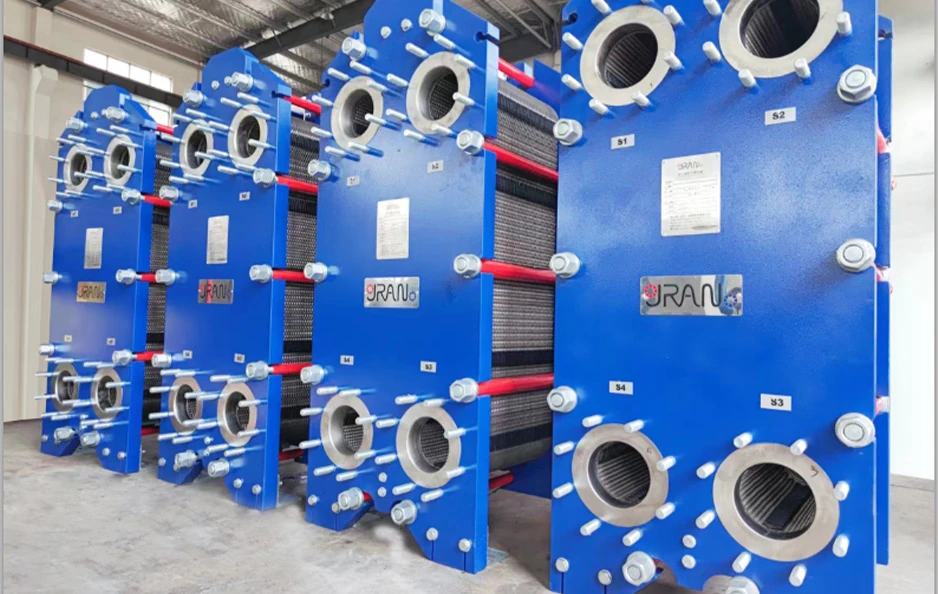

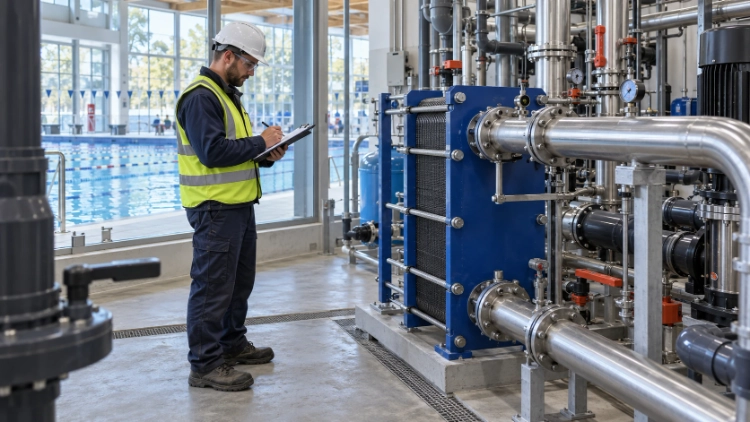
For a commercial pool heat exchanger, give every bidder one shared operating case before asking for a model number. This buyer’s brief shows what belongs in that case.
Calculate Two Loads, Not One
Warm-up data:
- usable water volume;
- starting and operating temperatures;
- permitted warm-up hours;
- cover position and circulation schedule.
Illustrative water-only load: about 97 kW for 250 m³, an 8 K rise, and 24 hours. The project calculation must then account for evaporation, wind, makeup water, pipe losses, and structural warm-up.
Attach the designer’s maintenance-loss calculation to the RFQ, including the assumed cover position, weather case, humidity, and air movement.
Give the Four Temperatures
Four temperatures for the datasheet:
- source inlet and return;
- pool inlet and outlet.
Other source data: fluid composition, available flow, and minimum and maximum conditions.
Low-temperature source check:
- available heat-pump capacity;
- actual supply and return temperatures;
- minimum seasonal source temperature;
- exchanger area selected for that smaller temperature difference.
Circuit separation protects the source loop from treated pool water, while sizing still depends on the four terminal temperatures.
Not every value has to be guaranteed. If the pool outlet is a calculated result, say so. A clearly marked assumption is useful. An unmarked assumption is a future dispute.
Put Flow Beside Pressure Drop
Hydraulic entries for each side:
- minimum, normal, and maximum flow;
- pressure drop available at the design flow.
Without both entries, a thermal selection can be correct and still be unusable in the installed circuit.
Low source flow limits heat input. Low pool flow can produce a warm outlet stream while the pool itself warms slowly. Check high-flow operation against available pump head and the supplier’s velocity limit.
Read the conditions behind every published kW figure. A “300 kW” label is not a constant output at every operating point.
Where filtration flow exceeds exchanger flow, document the bypass branch flow and verify it during commissioning with a measurable setting.
State the Chemistry, Including Upset Conditions
Send a chemistry sheet rather than the phrase “chlorinated water”:
- treatment and shock-treatment methods;
- normal and upset pH;
- chloride or salinity;
- disinfectant residual;
- maximum operating temperature;
- chemicals used for cleaning or shock treatment.
For a gasketed пластинчатый теплообменник, record the plate alloy and gasket compound.
For a кожухотрубный теплообменник, record pool-side tubes, tubesheet or end covers, seals, and connections.
If titanium is offered, identify which wetted parts use it.
Ask for a written compatibility statement against the supplied chemistry. Alloy grades and a wetted-material schedule are easier to audit than “stainless construction.”
Compare Constructions Against the Plant Room
Plate-and-frame review:
- compact footprint and close approach;
- access for pressure-plate movement and plate removal;
- controlled plate order, gasket condition, and tightening.
Shell-and-tube review:
- passage size and debris tolerance;
- end-cover or bundle access;
- mechanical-cleaning route and withdrawal space.
Compare duty, pressure drop, materials, fouling, cleaning, room layout, spares, and the maintenance skills available on site. Labels such as “efficient” or “robust” do not replace that comparison.
Walk Through the Piping Before Ordering
Review the project piping drawing against this list:
- Will filtered water reach the exchanger?
- Chemical injection: upstream or downstream, and why?
- Backflow protection: required for this arrangement?
- Isolation, venting, drainage, and measurement: accessible on both sides?
- Does a closed valve create a trapped, heated liquid volume?
- Is counterflow preserved as assumed in the thermal calculation?
- Can the exchanger be serviced without cutting permanent pipework?
Product-specific installation instructions may place treatment equipment downstream for a particular arrangement. Confirm the selected unit’s manual and local rules before adopting any layout.
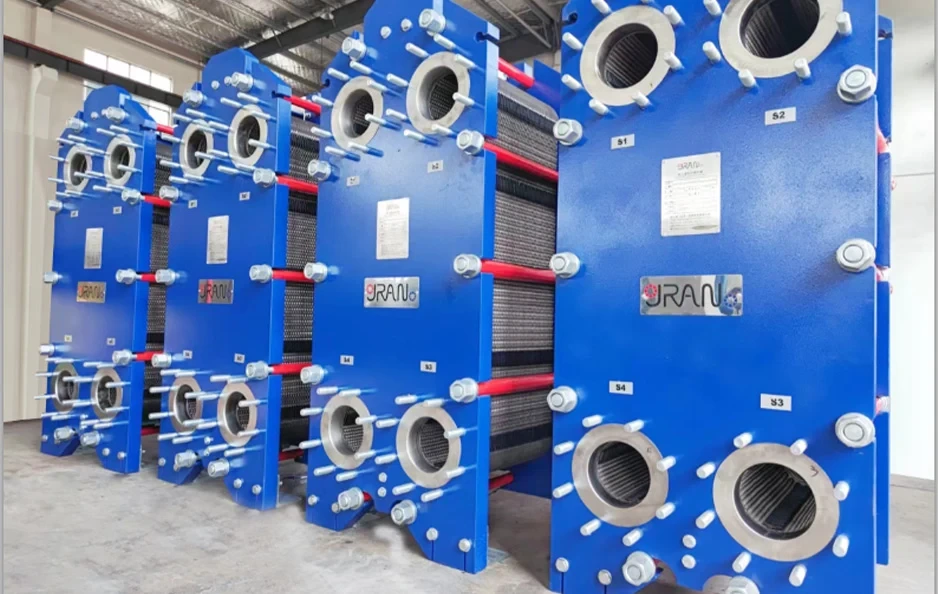
Nozzle-load check: independent pipe support and corrected alignment.
In humid rooms, review coating, fasteners, insulation, condensate drainage, and working access.
Write the Control Response in Plain Language
For loss of pool flow, state whether the source valve closes, the heat source stops, or both. Include the temperature limit, pump interlock, and freeze protection.
Cases for the control review:
- startup and normal shutdown;
- filtration backwash;
- pool-pump trip with a hot source;
- pump shutoff head and rapid valve movement;
- static head and trapped heated liquid.
Show operating and design pressure and temperature for both sides on the mechanical datasheet.
The system designer sets relief devices and the safe sequence; the exchanger supplier confirms the equipment limits used in its offer.
Доступ для технического обслуживания
The maintenance plan should cover hair, lint, treatment residue, mineral scale, and corrosion debris. Ask the supplier for the strainer opening and cleaning method.
Reserve enough room to remove plates, covers, or a bundle, including lifting access. For cleaning in place, show circulation points, drains, and chemical compatibility with metals, elastomers, and adhesive where used.
After commissioning, record flows, four temperatures, and differential pressure as a clean baseline. Compare later readings at similar duty when investigating blockage or lost performance.
Грано plate heat exchanger service includes cleaning support. A service quotation should make isolation, opening, cleaning, gasket work, reassembly, testing, startup, travel, and consumables separately visible.
Information to Send Grano or Another Bidder
Inquiry pack contents: pool volume, warm-up requirement, holding loss, source fluid and temperatures, both flows, pressure-drop limits, chemistry, material preference, design limits, connection standard, room constraints, and document list.
Retrofit additions: photographs and a marked, measured drawing. Provisional inputs belong in an assumption list, separate from guarantees. Grano’s engineering contact channel accepts the project data before manufacturing approval.
Commercial Pool Heat Exchanger RFQ Checklist
Final file check:
- volume, temperature range, warm-up time, and holding load;
- indoor or outdoor conditions, cover schedule, and the design-loss basis;
- source fluid, available capacity, and inlet and return temperatures;
- minimum, normal, and maximum flow on both circuits;
- allowable pressure drop and the relevant pump operating point;
- treatment method, pH, chloride or salinity, and upset values;
- wetted alloys and gasket or seal compound;
- construction type, configuration, and service clearance;
- connections, bypass, filtration, and chemical-injection location;
- control sequence, interlocks, design limits, and transient cases;
- guarantees, tests, document list, spares, warranty, packing, and delivery terms.
Budget-stage unknowns stay on the assumption list until final approval.
Заключение
Use one agreed design case for every bid. The selected pool heat exchanger can then be judged against the same duty, documentation, and total scope.