
When buying plate heat exchanger plates, visual match is only a first screen. Hanging details, gasket grooves, pressing, and port punching require a record-based check against the installed frame, plate schedule, and approved compressed dimension.
Start With the Nameplate and the Old Drawing
Nameplate record:
- manufacturer and exact model;
- serial or manufacturing number and year;
- plate count, plate alloy, and gasket material;
- design pressure and temperature;
- tightening dimension.
Add the assembly and element-configuration drawings if available. Use the model and serial data exactly as they appear on the installed unit’s nameplate and original drawings; submit those identifiers unchanged.
Photograph:
- the complete nameplate, photographed straight on;
- the full frame, including connections and guide bars;
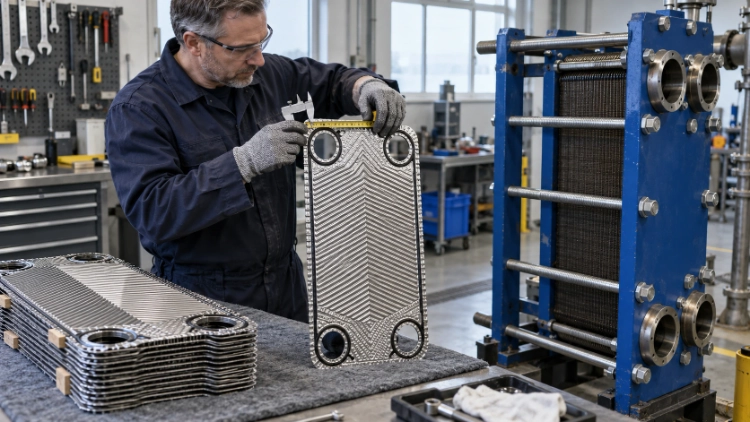
- one cleaned old plate from the gasket side and the opposite side;
- top and bottom hanging or guiding details;
- all four port areas and any blocked ports;
- gasket corners, clips, tabs, or adhesive areas;
- plate markings, lot codes, stamps, and material identifiers;
- the existing plate sequence before disassembly.
Keep the failed plate and label its pack position. Cracks do not erase its pressing marks, port pattern, hanging detail, or gasket groove.
Confirm How the Plate Hangs and Guides
Frame-interface checklist:
- overall height and width;
- port diameter and center distances;
- top carrying-bar profile;
- lower guide and corner form;
- locking or anti-rotation feature.
Do not use force on the carrying bar as a fit test. Incorrect geometry may hang at an angle, bind during opening, or shift the gasket as the frame closes.
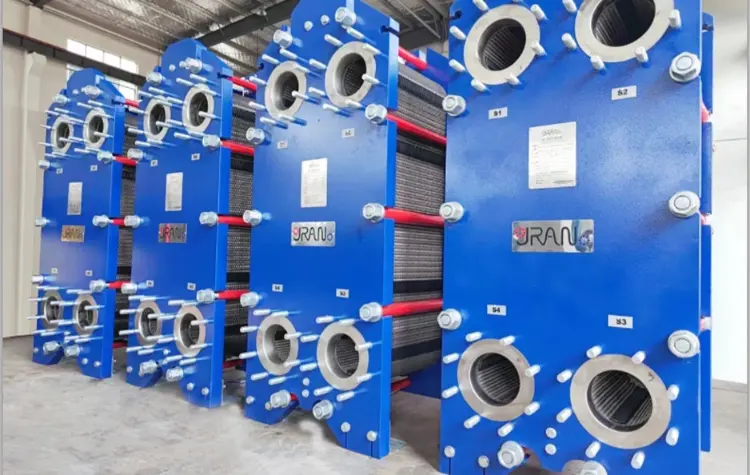
Грано пластинчатый теплообменник с прокладкой page shows the plate pack held between the fixed and movable frame plates, with guide bars controlling alignment as the bolts close the frame. In other words, replacement compatibility includes the frame interface.
Ask for a dimensioned confirmation drawing showing overall size, ports and centers, hanging profile, relevant pressing details, and gasket layout. Mark field measurements as reference checks; do not let them silently replace controlled manufacturing dimensions.
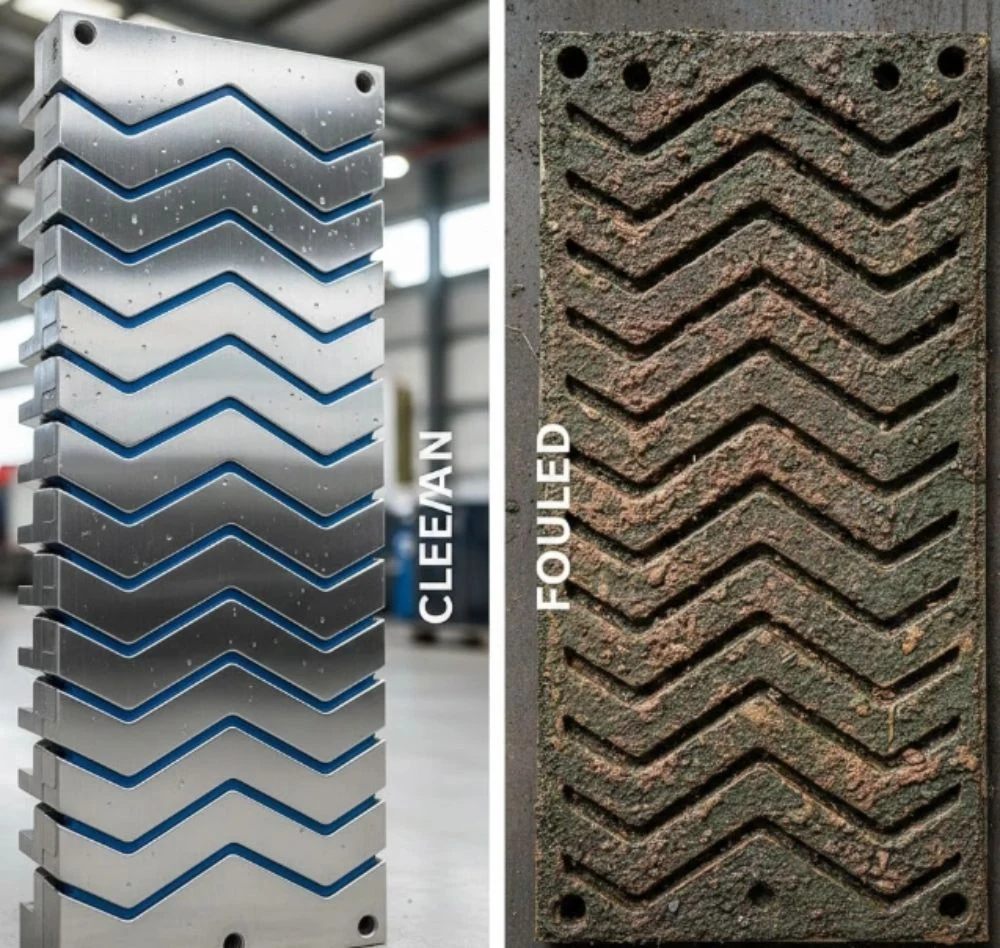
Do Not Treat the Chevron Pattern as Decoration
Corrugation record:
- chevron angle and pressing depth;
- distribution zone and contact pattern;
- left or right hand, often marked A or B;
- top orientation in the installed pack.
These features set the channel geometry and contact points. Use the element drawing or a verified schedule rather than rotating a plate until it appears to fit.
Mixed-pattern pack record: quantity by chevron type and the approved sequence. Replacing that mix with one convenient pattern requires a performance check.
Carry the exact plate designation through the quotation, packing list, bundle label, and assembly plan. The delivered stack should have an obvious place in the recorded sequence.
List the Open and Closed Ports
Not every plate has four open holes. Start, end, turning, and partition positions may be punched differently so the fluids follow the intended passes.
One wrong turning plate in a multi-pass pack can block a route or bypass part of the heat-transfer area. Even a single-pass pack can use special first and last plates. The schedule therefore needs plate order, hand, orientation, and hole pattern—not just a total quantity.
In a multi-pass unit, the arrangement of open and closed ports creates the intended flow path. Use the installed unit’s element or plate-arrangement drawing as the controlling record because an incorrect sequence can change performance.
Write the scope by position. “Replace three damaged plates at positions 18, 33, and 40” is more useful than “supply three plates.” For a larger order, list quantities by hand and punch pattern.
Order an Alloy Grade, Not “Stainless”
State the grade and the evidence required with it: certificate, lot traceability, or positive material identification where applicable. Review compatibility for both the process fluid and the cleaning chemical.
Order data: nominal thickness and alloy grade.
Measurement note: use the original record where possible; otherwise agree on the point and method before measuring a worn corrugated plate. For mixed-alloy packs, add material by plate position.
Check the Gasket as a Separate Part
Gasket identification:
- groove and cross-section;
- corners and venting path;
- fixing method: glued, clip-on, snap-in, slit-in, hook-on, or model-specific;
- elastomer compound and service range.
Color is supporting evidence, not proof of compound.
Confirm:
- gasket model and profile for the offered plate;
- compound and its service limits for the stated fluids and temperatures;
- fixing method and approved adhesive if applicable;
- special seals at start, end, partition, or nozzle positions;
- shelf life, storage, and installation conditions;
- delivery loose or preinstalled.
Bare-plate order: exact-groove gasket identification plus the approved compressed condition.
Existing Pack Record
Partial-replacement survey: thinning, corrosion, deformation, worn contact points, gasket condition, previous substitutions, and closed-pack dimension.
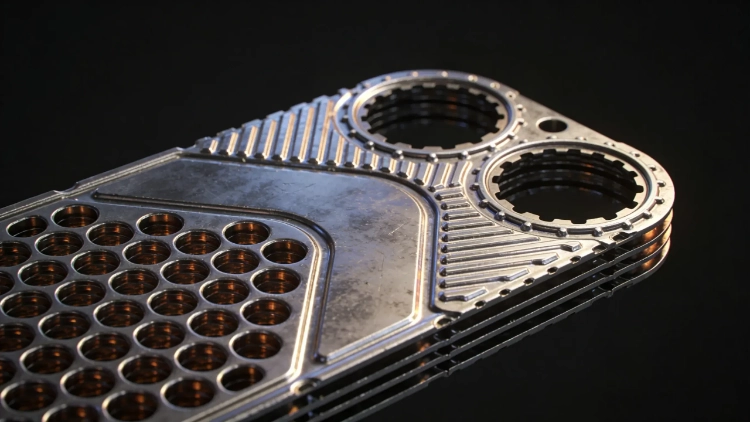
Removal record: numbered sequence, top mark, fluid-side mark, and any non-original parts. Use a non-damaging marking method.
Quotation status: approved for isolated positions, a defined section, or complete-pack replacement. Record any mixing restriction.
Grano publishes model families such as its Sondex plate and gasket list и GEA/Kelvion plate and gasket list. A list can narrow the inquiry. Release still requires confirmed dimensions, hand, punch pattern, alloy, thickness, gasket, and sequence.
Record Plate Count and Tightening Length Together
Record together:
- ordinary and special plate count;
- measurement locations;
- compressed distance before opening;
- approved closing range for the new gasket set.
The old compressed measurement may not be the target for new gaskets.
The installed exchanger’s manual should define the tightening length, measurement positions, and acceptable frame alignment. That equipment-specific manual remains the control document.
Changed plate count, thickness, or gasket: verify bar length, bolts, movable plate travel, and connection geometry.
Agree the Inspection File Before Shipment
Decide how delivered parts will be identified and checked. Depending on service risk, request:
- supplier part number and cross-reference to the installed model;
- controlled drawing and dimensional inspection report;
- alloy and nominal thickness;
- material certificate or traceability record;
- pressing and edge inspection;
- crack or penetrant test where specified;
- gasket batch, compound, and fixing method;
- quantity by plate hand and hole-punch pattern;
- packing list with bundle labels and sequence information;
- warranty scope and handling exclusions.
Receiving check before the shutdown: ports, hanging details, grooves, edges, markings, and quantity. First-article scope and batch-inspection scope should be listed separately.
Tolerance source: controlled drawing or model-specific inspection plan.
Packing and Storage Record
Packing basis: rigid support; clean, dry surfaces; protected edges; straps clear of plate edges.
Bundle label: alloy, hand, punch pattern, quantity. Storage notes: contamination control for alloy plates and gasket protection from heat, sunlight, ozone, oils, and incompatible chemicals.
Receiving action: reconcile the packing list, photograph damage, and quarantine bent corners, distorted ports, damaged grooves, or unclear labels.
Грано service and logistics information covers packaging inspection, shipment support, and plate-exchanger cleaning. Purchased scope should identify packing, destination, storage period, records, and field work.
Outage Work Pack
Safe-state checklist: isolation, zero pressure, drained circuits, acceptable temperature, and verification under the equipment procedure. Record sequence and pack dimension before moving parts.
Closure checklist: clean sealing surfaces, correct orientation, even frame movement, and approved final dimension. Separate repairs for seized bolts, bent guides, uneven frame plates, and pipe strain.
Post-assembly steps: alignment inspection and the required leakage or hydrostatic test within design limits. The responsible engineer or authorized service provider sets pressure, medium, duration, exclusion zone, and acceptance criteria according to the installed unit’s manual.
Tools and consumables: test blinds, calibrated gauges, suitable water, drainage, lifting tools, spare gaskets, replacement fasteners.
Build the RFQ Around Identification and Scope
A useful request includes:
- manufacturer, model, serial number, and year;
- nameplate and full-frame photographs;
- original assembly, element-configuration, and thermal drawings;
- total plate count and quantity to be replaced;
- plate sequence, hand, pattern, and hole-punch schedule;
- overall dimensions, ports, centers, and hanging or guiding details;
- alloy grade, nominal thickness, and required certificates;
- gasket model, profile, material, and fixing method;
- fluids, concentrations, temperatures, pressures, and cleaning method;
- current and specified tightening dimensions;
- replacement strategy: individual plates, section, or complete pack;
- quality records, packing, delivery date, warranty, and field-service needs.
Missing drawings: agree on measurements, rubbings, samples, or site checks; retain an open-point list until identification closes.
For a Grano inquiry, request confirmed geometry, material, open points, and a clear distinction between fit review and thermal redesign. Records can be sent through the Grano contact page for marked confirmation.
Replacement Plate Purchase Checklist
Written release checklist:
- installed make, model, serial number, and drawings identified;
- plate outline, ports, centers, carrying feature, and guiding feature match;
- corrugation pattern, pressing depth, plate hand, and orientation are confirmed;
- hole-punch pattern and sequence are listed by quantity;
- alloy grade and nominal thickness match the approved service basis;
- gasket profile, material, fixing method, and special gasket types are defined;
- partial replacement versus complete-pack use is stated;
- plate count and final tightening dimension are compatible with the frame;
- inspection file, traceability, labels, packing, and warranty included;
- assembly procedure, tools, spares, and leakage test planned.
Order release requires one traceable chain across the quote, drawing, plate schedule, labels, and quality file.
Заключение
Release the plate heat exchanger plates only after the compatibility file is complete and before the frame is opened.