



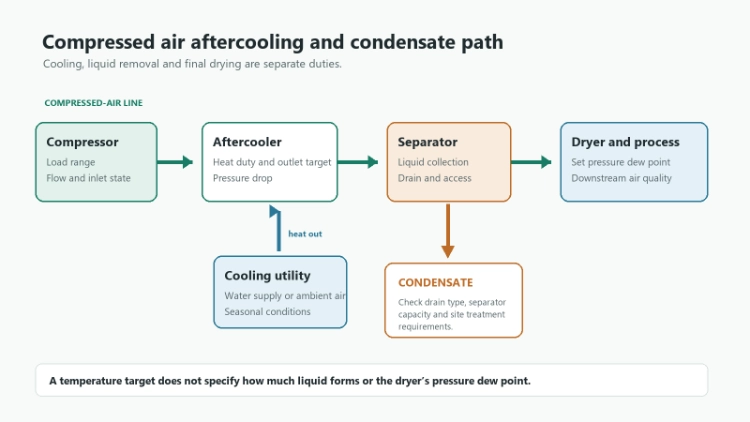
The water condensed by an aftercooler needs a route out of the air line. In a quotation I want the separator and drain named, not hidden under a promise of ‘dry air.’ The cooler sets an outlet temperature; the dryer has to achieve the pressure dew point. Those duties belong on separate lines so the package supplier cannot answer one question with the other’s figure.
A compressor motor size is not a heat-duty calculation. Give the exchanger bidder the air conditions at its inlet and the cooling utility available at the site. If the compressor loads and unloads through the afternoon, record those operating steps and their duration instead of sending one convenient design point.
|
Component |
Its job |
Specify separately |
|
Aftercooler |
Lowers air temperature |
Outlet temperature and air-side pressure loss |
|
Separator and drain |
Removes liquid water |
Condensate load, drain type and discharge route |
|
Dryer |
Controls moisture at pressure |
Required pressure dew point and inlet limits |
What an aftercooler does in a compressed-air system
On the cooler data sheet, I would put outlet air temperature next to the flow and cooling-water case that produced it. On the dryer sheet I would put pressure dew point at its stated operating pressure. They are not interchangeable numbers. The cooler may knock water out of the air; it has not promised what moisture level the dryer will deliver.
A package vendor may highlight ‘dry air’ in the quotation. Ask what was actually measured and where. Cooler outlet temperature belongs at the exchanger exit; dryer dew point belongs to the dryer performance case. The process sketch should show both points so bids can be compared on the same basis.
Which operating data define aftercooler duty?
I would take the air figures at the compressor discharge connection. Catalogue capacity is a starting reference, not necessarily the flow arriving at the exchanger. Note peak, normal and unloaded cases, including a hot utility case if the plant keeps running in summer.
Air flow, inlet temperature, and required outlet temperature
I would send three inlet cases from the exchanger flange: low, normal and peak flow. Each needs pressure and temperature beside it. Label the flow basis as actual, standard or normalized cubic metres; otherwise two bidders may rate different amounts of air while appearing to answer the same RFQ.
Check what temperature the dryer can accept at its inlet before fixing the cooler target. The process may impose its own limit. Include the reduced-flow case as well: if one line shuts down and the compressor runs on, the inlet conditions and the time spent at that load belong on the sheet.
Tell the bidder about oil carryover or a gas mix other than ordinary air. Both may affect materials, separation and cleaning. A note on page one is better than finding out after the rating assumed clean air and clean water.
Inlet pressure, pressure loss, and operating range
For an aftercooler drawing, the entry for how much pressure the shell must hold is distinct from what pressure can be shed by the air line. I set the mechanical maximum at the threshold of design line. Along with the filter, valve and piping losses that should already be in your plant budget next to them onthe operating line ask for some low normal and peak flowlosses.
An impossible therefore unit from a fitting and servicing perspective could still meet the heat duty. As a replacement, send images of the connections and supports, center to heart measurements; whip-free direction and free space for also pulling back however many group as could reasonably be expected. For the orders which we are making, Before the purchase order goes out Ask maintenance to check Drawing.
Cooling-water conditions and seasonal variation
The water utility sheet should travel with the RFQ. Record its source, flow, pressure, treatment, contaminants and the supply-temperature range, including summer conditions. Tower water, a closed loop and once-through water can provide entirely different answers to the cooler bidder. Use the facility that will actually hit this machine. Use the utility that will actually get to this machine.
For an air-cooled quote, specify the temperature at the fan inlet in the compressor room, not the outdoor forecast. Discharge air can circle back. Include the room’s ventilation, clearance, dust, noise and fan-power limits. CAGI’s compressed-air system selection guides give background, while the vendor’s rating must use this actual fan-inlet case.
How does condensate form, and where should it be managed?
If you cool the compressor discharge, some vapor can condense into liquid. All of these amounts are dependent on; inlet moisture, pressure and how much the temperature shifts. You cannot size a separator from the outlet-temperature target; therefore, force the bidder to specify what condensate basis it used. You cannot size a separator based on the target outlet temperature alone, so require that the bidder state which condensate basis it used.
Show the separator, drain and discharge on the piping sketch. The separator may be inside the cooler, at a pipe low point or in its own vessel; the drawing should settle which. State drain capacity and where the liquid goes. A manual drain needs an assigned operator task. For an automatic drain, show how a failed valve will be noticed before water reaches the dryer.
Ask if the condensed water will contain compressor oil. Then name the collection point, treatment or disposal route, and the party supplying the receiving pipe. The word ‘drain’ on a nozzle schedule does not assign that work to either vendor.
The dryer specification should state the required pressure dew point and the cooler conditions allowed at its inlet. The aftercooler can reduce the load on it, but cannot guarantee the dryer’s result. If a plant sees wet instruments despite the outlet-temperature target being met, I would inspect the separator, drain and dryer before buying more cooling surface.
What exchanger configuration fits a water-cooled aftercooler?
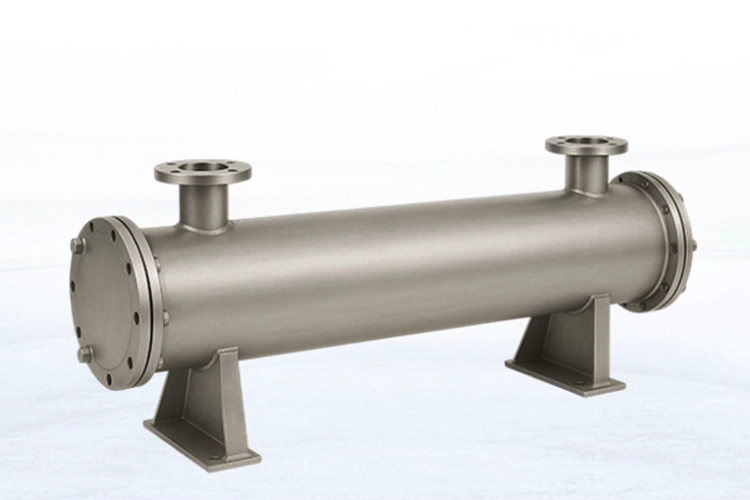
The word ‘aftercooler’ does not select a construction. I would compare duty, allowed air pressure loss, water quality, design pressure, compatible materials and cleaning space, then ask the bidder to show the inlet assumptions behind the rating.
Air-side pressure drop and flow distribution
Shell-and-tube may suit some air-to-water duties, subject to an actual rating. Compressor loading changes air flow; pressure loss must be checked against the available line budget, including filters, at the relevant cases rather than at one quoted point.
Getreide‘s shell-and-tube exchanger range and detachable plate products provide possible constructions. A category page does not select a model for this compressor. Send the inlet cases and ask Grano for an air-to-water rating; Über uns is background on the maker, not the rating report.
Water-side fouling, materials, and cleaning access
Gaskets separate each of the plates in a detachable plate exchanger, allowing the unit to be opened. Which is only useful where the plate pack can be pulled by the installer. In case untreated water commits fine solids, it may also deposition, but is too restrict a path and raise loss pressure where. Hence, the RFQ should indicate filtration and cleaning way with service clearance.
Grano can offer plates in stainless steel, copper, aluminum, titanium or nickel. Send the cooling-water details and any compressor-oil carryover with the RFQ, then have the bidder identify the chosen plate and gasket. Nitrile grades resist oil; EPDM is useful with water but unsuitable for petroleum-based products. Check both choices at the working temperature, not only by material name.
Keep the commissioning readings: flow, both inlet and outlet temperatures, and pressure losses. Later, they help show whether the utility changed or fouling developed. Check water treatment before adding surface area. Grano’s fouling and maintenance guide can inform the inspection plan; opening the equipment still follows site isolation and the lockout/tagout principles in OSHA’s control of hazardous energy guidance.
How to build an aftercooler RFQ that supports accurate sizing
The first RFQ attachment should be a process sketch. Mark whether the cooler is within the compressor package or is a separate piece of equipment, then put the separator, drain, sensors, bypass, controls and connecting pipes on the relevant supplier’s side of the scope line. That prevents a cheap quotation from leaving them unpriced.
Attach these RFQ fields:
- Air: low, normal and peak flow, with each reference state.
- Inlet: pressure, temperature and moisture; also state the outlet-air target.
- Unload pattern, staging sequence and startup conditions that affect operation.
- Cooling utility: water source, temperature, flow, pressure and quality; for air cooling, fan-inlet ambient and ventilation.
- Design pressure and maximum pressure drop for both streams.
- Condensate estimate, separator and drain scope, drain type and disposal requirements.
- Mechanical: materials, connections, orientation, footprint, supports and service access.
- Deliverables: controls, alarms, tests, drawings, spares and commissioning readings.
Use the ASME B31.3 Process Piping standard for the associated pipework if it governs the plant specification. It does not rate the exchanger’s heat transfer. An air receiver in the package is a separate vessel; in the U.S., OSHA’s air receivers standard is relevant to its inspection basis. Put duty, outlet temperature, pressure loss, materials and bid exceptions in a common return sheet so omissions are visible.
Installation and commissioning checks
Before starting the compressor, walk the installation against the signed drawing. Look at supports, pipe connections, valves, vents and drains. Clear construction debris by the supplier’s procedure, then trace the condensate outlet all the way to its receiving point. It must stay accessible after guards and neighboring machines are fitted.
During each agreed compressor load case, log the flow, inlet and outlet temperatures, pressure and loss across the cooler. Watch the drain while the machine is running. Those records make a later fouling complaint easier to separate from a changed load or utility supply. If pressure loss rises, check filters and valves too. Maintenance using compressed air remains subject to OSHA’s compressed-air cleaning requirement, including guarding and protective equipment.
Häufig gestellte Fragen
Does an aftercooler remove moisture from compressed air?
Some vapor condenses as the air cools. The separator and drain take out that liquid. The dryer is still responsible for the specified pressure dew point.
Is an air-cooled or water-cooled aftercooler better?
Use one outlet-air target for both offers. Air cooling needs the fan-inlet summer case, ventilation, noise and power checked. Water cooling needs the actual supply temperature, treatment, availability and discharge route. The better option depends on which utility the site can really provide.
Does an aftercooler replace an air dryer?
No. The aftercooler changes temperature and may condense water. Pressure dew point remains the dryer’s responsibility.
Which data matter most when sizing an aftercooler?
Which it has as data to You compressor flow and its reference conditions, pressure and temperature at the cooler inlet, target of exit, water or air-inlet fan available as well like the allowed loss of Pressure; condensate discharge plan. Insert the load sequence and inlet limit of downstream dryer. It is simply too little basis to size from a motor nameplate.
Abschluss
Before comparing quotations, agree which compressor cases count, how much line pressure may be spent and who removes the condensate. Send those conditions and the utility range to Grano through Contact Grano, and ask for the assumptions behind its rating.


