



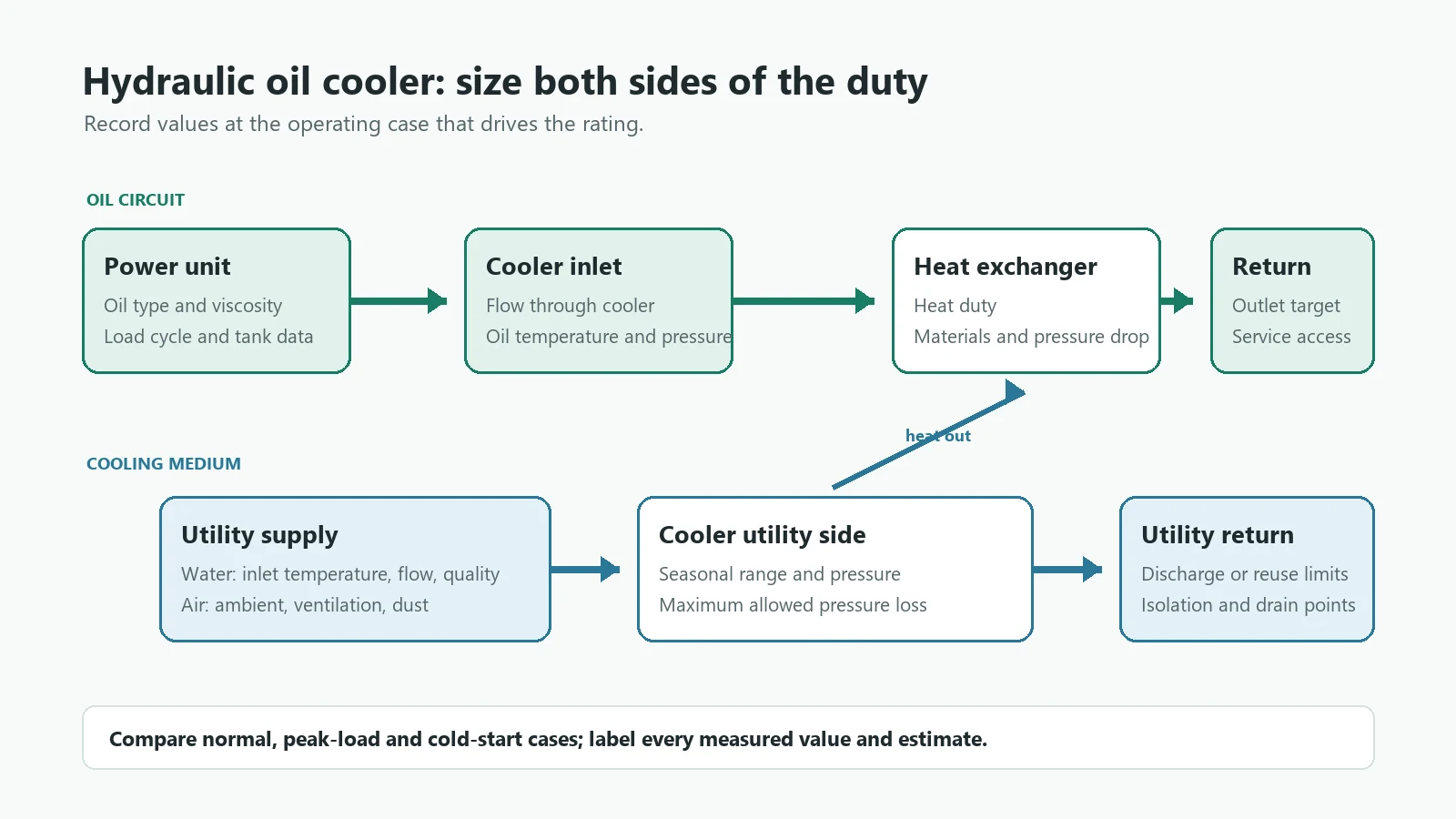
On a hydraulic power unit, the pump may deliver more oil than the cooler ever sees. A bypass can take part of the flow elsewhere. Before asking for a heat-exchanger rating, I would draw the route at idle, ordinary work and peak duty, with the cooler branch clearly marked.
I would put the oil and cooling-water readings on the same time line. The hottest oil from a hard shift cannot fairly be rated against water measured on a milder day. A press may warm during repeated strokes and settle during idle time, so the log should show both the stroke sequence and the utility conditions alongside it.
At a Glance
- The cooler rating needs the oil passing through its branch after any bypass split.
- Every case row needs its oil reading and the water or fan-inlet temperature taken with it.
- Before comparing prices, make sure the vendor rated the hot cycle and the viscosity at cold startup.
|
Operating case |
Data to capture |
何が変わるのか |
|
Hot production cycle |
Cooler-branch flow and oil inlet temperature |
Peak heat duty |
|
Cold start |
Oil grade and startup flow path |
Viscosity and pressure loss |
|
Summer utility |
Cooling-water inlet range or fan inlet air |
Available temperature difference |
|
Bypass operation |
Valve position and split flow |
Actual flow through the exchanger |
What an industrial hydraulic oil cooler needs to control
A reservoir gauge often changes slowly while the return line heats quickly through a repeated high-load movement. Note how many strokes occur, their duration and the idle gap. That sequence tells the supplier more about peak cooling duty than a shift-average motor figure.
Cooler-branch flow is what goes through the exchanger after the valves and bypass. Heat duty is the rate of heat to be removed; pressure drop is the resistance at a given flow and oil viscosity. A unit can hit the outlet temperature and still be too restrictive with cold oil. Another may have easy flow but fall short when summer water warms. The rating must show both limits for each relevant case.
Heat load, operating cycle, and reservoir conditions
If plant readings support the duty, note where and when they were taken. An estimate needs its working: pump and motor input, circuit pressure, relief-valve flow, leakage, actuator output and run time. Part of the motor’s input performs work elsewhere; it should not all be entered as heat in the oil.
Take the oil temperatures at the cooler connections when checking a proposed duty. A large reservoir sensor may average away a hot return stream; one right next to a return nozzle may overstate it. Mark the bypass rejoin and sensor locations on the circuit drawing. For a press with brief hard strokes and long idle intervals, ask for a peak rating and an idle case; one nominal point will not explain both temperature control and pressure loss.
Oil temperature limits and ambient conditions
I put the oil grade and temperature ceiling from the machine or fluid supplier at the top of the case sheet. The cold-start temperature goes beside them. Oil that is thick on startup may create the worst pressure loss, even if hot duty drives exchanger area. Show the startup flow path and bypass position with that case.
Water conditions belong at the cooler connection, including the hot-season inlet temperature. A tower, closed loop and once-through line differ in temperature and fouling behavior. An air-cooled bid needs the temperature in its cabinet at the fan inlet, where exhaust may recirculate. I would also flag dust, oil mist, vibration, washdown and nearby corrosive exposure.
Which inputs are needed before sizing a hydraulic oil cooler?
Each case row should describe one real machine state, with cooler-branch flow, oil temperatures and utility readings from that state. Put ‘estimated’ next to any unmeasured figure. For summer water with a broad uncertain range, get an outlet prediction at both limits. That shows whether the uncertainty could change the order decision.
Oil flow and inlet/outlet temperatures
Trace the cooler branch on the hydraulic drawing before entering a flow number. Pump displacement and rpm do not account for compensation, relief flow, leakage or a bypass. A suitable branch meter can settle the question on an existing machine. Without one, include the estimate method and show the valve positions that support it.
Mark the inlet-temperature sensor on the sketch and say which equipment limit sets the target outlet. An old cooler’s performance is historical data, not necessarily the requirement. I would ask vendors for predicted outlet readings at each named load so a nominal capacity cannot hide a weak hot case.
Cooling-water or air-side conditions
For a water side quote you will require the temperature, pressure and flow availability as other users of this site may also be pulling out water. That usually means a filter, so include treatment if necessary as well and any solids or scale problem known. Or else the waterproof rating might seem good on paper and lose performance as deposits accumulate in service. Otherwise a clean-water rating can seem good on paper and lose control as deposits accumulate during service.
It requires the position of its fan on the layout for an air-cooled design. Use all clearances, the path of ventilation and inlet temperature fitted to its expectation followed by dust, oil mist power and noise constraints. See where that hot exhaust goes; returning it to the inlet can ruin a reasonable rating. Look at where the hot gas ejects to: feeding it back into the inlet can ruin an otherwise sensible rating.
Allowable pressure drop and operating pressure
Separate the mechanical maximum working pressure from allowed pressure loss. The latter is what the pump must overcome at a named flow and viscosity. State limits for oil and utility separately at normal and peak conditions, and at cold startup where relevant. Label data-sheet pressures as gauge or absolute.
For a replacement power unit, send connection centers and support positions, plus the space needed to remove the cooler. Mark isolation, vent and drain access. Those dimensions can rule out an awkward construction before detailed thermal calculations are traded.
How do cooler construction and materials fit the circuit?
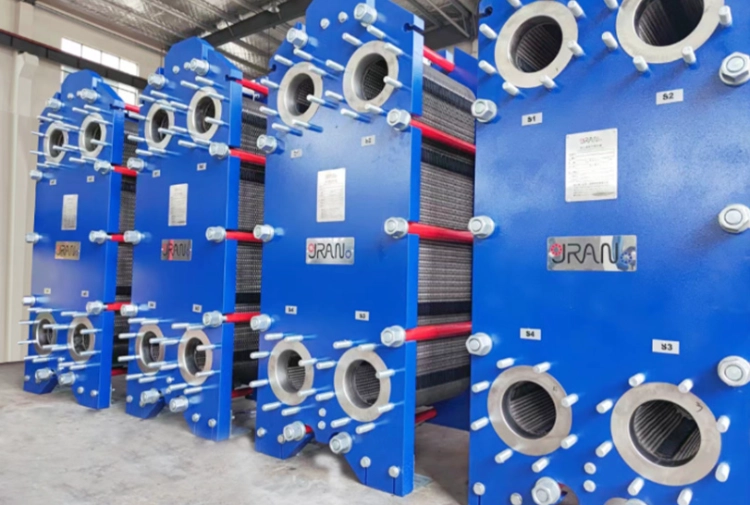
粒‘s plate and shell-and-tube offerings are possible starting points; plate exchangers are used in hydraulic applications. The shell-and-tube heat exchanger range そして detachable plate exchanger range are category pages, not an oil-to-water selection for this machine. Send Grano the case sheet and request rated duty, losses and materials for a model. 私たちについて provides maker background.
Do not compare a shell-and-tube bid on one utility case with a plate bid on another. One may offer a better cleaning route or pressure-loss fit; the detachable plate pack may be easier to open. Keep heat duty, utility temperature and allowable loss identical before judging the construction or price.
If a detachable plate exchanger is on the shortlist
A detachable exchanger clamps corrugated plates and gaskets in a frame. The service drawing should show not only its installed footprint but the space to release the bolts and take plates out. If the power unit bay cannot provide that clearance, ‘detachable’ offers little practical advantage.
Grano lists stainless steel, copper, aluminum, titanium and nickel for plates. Ask which one is compatible with this oil’s additives and the cooling utility. The gasket also sees both fluids: nitrile compounds offer oil resistance, while EPDM works in water service but not with petroleum-based products. The vendor should name the exact grade and allowed temperature.
Keep a compression-length record for the plate pack before anyone opens it. After plates or gaskets are replaced, close the frame evenly to its specified length and pressure-test. Spare gaskets should stay below 40°C in a cool, dry, dark place, protected from chemicals and crushing. None of those service steps makes an incompatible material suitable.
How should fouling and maintenance affect the specification?
The fouling question starts with what enters each passage. Hard water, fine solids, oil deposits and hydraulic debris call for different filters and cleaning access. A growing pressure loss or falling heat transfer can then be compared with the flows, temperatures and differential pressures kept from commissioning.
If the cooler runs hotter than it did at startup, I would first compare the utility supply, valve positions and strainers. Grano’s heat exchanger fouling guide is useful for inspection planning, but the plant must isolate the unit under its procedure and OSHA’s control of hazardous energy guidance before service. In the U.S., oil removed during that work is covered by EPA’s used oil management guidance; its oil spill prevention and preparedness regulations may matter where storage or transfer creates an obligation, with local rules also applying. Keep fluid safety information and use OSHA’s hazard communication standard for labeling and transfers.
What should an RFQ include for a hydraulic oil cooler?
Give every bidder the same circuit and installation drawings plus operating rows that pair oil and utility conditions in time. Include the duty calculation or its basis, oil grade, branch flow, inlet and target outlet, allowed loss, design pressure, materials, connections, access and controls. Put bypass, sensors and isolation valves into a named scope.
If connected piping uses ASME B31.3, state that as a pipework requirement. The ASME B31.3 Process Piping standard does not rate the exchanger’s thermal duty.
Check the quotation before comparing prices
Compare bids against the same summer utility case. Put rated duty, predicted outlets, flows, pressure losses, materials and assumptions in adjacent columns. A vendor who used cooler water or more flow should rerate before price comparison.
よくある質問
What data are needed to size a hydraulic oil cooler?
Send a measured or explained heat load, cooler-branch flow, oil inlet and target outlet, the worst matching utility case and allowed losses. The circuit sketch and machine cycle show why those numbers belong together.
Is a shell-and-tube exchanger suitable for hydraulic oil cooling?
Possibly. The actual proposed shell-and-tube model needs a rating for this oil, coolant, flow and duty, with pressure loss, materials and service access checked. Its construction label alone cannot settle the fit.
Should an RFQ use pump flow or cooler flow?
Cooler-branch flow. Valves and bypasses can split pump delivery, and that split may change while the machine cycles.
結論
A useful quotation says which operating case it covers. Send the sketch, readings and unresolved ranges through Contact Grano, and request the corresponding outlet temperatures and pressure losses.


