



“30 kW” looks like a complete requirement until two quotations arrive with different flow rates and different temperatures behind that number. Both suppliers may have done their calculations correctly. The missing part is an agreed duty, including what happens when the glycol is cold and when the storage water is already hot.
A solar thermal glycol heat exchanger works across a changing day. At startup the pump has cold fluid to move. Later there may be plenty of collector heat but little useful temperature difference left at the tank. Treating either condition as a small variation on the nominal rating can leave an uncomfortable gap in the purchase specification.
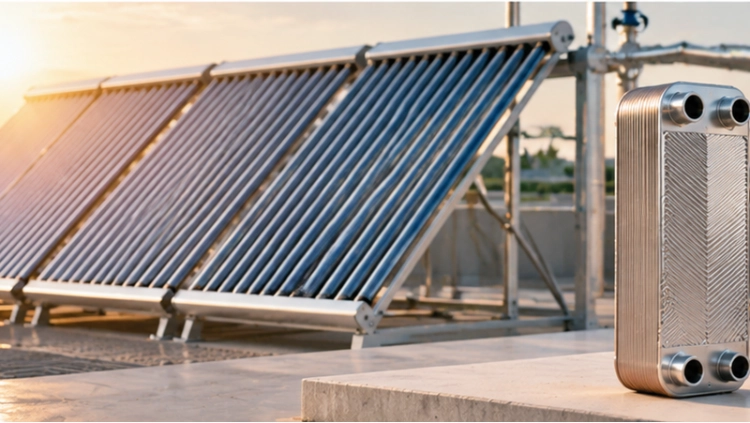
Start with the normal heat balance, then put cold startup and warm storage beside it. The fourth case is no demand. It needs a protection and control discussion, because a bigger exchanger cannot dispose of heat when there is nowhere for that heat to go.
Start with temperatures on both sides
An indirect system keeps the collector fluid apart from the water being heated. Heat crosses the exchanger between those circuits. This arrangement appears in the Department of Energy solar water-heating guidance, which is useful background for freeze-protected systems. It is the temperatures at the exchanger connections, though, that a supplier needs for the calculation.
There are four of them: collector-fluid inlet and outlet, water inlet and outlet. Write all four on the sketch. If the tank is stratified, an average tank temperature may not represent the water being drawn through its connection. Show the connection location as well; the temperature assigned to it must describe the condition being quoted.
Early in the heating cycle the tank may offer a relatively cool return. Later, with the tank much warmer, less temperature difference remains. Yet the enquiry may ask for the same heat transfer in both cases. That is the first issue to settle. Otherwise a supplier can select a unit at the easier condition while the buyer expects its nominal output throughout the day.
Use glycol properties in the calculation
The heat balance uses three inputs multiplied together: mass flow, specific heat and temperature change, or Q = m × cp × ΔT. The tempting shortcut is to use water properties. Resist it. Take density and specific heat from the chosen glycol product’s data at the concentration and temperature in question. A flow reading in litres per minute also needs conversion to mass per second using that density.
For example, use 0.50 kg/s as an assumed mass flow, 3.70 kJ/kg·K as an assumed specific heat, and a temperature fall of 12°C. Multiplication gives 22.2 kW. These example inputs illustrate the arithmetic only; a real selection needs the measured flow and temperature change with the actual mixture’s properties. No glycol concentration or tested Grano output is being specified here.
Now work backwards from the water circuit’s flow and temperature rise. A result far from the glycol-side calculation needs explaining. Check the measuring points and whether heat is lost between them, then revisit the input assumptions. Resolve the disagreement before it turns into an arbitrary allowance in the equipment size.
The pump check belongs at cold startup
The pump selection deserves a cold set of numbers. A calculation made with warm glycol can look satisfactory and still say little about the first circulation of a cold morning. Give the supplier the lowest planned circulation temperature, and obtain pressure loss at the flow intended for that condition.
That pressure loss goes into the circuit calculation along with the collectors, pipes, fittings and valves. The pump has to overcome the complete resistance. An apparently modest exchanger allowance can be too much if most of the available head is already needed elsewhere in the loop.
The concentration used in the quote should be the one that goes into the system. To choose it, use the fluid supplier’s freeze-protection data for the site conditions. A late substitution needs another thermal and hydraulic check, even if the replacement product is also sold as solar glycol. Keep the installer and equipment supplier working from the same fluid specification.
Keep freeze protection and stagnation separate
Freeze protection answers a winter question. On a sunny day, the tank may reach its target before collection ends. The system then has to cope with heat that is no longer being usefully removed. Giving the exchanger more plates doesn’t provide another place to put the heat. Stagnation protection has to be resolved in the system design.
For background on indirect systems and overheating, see PNNL’s solar water-heating guidance. The equipment enquiry needs a more specific answer: under the proposed controls, what conditions can reach this exchanger? Compare those conditions with the fluid limits and the ratings of the exact model offered. A broad temperature claim for the product family leaves too much room for an incorrect assumption.
Choose construction around the service plan
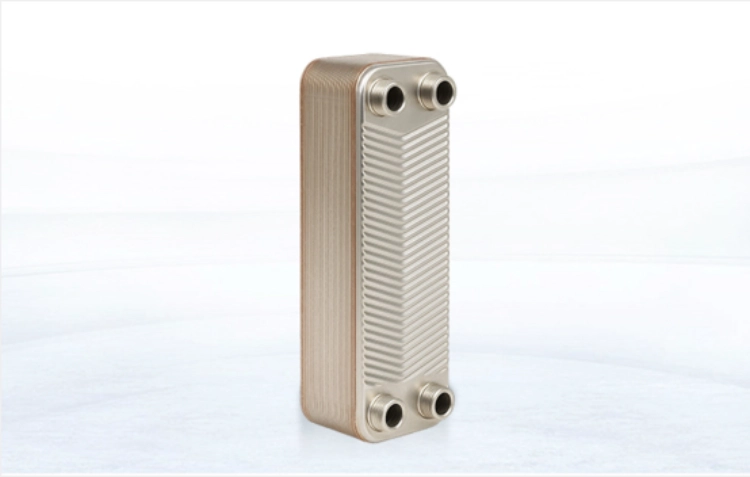
Grano supplies brazed units as well as detachable plate heat exchangers. El intercambiador de calor de placas soldadas offers a compact construction for consideration. Suitability still depends on the offered unit’s metal specification, including the joining metal, and its permitted operating conditions. Those details need to be checked against both fluids before purchase.
Brazed construction joins metal plates into a compact assembly. That differs from a detachable plate pack, whose heat-transfer plates and sealing gaskets are held between clamping plates with bolts. Its plates are located on guide rods. Corrugations run across the heat-transfer faces, while holes at the corners carry fluid to the passages between adjacent plates.
Leave some time in the specification review for maintenance access. A detachable unit can be opened for cleaning and inspection of individual plates. A brazed unit does not offer the same removable plate pack. If deposits are likely, the cleaning method deserves a place in the equipment discussion. So does replacement access, particularly where removing a failed unit would mean dismantling adjacent piping.
Allow for what water can leave behind
Poorly controlled water quality can leave scale on the heat-transfer surface. Heat passes less readily through that deposit because scale conducts it poorly. Blockage is another issue: particles and debris lodged in the plate passages can make pressure drop rise. Both circuits need attention to deposits, even though their fluids are kept apart.
For the detachable option, gaskets do more than close the perimeter; they also help form the fluid channels between plates. Their sealing faces should be flat and smooth, with no defects that spoil the seal. Bubbles, pits and flash on those faces are examples of defects that can interfere with sealing. Assembly requires clean corrugations and clean gasket grooves. Fit the gaskets without twists or displacement from those grooves. Choosing an appropriate rubber material is only part of obtaining a sound seal.
Grano’s parts offering includes plates, gaskets and bolts, alongside plate heat exchanger maintenance services. For plate and gasket orders, Grano can also bond the gaskets to the plates before dispatch when requested. Keep a record of the parts selected for this order. For a detachable exchanger, reserve space around it for maintenance. Mark that space on the layout before insulation, valves and nearby pipes fill what appeared to be an empty gap.
A small closed-loop package with clean fluid may favor a different arrangement from a system whose plates must be inspected regularly. The service plan helps explain why one is being chosen. Make that choice part of the order, where the maintenance team can review it.
Set the fluid-separation requirement before ordering
The words “water side” can hide an important difference. Name the service in full: perhaps a closed heating circuit, perhaps drinking water. Leakage into drinking water raises a different question from leakage into a closed process loop. Confirm the applicable separation requirements for the installation jurisdiction and the selected fluid before approving the arrangement.
A page headed “plate heat exchanger” cannot establish potable-water approval, double-wall construction or provision for detecting a leak. If the project requires any of these, get model-specific evidence before purchase. An intermediate circuit may be another proposal. Cost and check it as a working circuit, with its own pump and controls and another temperature difference in the heat-transfer path.
Settle this before accepting the thermal quotation. Changing the separation arrangement later can also change the temperatures available to heat the tank. It can turn an apparently minor approval issue into a new thermal selection.
Put four operating cases on the enquiry
Enviar Grano the four cases below with the enquiry. Blank inputs are easy to overlook, so mark them “not yet established” where necessary. That gives the quotation reviewer a visible question to resolve.
|
Caso de funcionamiento |
Information to provide |
Required check |
|
Normal collection |
Glycol identity and concentration, both flows, four temperatures |
Heat duty and outlet conditions |
|
Cold startup |
Lowest circulation temperature and pump information |
Glycol-side pressure loss and achievable flow |
|
Warm storage |
Highest tank-side inlet during useful collection |
Remaining temperature difference and transferred load |
|
No demand or abnormal heat |
Control response and credible exposure conditions |
Equipment limits and system protection |
Include a connection sketch and the water-quality information. Clean the connected pipework before startup so that sand, welding slag and other debris cannot be carried into the exchanger to block its channels. Follow the factory nameplate for the inlet and outlet directions. Do not infer the connections from the way the frame happens to face in the room.
When reviewing the offer, start with the case the nominal rating describes. Look for an answer to the cold-start question too, and written confirmation of the separation arrangement. Missing answers should be resolved while the model can still be changed. Save them with the calculation and material specification; that file will be useful if a different fluid or pump is proposed later.


