
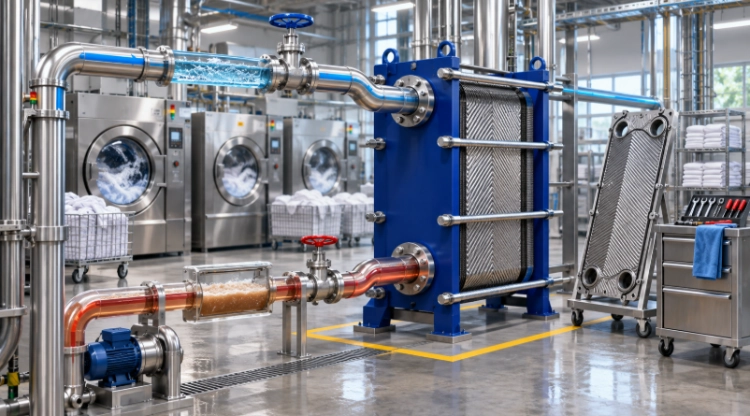
The hot drain in a laundry is easy to notice. So is the cold water coming in beside it. On a sketch, the pipes almost connect themselves. On a working shift, a drain that was hot at ten o’clock may be cool an hour later; lint arrives in waves, and batch machines empty without warning. A tunnel washer behaves differently. Rate a plate exchanger from one warm sample and the data sheet may look persuasive even while the installed unit sits bypassed or blocked for much of the afternoon.
There is a sound case for recovering this heat. The EPA’s industrial-laundry review records the industry’s use of exchangers to conserve energy. It does not tell a particular plant where to connect one. That takes a short survey of its own water circuit.
At a glance
- Follow a complete wash shift before choosing a heat-recovery connection.
- Size the screen and plate passage for actual lint and grit, then leave room to open the frame.
- Compare rated and commissioned performance at the same flow, temperature and wash pattern.
|
Survey case |
Reading to preserve |
Decision it informs |
|
Busy discharge |
Wastewater flow, temperature and solids |
Screen and surge handling |
|
Quiet interval |
Hot and cold flow at the same time |
Whether storage is useful |
|
Maintenance day |
Isolation route and plate-removal space |
Whether the pack can be serviced in place |
Start at the drains, then find a useful cold stream
Walk the discharge route. Which washers empty into it? Does the warm flow appear during every shift or only when certain programs run? Does a clean rinse mix with a heavily soiled wash before the proposed tie-in? A sample taken at an upstream tank might miss the very mixing that governs the exchanger inlet. Watch the proposed connection during a complete cycle. The total on the daily meter is useful for billing. It cannot tell you whether ten minutes of heavy flow pushed debris into the screen.
Now trace the incoming water. Preheating it before a wash-water heater is a plausible use for the recovered energy. But the two flows need to overlap. At the end of a batch, warm wastewater may arrive just after the incoming-water valve shuts. Storage could bridge that mismatch. It also brings a tank to clean, a level to control and space to find in the plant. Price the whole circuit, tank included.
Give lint somewhere to stop before the plates
Look in the drain basket after a busy load: fibers, labels and grit are common reasons a narrow passage stops flowing. The supplier’s proposed channel width should set a practical upper limit for what reaches the plates. Choose the upstream screen on that basis, with room to clear it and a pressure reading across it. Otherwise a plugged screen may present itself as an exchanger problem, and the maintenance crew will open the wrong piece of equipment.
One warm surge can exceed the normal flow many times over. Will the tank absorb it? Will the bypass open? Will the pump trip? The answer changes pressure loss and heat recovery. Do not use the highest observed instant as if it lasted eight hours, but do not make it disappear in a daily average either.
Decide how the clean side is protected
A standard gasketed plate pack separates the liquids with a metal wall and seals. What would the operator see if that wall developed a small leak? If the cold side feeds washing water, the answer has water-quality consequences. Work through the direction of flow with both pumps running and with one stopped. The site may require a pressure hierarchy, leak indication or an additional barrier. Isolation and bypass valves then let the laundry continue while the pack is checked, without silently connecting dirty water to the clean line.
Measure temperature where each pipe meets the unit. A probe after a mixing valve reports the blended water, even if the exchanger itself is weak. The pressure taps need to isolate the pack too. Put one pair across the screen and another across the plates, or a later pressure rise will start an argument rather than a diagnosis.
The shift log is the sizing document
Keep the hot- and cold-side readings on the same line of the shift log, taken at the same time. Record a busy period and the low flow after a wash cycle, with inlet temperatures, the clean-water target and available pump head. Repeat the exercise when makeup water is coldest. A night or weekend shift needs its own entry if the wash mix changes; otherwise the quoted duty may describe a shift the plant rarely runs.
If the requested clean-water outlet is almost as hot as the waste entering the unit, the last part of the transfer has little temperature difference to work with. Ask how much area and what flow arrangement that requires at the least favorable inlet pair. Keep the four temperatures, both flows and pressure losses beside the kilowatt figure when comparing quotations.
Do not leave fouling buried in a generic allowance. The mix of oil, detergent residue, mineral deposits and fibers depends on the textiles and wash program. Send a sample or analysis that represents the troublesome part of the shift. How often can the plant stop to open the pack? The DOE heat-transfer brief includes fouling and expected loads in equipment evaluation. An attractive clean-water rating will not preserve its own performance once deposits arrive.
How much pump head can this recovery loop spend? Write that figure down before comparing rated units. At startup, keep readings from a known wash pattern. If the pressure loss climbs months later and recovery falls, the crew can work from the screen toward the pack. If pressure stays steady while temperatures move, the wash recipe or makeup-water season may explain more than a dirty plate. Inspection then follows the evidence.
Buy a pack the maintenance crew can actually open
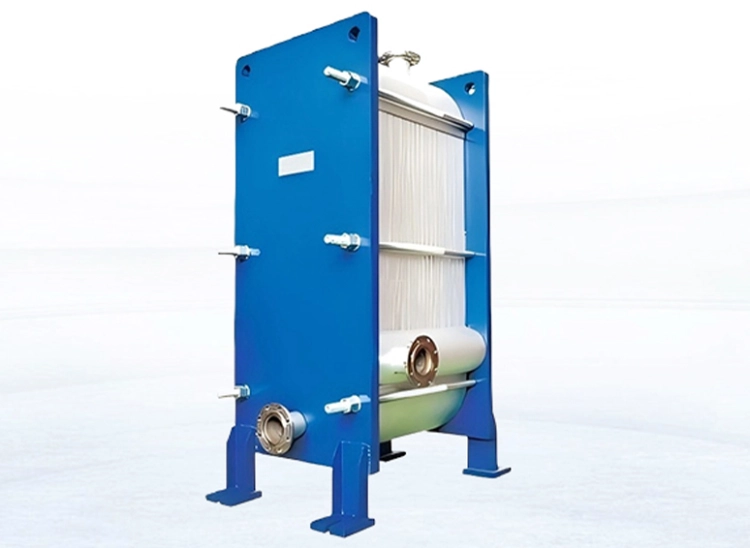
On this stream, access can matter more than the smallest possible footprint. Grano’s detachable plate exchanger family puts corrugated plates in a clamped frame, with gaskets forming separate channels. The pack can be opened so a technician can see deposits and clean the affected surfaces. Grano’s supplied product information also lists replacement plates and gaskets. Those parts give a plant a repair route when a plate is damaged or a seal ages, provided the exact pack configuration is recorded.
“Same frame size” is not enough when a spare part is needed. In the Grano assembly, a corrugated plate hangs within a frame squeezed by clamping plates and bolts; sealing pads around the ports send each liquid down its assigned channel. Save that plate order and the closing dimension with the equipment drawing. On reassembly, use the specified parts and tighten the pack evenly to that dimension. Mark the space needed to pull a plate out. A pipe rack across that space turns a nominally openable design into a shutdown job.
Take the dirty-water sample and the cleaning-fluid label to the materials discussion. Grano offers stainless-steel and titanium plate options. The proposal still needs to name a gasket and connection materials for this effluent, along with a reason for each choice. Chloride, pH and temperature readings help settle the plate question; the cleaner can change the seal question. Get the wetted-material list for the unit being quoted. A permanently joined core might fit a cleaner stream, where opening the channels is less important; here the maintenance cost could dominate the small footprint benefit.
گرانو کا frame-exchanger maintenance article is useful background for setting observations, but the plant’s own baseline should decide when to inspect. Copying someone else’s cleaning interval will miss changes in detergent use, fabric mix and intake water.
Turn the quote into an acceptance test
Send the circuit sketch and paired shift log with the enquiry. Include the water analysis, pump-head budget, connection and code requirements, and a photo of the opening space. Name the crew that will clean the pack. In return, ask for low, normal and peak ratings, wetted materials, passage and screen assumptions, spare-part IDs and opening clearance. The commissioning team needs a temperature at a stated flow to check, rather than a claim of high efficiency.
Use a known wash pattern for commissioning. Put the measured temperatures, flows and pressure losses beside the corresponding supplier rating. Operate the bypass and isolation valves in the sequence staff will use on a maintenance day. If a leak or shutdown could connect effluent to clean water, correct the piping or response plan before normal operation. Annual energy estimates can then use the number of hours represented by each measured case.
For a model-specific discussion, send اناج the shift log and the circuit sketch. Those two items will reveal more than a request for the largest exchanger that fits the room.
اکثر پوچھے گئے سوالات
Can raw laundry discharge run through a compact plate pack?
Sometimes, after suitable screening and a channel and cleaning review. Lint and grit do not vanish because the plates are corrugated. The supplier needs the real solids load.
Is heat recovery the same as reusing the water?
No. Warmth passes through the plate; the used wash water stays on its own side. Reusing that water would require a separate treatment and quality decision.