
Une utilisation correcte commence par la vérification de l'installation, un démarrage contrôlé, un fonctionnement stable et un entretien régulier. Ouvrir une vanne trop rapidement peut provoquer une surpression ou déplacer un joint.
Pour des équipements de transfert de chaleur compacts et faciles d'entretien, Grain Ces unités à joints d'étanchéité, dotées de plaques métalliques ondulées et de configurations flexibles, permettent un transfert efficace, un contrôle précis de la température et un nettoyage et une inspection aisés. Les accessoires de maintenance facilitent également la manipulation des fixations du châssis.
Principes de fonctionnement des échangeurs de chaleur à plaques
Comprendre comment interagissent le bloc de plaques, les ports et le châssis permet d'identifier les tuyauteries incorrectes, les serrages inégaux ou les configurations d'écoulement inadaptées avant la mise en service.
Empilement de plaques ondulées et voies d'écoulement à quatre ports
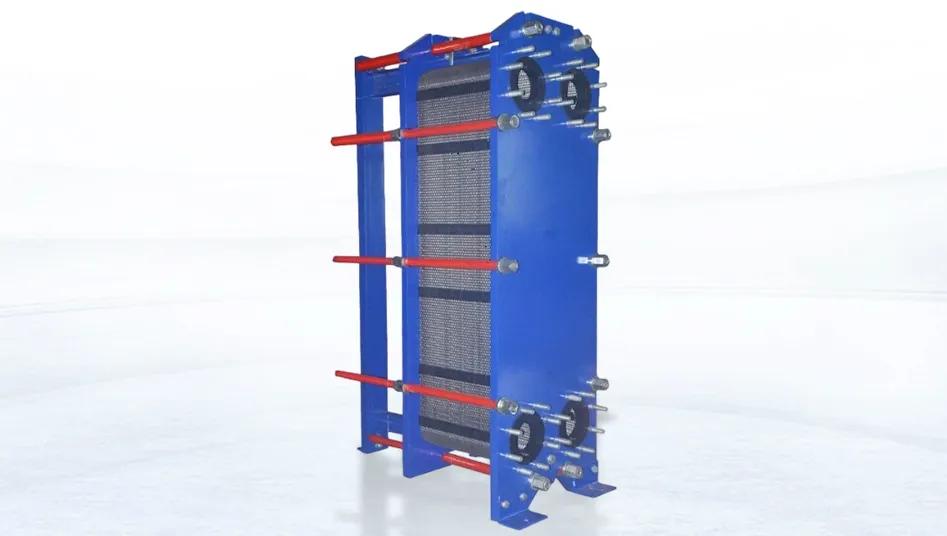
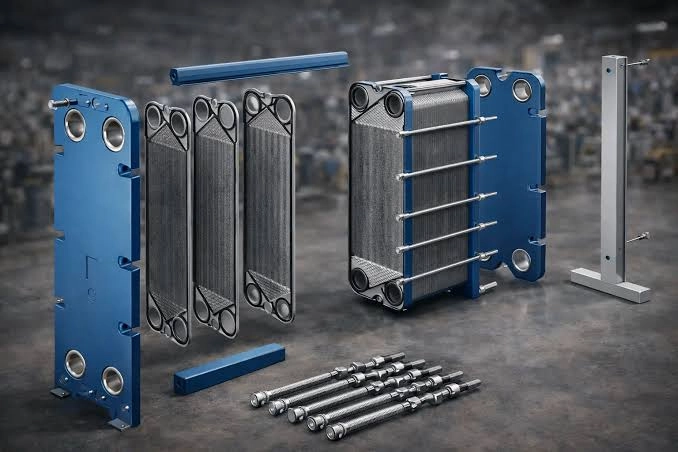
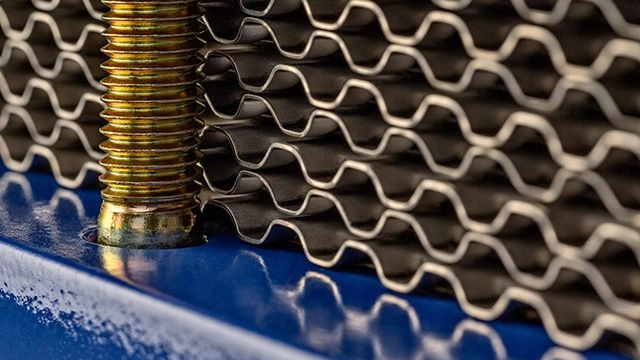
Un joint d'étanchéité Échangeur de chaleur à plaques Il est constitué de plaques métalliques ondulées empilées. Quatre orifices situés aux angles acheminent les fluides chauds et froids à travers des canaux séparés, où la turbulence favorise un transfert de chaleur efficace au sein d'une structure compacte.
Les plaques sont suspendues à une tige de guidage supérieure et s'alignent sur une tige de guidage inférieure. Lors de l'inspection, vérifiez qu'aucune plaque n'est tordue, inversée ou mal positionnée.
Ensemble de plaque de serrage fixe et mobile
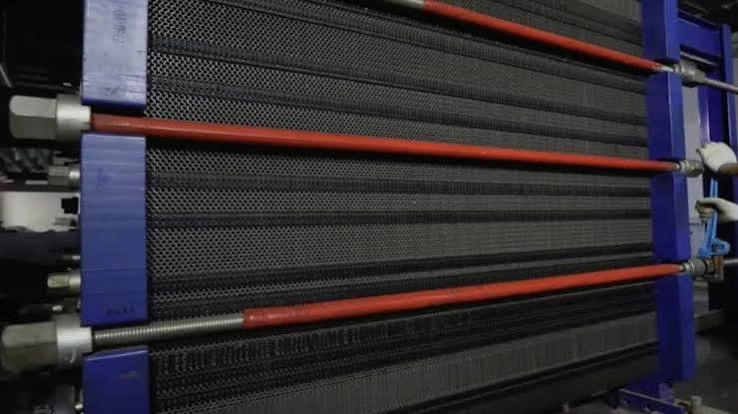
Un cadre fixe, une plaque de serrage mobile et des boulons de serrage maintiennent l'ensemble de plaques. Le cadre peut être ouvert pour le nettoyage ou l'inspection sans avoir à démonter tous les composants.
N’utilisez pas le cadre comme plateforme de support. Les charges sur les tuyaux, les impacts et un mauvais alignement des fondations peuvent fragiliser le faisceau et les connexions.
Connaissance de la configuration en une seule passe et en plusieurs passes
Les configurations à passage unique raccordent généralement les canalisations au niveau de la plaque fixe. Les configurations à passages multiples acheminent le fluide à travers plusieurs sections, ce qui exige une attention particulière lors de la tuyauterie et du remontage.
| Configuration | Caractéristique principale | Préoccupation pratique |
|---|---|---|
| Passage unique | Les connexions sont généralement situées sur la plaque fixe. | Tuyauterie simplifiée et accès facilité pour l'entretien |
| Multipass | Le fluide change de direction à travers plusieurs passages. | L'ordre des plaques et la disposition des ports nécessitent une vérification plus approfondie. |
Ne copiez jamais le schéma de tuyauterie d'un autre appareil en vous basant uniquement sur l'apparence du châssis ; son agencement interne peut différer.
Inspection et préparation avant démarrage
Inspectez l'échangeur dans son intégralité après installation, stockage prolongé, maintenance ou modification de la tuyauterie. Des contrôles précoces permettent d'éviter le déplacement des joints et les arrêts imprévus.
Contrôles de l'état de la plaque, du joint et du cadre
Vérifiez que les plaques ne sont ni déformées ni corrodées, que les joints ne sont ni fissurés ni desserrés et que les surfaces d'étanchéité ne présentent aucune contamination. Le pack doit reposer à plat, la plaque mobile étant parallèle à la plaque fixe.
Après le nettoyage, essuyez toute trace d'humidité. La présence de liquide à plusieurs reprises au même endroit peut indiquer une fuite nécessitant une investigation.
Vérification des connexions et des flux
Vérifiez que chaque entrée et sortie est conforme au schéma de procédé approuvé, notamment le sens d'écoulement, les évents, les drains, les vannes et les instruments. Retirez les protections de transport avant la mise en service, mais protégez les tuyaux ouverts jusqu'au raccordement.
Le cas échéant, rincez les nouvelles canalisations avant la mise en service. Les débris de soudure, le tartre et les particules dures peuvent obstruer les conduits étroits ou endommager les plaques.
Alignement des fixations et inspection des fixations
Vérifiez que les fixations ne sont ni corrodées, ni endommagées, ni desserrées. Assurez-vous que le paquet correspond à la dimension de fermeture spécifiée ; ne le serrez pas au toucher et ne le comprimez pas en dessous de cette dimension.
Pour la maintenance, le kit de clé à cliquet prend en charge différentes tailles de boulons et exigences de couple.
| Fonctionnalité | Capacité vérifiée |
|---|---|
| Tailles de boulons prises en charge | M20, M24, M30, M36, M39 et M48 |
| Plage de couple | 20–2000 N·m |
| Capacité de préchargement M48 | Jusqu'à 2400 N·m |
| Conception de la prise | Interrupteur hexagonal et à 12 points à commutation rapide |
| Compatibilité avec la tête de boulon | Têtes de boulons conformes à la norme ISO/DIN |
Il s'agit des capacités de l'outil, et non des paramètres universels de l'échangeur. Suivez les instructions spécifiques à votre appareil.
Démarrage, fonctionnement et arrêt contrôlés
Remplissez, purgez, pressurisez et fermez l'échangeur progressivement. Un mouvement brusque des vannes peut provoquer des chocs de pression dommageables.
Introduction progressive de liquide et élimination de l'air
Ouvrez lentement les vannes pour remplir les canaux. Si possible, introduisez d'abord le fluide le plus froid, puis progressivement le fluide le plus chaud. Ouvrez les évents jusqu'à ce que le liquide s'écoule de façon régulière.
L'air emprisonné réduit le transfert de chaleur et peut entraîner des mesures instables ou un débit irrégulier. En cas de bruit de cliquetis ou de sifflement dans les tuyaux, il convient d'enquêter plutôt que de l'ignorer.
Surveillance du débit et de la température
Surveillez les températures d'entrée et de sortie, la pression, la stabilité du débit et les fuites visibles. Comparez les résultats avec les données de fonctionnement normales de l'appareil plutôt que de vous fier à une valeur cible universelle.
Une baisse progressive des performances peut indiquer un encrassement. Des changements soudains peuvent refléter un blocage, un mauvais positionnement de la vanne, de l'air emprisonné ou une autre perturbation du processus.
Isolation contrôlée et décompression
Lors de l'arrêt, réduire progressivement le débit côté chaud et isoler le circuit restant conformément aux procédures du site. Laisser refroidir avant d'ouvrir les purges ou de desserrer les fixations.
Vérifiez que la pression est bien retombée à zéro. Le fluide emprisonné entre les vannes fermées peut rester chaud ou dangereux après l'arrêt du système.
Précautions de nettoyage, d'entretien et de sécurité
La fréquence de maintenance doit être basée sur les conditions de fonctionnement, les signes avant-coureurs et les intervalles planifiés. Ouvrir le châssis inutilement engendre du travail supplémentaire, tandis qu'un retard excessif peut aggraver les dépôts et endommager les joints.
Signes avant-coureurs de fuites, d'encrassement et de performances
Les signes d'alerte comprennent des écoulements externes, un mélange de fluides, une augmentation de la perte de charge, une baisse de la température de sortie, un débit instable ou des cycles de chauffage et de refroidissement plus longs. Notez l'apparition des symptômes afin de distinguer l'encrassement progressif des pannes mécaniques soudaines.
Arrêtez immédiatement l'opération si une fuite crée un risque pour la sécurité ou si une contamination croisée est suspectée.
Procédures de nettoyage des plaques et des joints
Adaptez les méthodes de nettoyage au matériau de la plaque, du joint et aux dépôts. Privilégiez les brosses douces et les produits compatibles aux outils métalliques pointus, qui risquent de rayer les surfaces et de favoriser l'accumulation de dépôts.
Rincez les débris et inspectez les orifices. Ne réinstallez pas les plaques dont les rainures d'étanchéité sont endommagées, présentent des rayures profondes ou dont les joints sont mal positionnés.
Démontage en toute sécurité et remontage correct
Avant d'ouvrir le châssis, isolez et purgez les deux circuits, relâchez la pression restante et attendez que la température de manipulation soit suffisamment basse. Marquez l'ordre des plaques avant de les retirer et replacez chaque plaque dans sa position et son orientation correctes.
Serrez le cadre uniformément en suivant un schéma équilibré. Des outils adaptés améliorent le contrôle, mais le respect de la séquence et des dimensions de fermeture reste essentiel.
Assistance produit et service
Un fonctionnement fiable nécessite un équipement adapté aux propriétés du fluide, aux températures, aux conditions de pression, aux besoins de nettoyage et à l'espace d'installation. Discuter des exigences de service avant l'achat, et non après un arrêt imprévu.
Aide au choix de l'équipement
Lors de votre demande d'équipement, veuillez fournir des conditions de fonctionnement précises et des informations complètes sur les fluides. Ces éléments déterminent la configuration et les besoins de maintenance. Un châssis compact permet un gain de place, mais un dégagement suffisant reste nécessaire pour ouvrir le plateau mobile.
Planification de la maintenance et guide des accessoires
Prévoyez le contrôle des joints, le nettoyage des plaques, la manipulation des fixations et le stockage des pièces de rechange. Pour obtenir de l'aide concernant le choix des accessoires ou le service après-vente, visitez le canal de contact officiel.
FAQ
Comment démarrer et arrêter un échangeur de chaleur à plaques ?
Remplir et purger progressivement, en ouvrant les vannes lentement tout en surveillant la pression et la température. Lors de l'arrêt, réduire l'apport de chaleur, isoler les deux circuits, relâcher la pression résiduelle et laisser refroidir en toute sécurité avant toute intervention de maintenance.
Quelles précautions permettent de protéger les plaques et les joints ?
Évitez les chocs de pression, le serrage excessif, la contamination des tuyauteries, l'utilisation d'outils de nettoyage tranchants et un ordre de montage incorrect des plaques. Vérifiez régulièrement l'étanchéité des joints, l'alignement du châssis, les fuites, les pertes de charge et les performances thermiques.
Quand faut-il faire appel à un service d'entretien d'échangeur de chaleur à plaques ?
Demandez de l'aide en cas de réapparition de fuites, de suspicion de mélange de fluides, d'augmentation continue de la chute de pression, de plaques endommagées, d'incertitude quant au choix du joint ou d'impossibilité pour le cadre d'atteindre sa dimension de fermeture correcte.